
There is a moment in every extraordinary story when the numbers stop feeling real.
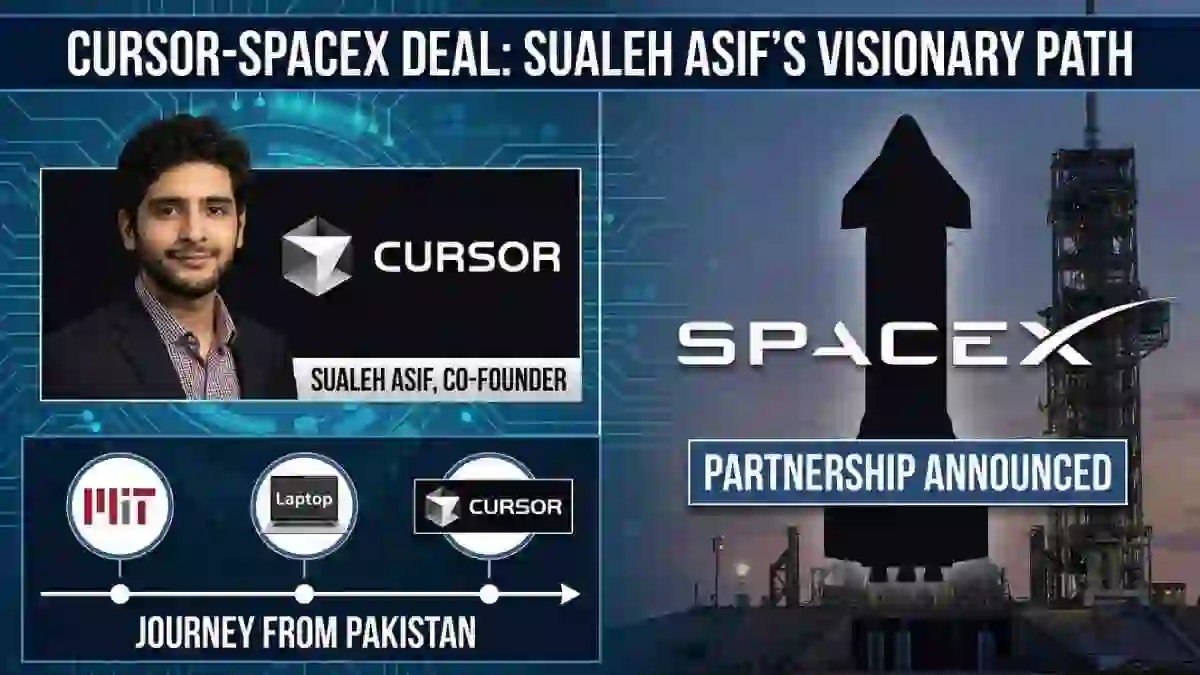
When Elon Musk’s SpaceX announced on April 21, 2026 that it had secured the right to acquire AI coding startup Cursor for $60 billion — making it the largest potential AI acquisition in history — the headlines focused on the deal, the valuation, and the competitive implications for OpenAI, Anthropic and Microsoft.
They should have also focused on Karachi.
Because at the heart of this story is Sualeh Asif — a middle-class kid from Pakistan’s largest city who rode motorcycles through its chaotic streets, competed in the International Math Olympiad, made it to MIT, and co-founded the fastest-scaling B2B software company ever recorded.
The Deal That Shook Silicon Valley
SpaceX said it struck a deal with artificial intelligence startup Cursor, obtaining the right to acquire the company for $60 billion later this year, or to pay $10 billion for work they are doing together. “SpaceXAI and Cursor are now working closely together to create the world’s best coding and knowledge work AI,” the company said in a post on X.
The option period runs through the end of 2026. Whether SpaceX exercises the $60 billion option will depend in part on how the joint model development progresses over the intervening months. No employee transfer or integration details have been disclosed.
The SpaceX agreement came together so late in Cursor’s fundraising process that prospective investors were caught off guard by the deal. Until a few hours before SpaceX announced its arrangement, Cursor was on track to close a $2 billion funding round later that week — at a $50 billion valuation — with Andreessen Horowitz slated to co-lead and Nvidia and Thrive Capital also expected to participate.
SpaceX didn’t just win the deal. It upended the entire deal that was already closing.
Microsoft Tried First — and Passed
Prior to SpaceX’s announcement, Microsoft looked at a potential deal for the AI coding startup. Microsoft, which is trying to boost the popularity of its AI tools to keep pace in the booming market, chose not to proceed with a bid. While Microsoft has gained traction among developers with GitHub Copilot, the AI coding market is currently being dominated by Cursor, along with Anthropic and OpenAI.
Microsoft CEO Satya Nadella told analysts in January that GitHub Copilot had 4.7 million paying subscribers, up 75% from a year earlier. OpenAI’s Codex has reached 4 million active users. But neither dominates the enterprise developer market the way Cursor does.
Microsoft passing on Cursor will likely be studied as one of the costliest decisions in modern tech M&A — particularly since Cursor then went to SpaceX at a price point that has since only risen further.
What Is Cursor and Why Is It Worth $60 Billion?
To understand the valuation, you need to understand how completely Cursor has taken over professional software development.
Cursor, a fork of Visual Studio Code with deep AI integration, was developed by Anysphere — a company founded in 2022 by four MIT students: Michael Truell, Sualeh Asif, Arvid Lunnemark and Aman Sanger. It was valued at $400 million in a Series A in mid-2024, climbed to $2.5 billion by January 2025, raised $900 million at $9.9 billion in June 2025, and closed a $2.3 billion Series D in November 2025 at $29.3 billion. By February 2026 it had crossed $2 billion in annualised recurring revenue — making it the fastest B2B company to scale from zero to $2 billion in roughly three years, by widely cited metrics. More than half of the Fortune 500 now use Cursor.
Over one million developers interact with the platform daily, and 67% of Fortune 500 companies have embraced it, collectively producing upwards of 150 million lines of enterprise code each day. Anysphere is forecasting more than $6 billion in annualised revenue by the end of 2026.
Growth from $100 million in annualised revenue to $2 billion in 13 months. For context, that trajectory outpaced Slack, Zoom, Snowflake and every SaaS benchmark ever recorded.
Why SpaceX Needed Cursor
The acquisition is not only about Cursor’s success. It is about a critical gap in SpaceX’s AI ambitions.
For SpaceX, which absorbed Elon Musk’s AI venture xAI in an all-stock transaction in February 2026 valuing the combined entity at $1.25 trillion, the deal addresses a visible gap. While OpenAI’s Codex has reached three million weekly users and Anthropic’s Claude Code has become the most-used AI coding tool among professional engineers, xAI has no comparable product. The Colossus supercomputer in Memphis, targeting one million H100-equivalent GPUs, gives SpaceX training infrastructure at scale — but without a leading application to route it through. The Cursor partnership provides that application.
If SpaceX goes through with the acquisition, the space giant will likely keep the entire Cursor team intact. Unlike Google’s purchase of Windsurf, which was structured as an acqui-hire of key individuals, SpaceX currently lacks a meaningful AI workforce and is widely seen as not having a significant AI business.
SpaceX is also preparing for a planned Nasdaq listing in June 2026, targeting a $1.75 trillion valuation. A $60 billion option over the world’s fastest-growing AI developer tool adds narrative and commercial value to that prospectus regardless of whether the option is ultimately exercised.
The deal positions SpaceX — primarily known as a space and satellite company — to be valued as an AI company when it lists. That is worth more than the $60 billion acquisition price in itself.
Read more: How Pakistan’s Startup Ecosystem is Entering a More Stable Phase in 2026
The Man From Karachi: Sualeh Asif’s Story
In all the billion-dollar noise, the most compelling story belongs to the person least likely to be mentioned in the Wall Street coverage.
Originally from Karachi, Asif attended Nixor College before attending MIT, and represented Pakistan in the International Math Olympiad from 2016 to 2018.
He earned honourable mentions at both the 2017 and 2018 Asian Pacific Mathematical Olympiads, scoring solid marks on the toughest problems. Between 2016 and 2018, he competed at the IMO and even taught at Pakistani math camps. These formative experiences reflect his early drive and technical acumen.
Born and raised in Karachi, Sualeh spent his early twenties navigating the city’s busy streets on a motorcycle. Before stepping into the startup spotlight, he had already proven his mathematical brilliance by representing Pakistan at the International Mathematical Olympiad. His academic journey led him to MIT, where he became part of the prestigious Neo Scholars programme.
At MIT, Truell and his classmates Aman Sanger, Sualeh Asif and Arvid Lunnemark were interested in AI before OpenAI changed the industry by launching ChatGPT in 2022. In 2021 they were thinking about what to do with that interest. “Do we go and work on AI in academia? Or do we go join a big existing AI effort? Or do we start our own thing?” By 2022, they had their answer. They were obsessed with Microsoft’s GitHub Copilot, which launched for individual developers in 2022 — but found it had its limits, and could be improved.
Asif, now Chief Product Officer, leads development on core features like the “Tab” function — a speculative-editing tool that anticipates multi-line code changes. He brings to Cursor a blend of mathematical rigour, a global perspective from Pakistan, and product vision honed at MIT.
Pakistan Reacts: Pride, Reflection, and a Call to Action
The news landed in Pakistan with a force that felt personal.
Umar Saif, the former federal minister for IT, praised the co-founder, calling him “the kind of role model Pakistani youth needs.” He said: “Not property dealers, tax evaders, bank defaulters, rent seekers, born into wealth. But a self-made kid from a middle-class family in Karachi. Studied at MIT, started a hugely impactful company, changed the way people write code, now worth over $1 billion at the age of 26.”
Today, millions of software developers at 50,000 enterprises like Nvidia, Adobe, Uber and Shopify use Cursor to generate and edit chunks of code, according to Forbes,
Sualeh’s achievements shine a light on a much deeper issue — the consistent loss of brilliant Pakistani minds to more supportive environments abroad. His success story reveals the immense potential within Pakistan’s streets and classrooms, yet also reminds us of the systemic challenges that force talent to seek growth elsewhere. If even a fraction of the resources currently channelled elsewhere were redirected toward developing local talent, Pakistan could foster thousands of Sualehs — each capable of making global contributions in AI, coding and innovation.
What the Deal Means for Pakistan’s Tech Ambitions
Sualeh Asif is not the first Pakistani to build something significant in Silicon Valley. But the scale and visibility of the Cursor deal — with its $60 billion headline, SpaceX’s platform, and the global media attention it generated — places him in a different category entirely.
For Pakistan’s technology sector, which is building its own ecosystem of Special Technology Zones, IT exports that crossed $3 billion annually, and a startup ecosystem valued at $4 billion, Asif’s story carries a specific message: the foundational capability is there.
The mathematical training that shaped him happened in Pakistani classrooms. The competitive rigour came from representing Pakistan at the IMO. The drive to build something that mattered was formed on the streets of Karachi.
What followed at MIT and in Silicon Valley was the application of tools that Pakistan gave him — applied in an environment that rewarded that application.
The question that Asif’s story poses for Pakistan’s policymakers, educators and investors is direct: what would happen if even a fraction of the talent that currently leaves Pakistan to find that enabling environment instead found it at home?
Read more: Entrepreneur Salman Habib, investor Hassan Chaudhry make it to Forbes 30 Under 30 US 2026
Frequently Asked Questions (FAQs)
Q: What is the SpaceX-Cursor deal and how does it work? SpaceX has secured a call option to acquire AI coding startup Cursor — developed by Anysphere — for $60 billion by the end of 2026. If SpaceX does not exercise that option, it will still pay Cursor $10 billion as consideration for their joint AI development work. The arrangement includes an immediate collaboration using SpaceX’s Colossus supercomputer to train Cursor’s next-generation models.
Q: Who is Sualeh Asif and what is his role at Cursor? Sualeh Asif is a Pakistani-born co-founder and Chief Product Officer of Cursor. Originally from Karachi, he attended Nixor College, represented Pakistan at the International Mathematical Olympiad from 2016 to 2018, and went on to study at MIT where he co-founded Anysphere with Michael Truell, Arvid Lunnemark and Aman Sanger. He leads product development at Cursor, including its signature Tab feature and the Composer model that is central to the SpaceX partnership.
Q: What is Cursor and why do developers use it? Cursor is an AI-native code editor — a fork of Microsoft’s Visual Studio Code — that integrates AI assistance directly into the coding environment. It maps an entire codebase, anticipates multi-line edits, orchestrates multiple AI models including GPT-4 and Claude, and allows developers to collaborate with AI in real time. More than 1 million developers use it daily, including engineers at 67% of Fortune 500 companies.
Q: Why did Microsoft pass on acquiring Cursor? Microsoft reviewed a potential acquisition of Cursor but chose not to proceed. The reasons have not been publicly disclosed. Microsoft already owns GitHub Copilot and Visual Studio Code — the very platform Cursor is built on — which may have created strategic complications. The decision is widely seen as a significant missed opportunity, as Cursor went on to attract a $60 billion SpaceX offer within days.
Q: How fast has Cursor grown? Cursor scaled from $100 million in annualised recurring revenue in January 2025 to $2 billion by February 2026 — a period of just 13 months. This trajectory surpassed every SaaS benchmark on record, including the growth rates of Slack, Zoom and Snowflake. Anysphere is projecting more than $6 billion in annualised revenue by the end of 2026.
Q: What does Sualeh Asif’s success mean for Pakistan? It demonstrates that world-class AI talent can emerge from Pakistani schools, middle-class families, and public education systems. His journey from competing in math olympiads in Pakistan to co-founding one of the most valuable AI companies in the world is a direct argument for investing in STEM education, creating enabling environments for technical talent, and connecting Pakistan’s youth to global opportunities — before they have to leave to find them.


Join the Conversation
Share your thoughts, questions, or feedback below.