
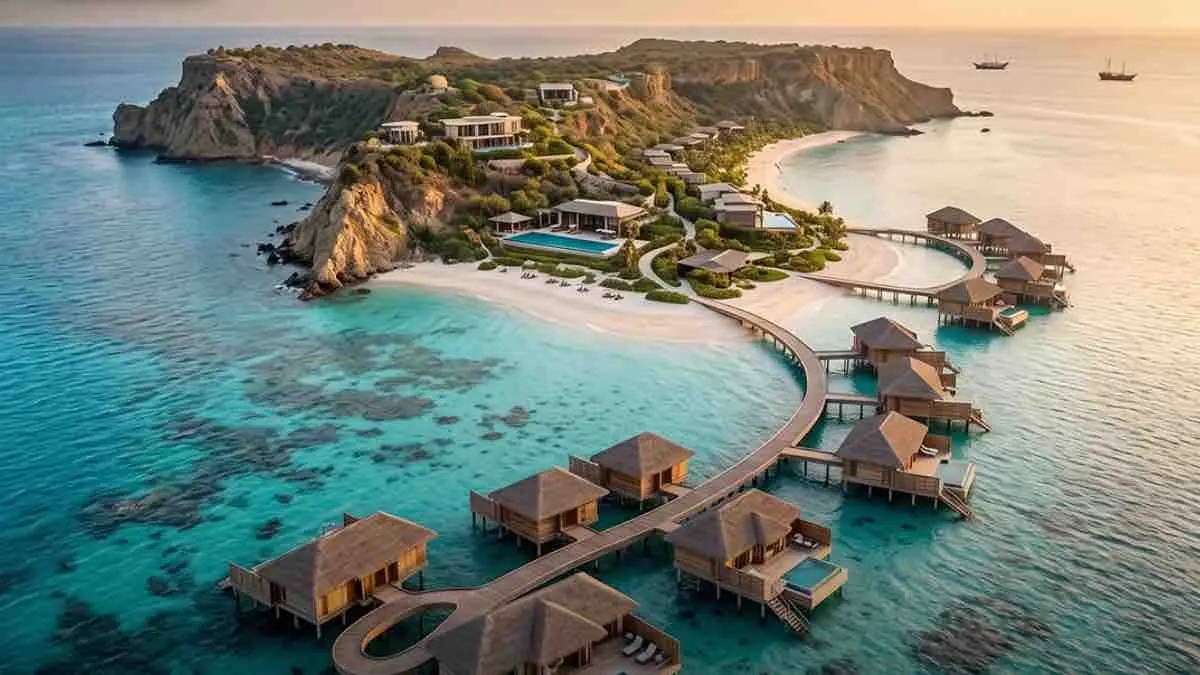
It has been mentioned in historical records since 325 BC, when sailors in Alexander the Great’s fleet were warned about a mysterious uninhabited island off the Makran coast. For more than two thousand years, Astola Island remained exactly that — remote, wild, and largely unknown to the wider world.
That is about to change.
Interior Minister Mohsin Naqvi has unveiled plans to transform Astola Island into Pakistan’s flagship tourism destination, drawing comparisons with the Maldives and positioning it as a magnet for global eco-tourism investment.
The Announcement: A Maldives in Balochistan
Naqvi pointed to tourism potential in Balochistan, particularly Astola Island, which he said could rival international destinations if developed properly. He announced plans to visit the province and suggested launching a roadshow with the Chief Minister to promote tourism and investment.
The interior minister said areas such as Astola Island could rival the Maldives if developed properly, emphasising that Pakistan must move away from informal financial systems and strengthen institutional frameworks for economic stability.
The declaration came as Naqvi addressed Karachi’s business community — urging investors to repatriate overseas capital and channelling that ambition toward Pakistan’s untapped natural assets. Astola, he made clear, is the centrepiece of that coastal vision.
What Is Astola Island?
Few Pakistanis have visited it. Fewer foreigners have heard of it. Yet Astola Island possesses a profile that would make most island nations envious.
Astola Island, also known as Haft Talar — the Island of the Seven Hills — is an uninhabited Pakistani island in the Arabian Sea approximately 25 km south of the nearest part of the coast and 35 km southeast of the fishing port of Pasni. It is Pakistan’s largest offshore island, with an area of 6.7 km², and its highest point rises 75 metres above sea level.
The island features a large tilted plateau and a series of seven small hillocks, with deep chasms and crevices. The north face drops sharply and vertically, while the south face slopes gradually downward. Around its periphery, a slender white beach runs along the bank of clear blue water, and rocky formations create beautiful, secluded coves.
There are no permanent residents, no hotels, no roads — and no fresh water source. Everything that makes it difficult to visit also makes it extraordinary.
Pakistan’s First Marine Protected Area
Astola Island was designated Pakistan’s first-ever Marine Protected Area on June 15, 2017, through a notification issued by the Government of Balochistan. The island is ecologically important as its beaches provide nesting grounds for the endangered green turtle and hawksbill turtle, while also supporting a large variety of migratory birds.
The MPA covers 401.47 square kilometres including its buffer zone — making it not just a protected island but a protected seascape.
A comprehensive management plan was approved by the Balochistan government on April 20, 2025, establishing zoning for habitat conservation, sustainable research access, and regulated visitation to minimise disturbance. The plan was informed by baseline ecological surveys conducted by WWF-Pakistan and IUCN.
The Biodiversity That Makes It Special
Astola’s ecological inventory is staggering for an island of its size — and it forms the foundation of any serious tourism proposition.
Marine life: The marine ecosystem includes 23 species of hard corals, various soft corals, and a multitude of associated fish and invertebrate species. The surrounding waters are home to nine species of sea snakes. Endangered Arabian Sea humpback whales have also been observed in the waters off the island’s shores.
Sea turtles: Over 800 green turtle nests have been recorded on the north beach of the island in a single survey season. Nesting green turtles and their hatchlings face multiple threats including ghost nets, which clog the island’s shallow waters and beaches, disrupting nesting areas and choking corals.
Birds and reptiles: Astola Island supports a diverse bird population, with studies recording 61 species across various families, including resident species, winter visitors, and migratory birds. The island is also home to the Astola viper (Echis carinatus astolae), a saw-scaled viper endemic to the island and found nowhere else in the world.
Dolphins and whales: A variety of coral species are found in the surrounding waters along with the Arabian Sea Humpback Whale — one of the rarest whale populations on the planet — and dolphins.
For scuba divers, snorkellers, wildlife photographers, and marine biologists, this is a destination with no equivalent on Pakistan’s coastline.
Read more: The 10 most beautiful countries you must see in your lifetime
History Carved in Stone and Sea
Astola’s appeal is not purely natural. It carries centuries of human history.
The earliest mention of Astola is in Arrian’s account of Admiral Nearchos, who was dispatched by Alexander the Great to explore the coast of the Arabian Sea and the Persian Gulf in 325 BC. Sailors in Nearchos’ fleet were “frightened at the weird tales told about an uninhabited island.” The island was also known to the ancient Greeks as Carnine, and was said to be inhabited by the Ichthyophagoi — “fish eaters” — whose very mutton was said to taste of fish.
Ruins of an ancient Hindu temple dedicated to the goddess Kali still stand on the island, alongside a small mosque dedicated to the Muslim saint Pir Khawaja Khizr, used by mainland fishermen during the fishing season. These historical remnants reflect the island’s layered spiritual and cultural heritage across multiple traditions.
In 1982, the Government of Pakistan installed a lighthouse on the island for the safety of passing vessels, which was replaced by a solar-powered one in 1987.
The Tourism Opportunity — and the Comparison With Maldives
The Maldives welcomed a record 2.25 million international visitors in 2025, generating over $5.4 billion in tourism receipts. Naqvi asserted that Astola could capture a significant share of such high-value tourism flows. If even a fraction of Maldives-bound travellers redirected to Pakistan, the economic impact would be transformative.
Pakistan’s own tourism trajectory supports the case. In 2023, the tourism sector contributed $19.8 billion to the national economy, representing 5.8 percent of GDP and supporting 4.73 million jobs. Projections indicate continued expansion, potentially reaching $36 billion in total contribution by 2034.
Balochistan currently lags in tourism development despite its vast untapped coastal resources. Government roadshows will target investors for hospitality infrastructure on and around the island. Tax waivers for hotel projects of up to 16 months are under consideration to accelerate development. Feasibility studies for ferry services and basic amenities have already been directed by the ministry.
What Sustainable Development Must Look Like
The comparison to the Maldives carries a warning as much as a promise. Astola’s value as a tourism destination is inseparable from its ecological integrity — and that ecology is already under pressure.
Despite its remoteness, Astola faces serious threats. Fish stocks are gradually being depleted by large commercial trawlers. Feral cats, introduced by fishermen to control rodents, now pose a threat to wildlife breeding sites. Abandoned fishing gear and ghost nets are clogging the island’s shallow waters and beaches, disrupting turtle nesting areas and choking corals.
Balochistan authorities have reported insufficient resources — no dedicated patrol boats or on-site staff — to monitor regulations or curb illegal activities, leading to persistent violations despite the MPA status. Fishermen have raised concerns over fishing restrictions without adequate alternative income support.
Development that ignores these realities risks destroying the very asset it seeks to monetise. The management plan endorsed in 2025 provides the framework — but enforcement, investment in conservation infrastructure, and genuine community inclusion must come alongside any luxury resort development.
The direct beneficiaries of responsible development would include 20,000 fishing community inhabitants of Pasni town and other inland Balochistan coastal villages, with indirect benefits reaching an estimated 50,000 annual tourists, researchers, and public organisations.
CPEC Connectivity: An Underrated Advantage
One factor often missing from discussions about Astola is its proximity to Gwadar — Pakistan’s deep-water port and the southern terminus of the China-Pakistan Economic Corridor.
Strategic positioning near CPEC routes will integrate the island into national connectivity networks. Security enhancements including Pakistan Coast Guards support will guarantee visitor safety. Improved infrastructure under related initiatives will enhance accessibility from Karachi and Gwadar.
As CPEC matures and Gwadar grows into a regional logistics hub, Astola sits just offshore — reachable in under three hours by boat from Pasni, and likely far less from a properly developed Gwadar tourism pier. The infrastructure investment arriving through CPEC creates a rare opportunity to simultaneously develop tourism access without the cost burden falling entirely on Pakistan’s public finances.
Frequently Asked Questions (FAQs)
Q: Where is Astola Island located?
Astola Island lies in the Arabian Sea approximately 25 km south of Pasni in Balochistan’s Gwadar district. It is Pakistan’s largest offshore island, covering 6.7 square kilometres, and can currently be reached by boat from Pasni in about three hours.
Q: Why is Astola Island protected and what does that mean for tourism?
Astola was designated Pakistan’s first Marine Protected Area in June 2017 under the Convention on Biological Diversity. The MPA status means any tourism development must follow strict conservation guidelines. The 2025 management plan allows regulated eco-tourism — including snorkelling, diving, and guided camping — while prohibiting activities that harm the coral reef ecosystem and turtle nesting beaches.
Q: What makes Astola comparable to the Maldives?
Both destinations share crystal-clear waters, coral reefs, turtle nesting beaches, and extraordinary marine biodiversity. Astola’s advantage is its raw, untouched character — something the Maldives’ more developed resorts can no longer offer. Its dramatic rocky cliffs, endemic wildlife, and ancient cultural ruins add dimensions the Maldives cannot match.
Q: What wildlife can visitors expect to see at Astola?
Astola hosts endangered green and hawksbill sea turtles with over 800 nests recorded per season, 23 species of hard coral, 61 bird species, dolphins, the rare Arabian Sea humpback whale, and the Astola saw-scaled viper — a snake found nowhere else on earth.
Q: What investment incentives is the government offering for Astola development?
Interior Minister Naqvi indicated tax waivers of up to 16 months for hotel projects, planned investor roadshows with Balochistan’s Chief Minister, feasibility studies for ferry services, and a broader business passport initiative to attract foreign investment into Pakistan’s tourism sector.
Q: What are the main risks to Astola’s development plan?
The key challenges include lack of fresh water on the island, absence of existing infrastructure, insufficient MPA enforcement capacity, threats from illegal fishing and ghost nets, invasive feral cats, and the need to balance luxury development with strict conservation obligations to protect the coral reefs and turtle nesting grounds that make the destination valuable in the first place.



Join the Conversation
Share your thoughts, questions, or feedback below.