
Seven years. Three governments. Multiple rounds of meetings. Several ministerial visits. One site inspection by a Saudi energy minister. One crown prince visit. Agreements worth $21 billion announced in a single ceremony.
And still, not one barrel of crude has been processed at Gwadar.
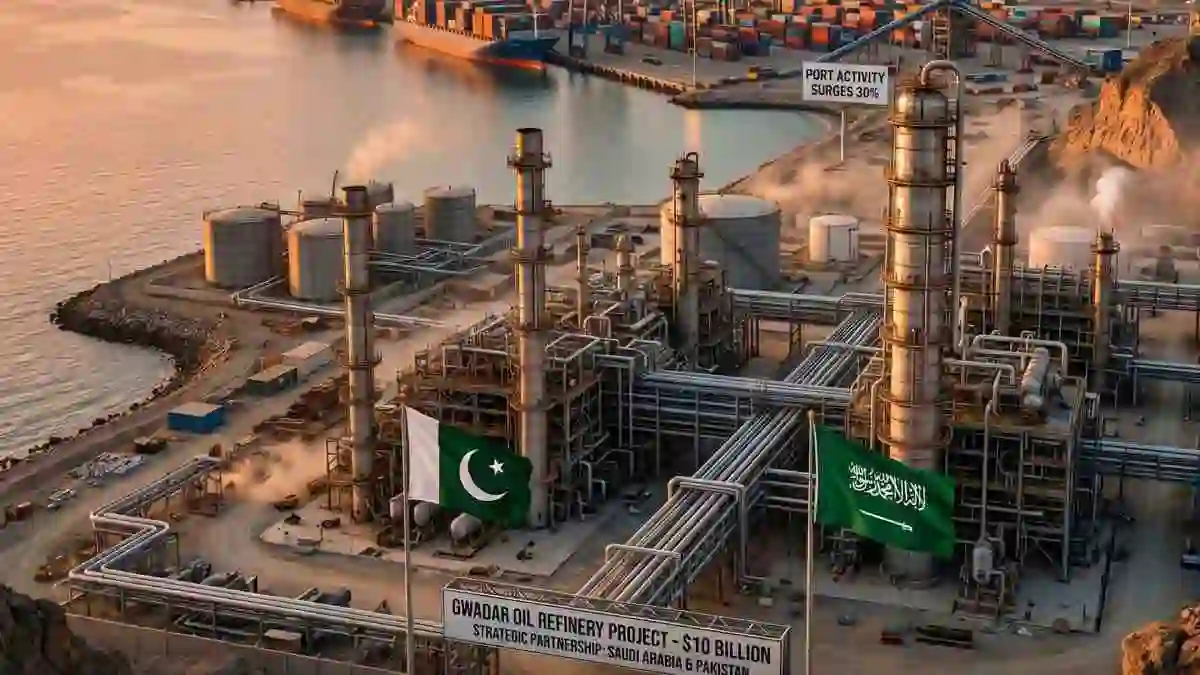
Pakistan’s $10 billion Saudi oil refinery is the most anticipated, most delayed, and most consequential single investment project in the country’s economic history. On June 5, 2026 — with Gwadar Port activity surging 30 percent and Saudi-Pakistan relations at their closest in decades — Pakistan has formally renewed the proposal. Again.
This time, the context is different. Whether the outcome will be is the question that matters.
The Proposal: What Pakistan Is Now Offering
Pakistan has again urged Saudi Arabia to move ahead with a $10 billion oil refinery project at Gwadar as activity at the deep-sea port rises and Islamabad seeks to attract fresh investment into energy and maritime infrastructure.
The Ministry of Maritime Affairs presented several proposals to the Saudi-Pakistan Joint Business Council Chairman, Mansour bin Mohammed Al Saud, and other participants during an online meeting. The proposals included the development of the refinery at Gwadar and investment in liquefied petroleum gas and liquefied natural gas terminals at Karachi Port.
The package being offered to Saudi Arabia is now broader than just the refinery. The maritime minister has also had 100 acres of land vacated at Karachi Port for proposed industrial projects. Saudi Arabia has shown interest in establishing a petrochemical complex at the site.
A dedicated Energy City concept has been introduced alongside the refinery proposal. The government has planned an Energy City at Gwadar Port, where oil-producing countries are being invited to establish strategic petroleum reserves.
Officials said participating countries could store oil in Pakistan and export it to other markets, while the Pakistan government would retain the first right to use the reserves. Petroleum Minister Ali Pervaiz Malik has held meetings with ambassadors of several countries to seek investment in strategic oil storage facilities, adding that investors developing oil storage facilities would also be offered tax holidays.
The Trigger: Gwadar’s 30 Percent Traffic Surge
The timing of this renewed push is not coincidental. There is a commercial case now that did not exist before.
Activity at Gwadar Port has increased by up to 30 percent in recent months as more vessels use Pakistani ports for transshipment amid the US-Israel-Iran conflict. The government expects port operations to expand further in the coming months.
Traffic at Gwadar Port has increased by up to 30 percent in recent months in the backdrop of the US-Israel-Iran war, with more vessels arriving at Pakistani ports for transshipment. The port is now being seen by Pakistani authorities as a growing transit hub, with expectations of further activity in the months ahead.
The Strait of Hormuz closure, the dual naval blockade of Iranian ports, and the disruption of the UAE’s Jebel Ali hub together created a structural shift in regional shipping flows that has landed squarely at Pakistan’s doorstep. A 30 percent surge in Gwadar traffic is not a diplomatic talking point. It is a commercial data point that Saudi investors can verify independently.
For a refinery project whose commercial logic depends on Gwadar being a functioning transshipment and logistics hub — not merely an aspiration — the current traffic environment strengthens the investment case in a way that no government presentation could.
Read more: Saudi Arabia Eyes Major Investment Projects in Balochistan’s Mining and Technology Sectors
The History: Seven Years of Broken Promises
To understand why this renewal is generating both hope and scepticism, the full history matters.
In January 2019, Saudi Energy Minister Khalid Al-Falih visited Gwadar and announced that Saudi Arabia planned to set up a $10 billion oil refinery at the port. He visited the proposed site and said Crown Prince Mohammed bin Salman would travel to Pakistan in February to sign the agreement.
During Crown Prince Mohammed bin Salman’s visit to Islamabad in February 2019, Saudi Arabia and Pakistan signed seven investment deals worth $21 billion covering mineral, energy, petrochemical and food and agriculture projects involving Aramco, ACWA Power and the Saudi Fund for Pakistan. The Saudi investments included around $10 billion for an Aramco oil refinery and $1 billion for a petrochemical complex project at Gwadar.
Read more: First Aramco-branded fuel station begins operation in Lahore
A masterplan was commissioned. Capacity parameters were set. The refinery was projected to process 250,000 to 300,000 barrels per day, later revised upward to as much as 400,000 barrels per day. A timeline of five to six years to commissioning was discussed.
However, almost four years later there had been little progress on the project. As late as November 2023, Pakistan’s energy minister told Arab News that active engagement was under way and progress would be visible within one to two months.
That deadline passed without progress.
Pakistan’s current combined refining capacity stands at roughly 450,000 barrels per day yet utilisation rates remain low, forcing heavy reliance on imports. Pakistan spent more than $17 billion on oil and petroleum imports in the first ten months of the current fiscal year alone.
Why It Has Never Happened
Saudi investors had identified policy inconsistency and bureaucratic delays as two major obstacles to investment in Pakistan. Officials expect further bilateral discussions to focus on resolving these concerns and advancing proposed projects.
The Saudi hesitation has never been about desire. Crown Prince Mohammed bin Salman personally announced the investment. Saudi Energy Minister Al-Falih personally visited the site. Aramco was named as the lead developer. The political will on the Saudi side was real.
The obstruction has consistently been on the Pakistani side. Five governments across the period from 2019 to 2026 each inherited the proposal, held meetings, expressed enthusiasm, and then failed to deliver the single thing Saudi investors needed: a stable, consistent policy environment with clear land titles, transparent fiscal incentives, and a regulatory pathway that did not change between one minister and the next.
Pakistan has since approved an oil refinery policy intended to facilitate new investment, while the SIFC is working to remove bureaucratic barriers.
The new oil refinery policy — combined with SIFC’s mandate to cut through inter-ministerial friction — addresses the exact failure mode that has derailed the project four times since 2019.
The Project Structure: Who Would Build What
Aramco is expected to collaborate directly with Pakistan’s state-owned giants PSO, OGDCL, PPL and GHPL on the project. Pakistani companies would shoulder 40 to 45 percent of the total investment, underscoring deep local partnership. The refinery is designed to process between 300,000 and 400,000 barrels of crude oil per day once operational. Fresh momentum has been supported by government-backed tax incentives including a proposed 20-year tax holiday and full customs exemptions.
The ownership structure — 55 to 60 percent Saudi, 40 to 45 percent Pakistani state entities — means the project would sit inside both countries’ sovereign balance sheets rather than being a purely private commercial venture. That structure provides political protection on both sides: neither government can abandon it without writing off a stake already booked as a national asset.
A refinery of 400,000 barrels per day capacity would represent the single largest industrial investment in Pakistan’s history. For context, Pakistan currently imports the vast majority of its refined petroleum products — petrol, diesel, jet fuel, furnace oil — paying international prices for goods that a domestic refinery could produce from imported crude at significantly lower cost.
What Is Different in 2026
Four factors make this renewal meaningfully different from the previous four attempts.
The defence pact changes the stakes. Pakistan now believes the timing may be more favourable for reviving the stalled plan, particularly after Pakistan and Saudi Arabia signed a defence pact and as relations between the two countries have drawn closer following the US-Iran war.
The Strategic Mutual Defence Agreement signed in September 2025 — which treats any attack on either country as an attack on both — means Saudi Arabia’s investment in Gwadar is no longer purely commercial. It is strategic. Saudi infrastructure on Pakistani soil, defended under a mutual defence clause, is a different proposition from a commercial refinery deal.
Gwadar traffic is real, not projected. Every previous pitch for Saudi investment in Gwadar was based on projected volumes. The 30 percent traffic surge is a current number, verifiable by ship tracking data, port operator statistics and shipping line schedules.
Pakistan’s fiscal crisis is over the worst. The IMF programme, combined with falling inflation and stabilising foreign exchange reserves, has removed the immediate sovereign risk that made every Saudi investment discussion in 2022 and 2023 conditional on Pakistan’s very survival as a functioning economy.
100 acres at Karachi Port is physically cleared. Moving land from bureaucratic allocation to actual physical clearance is one of Pakistan’s most persistent infrastructure bottlenecks. The maritime minister’s decision to physically vacate 100 acres at Karachi Port for Saudi petrochemical investment signals operational seriousness rather than just negotiating intent.
Pakistan’s Energy Vulnerability — The Number That Explains Everything
Pakistan currently has no strategic petroleum reserves and relies on commercial stocks maintained by oil marketing companies and refineries.
The Iran war demonstrated exactly what that vulnerability looks like in practice. When the Strait of Hormuz closed on February 28, 2026, Pakistan had less than 30 days of petroleum stocks. Emergency diplomatic channels had to secure a single cargo vessel — the Khairpur — carrying 45,000 tonnes of diesel and 10,000 tonnes of jet fuel through Kuwait’s intervention.
A 400,000 barrel per day domestic refinery changes that calculus entirely. It does not eliminate import dependence — Pakistan does not produce enough crude domestically to feed such a facility — but it transforms Pakistan from an importer of refined products to an importer of crude oil, processed domestically. The difference in cost, in energy security, and in foreign exchange outflow is enormous.
Pakistan spent $17 billion on petroleum product imports in ten months. A fully operational Gwadar refinery would process imported crude into finished products locally — reducing the foreign exchange cost of fuel, creating an export surplus of refined products for regional markets, and generating thousands of direct industrial jobs in Balochistan.
The SIFC Mechanism — Pakistan’s Answer to Bureaucratic Failure
Previous refinery negotiations died in the gap between ministerial meetings and actual regulatory clearance. The SIFC — Special Investment Facilitation Council — was created specifically to kill that gap.
The Special Investment Facilitation Council is leading efforts to secure Saudi investment and address administrative obstacles affecting proposed projects. A Saudi delegation led by the business council chairman held further discussions with Pakistani officials.
The SIFC operates under direct oversight of the civil-military leadership and has the authority to override departmental delays, resolve inter-ministerial disputes, and provide investment guarantees that individual ministries cannot give. For Saudi investors who have experienced Pakistan’s administrative fragmentation firsthand over seven years, the SIFC offers something new: a single accountable interlocutor with the power to deliver what it promises.
Whether that power is actually exercised — or whether the SIFC becomes another layer of meetings in a long chain of meetings — will determine whether this renewed proposal has a different ending from the previous four.
Frequently Asked Questions (FAQs)
Q: When was the $10 billion Saudi refinery at Gwadar first announced?
Saudi Energy Minister Khalid Al-Falih first announced the plan during a visit to Gwadar in January 2019. Crown Prince Mohammed bin Salman formally included the refinery in a $21 billion investment package signed during his Islamabad visit in February 2019. Seven investment agreements were signed covering energy, petrochemicals, minerals and agriculture. Despite this, no construction has begun in the seven years since.
Q: Why has the refinery not been built despite being announced in 2019?
Saudi investors have consistently identified policy inconsistency and bureaucratic delays as the primary obstacles. Multiple Pakistani governments inherited the proposal but failed to provide the stable regulatory environment, clear land titles and consistent fiscal framework that Saudi Aramco requires before committing capital. The project also requires navigating overlapping jurisdictions between the federal petroleum ministry, maritime ministry, Balochistan provincial government, and CPEC authority — a coordination challenge that has repeatedly stalled implementation.
Q: What is the proposed capacity of the Gwadar refinery?
The most recent figures indicate a processing capacity of 300,000 to 400,000 barrels of crude oil per day. Earlier projections from 2021 cited 250,000 to 300,000 barrels per day. A separate $1 billion petrochemical complex producing polyethylene and polypropylene was also part of the original 2019 package alongside the main refinery.
Q: Who are the Pakistani partners in the proposed refinery?
The proposed ownership structure involves Saudi Aramco as the lead developer taking 55 to 60 percent, with Pakistani state-owned companies — Pakistan State Oil, OGDCL, Pakistan Petroleum Limited and Government Holdings Private Limited — collectively holding 40 to 45 percent. This public-sector partnership structure means both countries have sovereign skin in the game.
Q: What is the Energy City concept announced alongside the refinery?
The Energy City is a separate but complementary proposal to develop bonded petroleum storage facilities at Gwadar where Gulf and other oil-producing nations can store crude and refined products. Participating countries retain ownership and can export stored oil to other markets, while Pakistan holds the first right of access to those reserves. Tax holidays are being offered to investors who develop storage infrastructure. The concept turns Gwadar into a regional petroleum logistics hub beyond just a domestic refinery.
Q: Why is Gwadar’s 30 percent traffic surge significant for the refinery proposal?
Previous pitches for Saudi investment in Gwadar were based on projected future volumes — a circular argument since volumes depend on infrastructure that depends on investment. The current 30 percent traffic surge, driven by the diversion of shipping from blockaded Gulf ports during the US-Iran war, demonstrates actual present-day commercial demand for Gwadar’s services. For Aramco’s investment committee, a verified surge in port activity is substantially more persuasive than a government projection.
Join the Conversation
Share your thoughts, questions, or feedback below.