
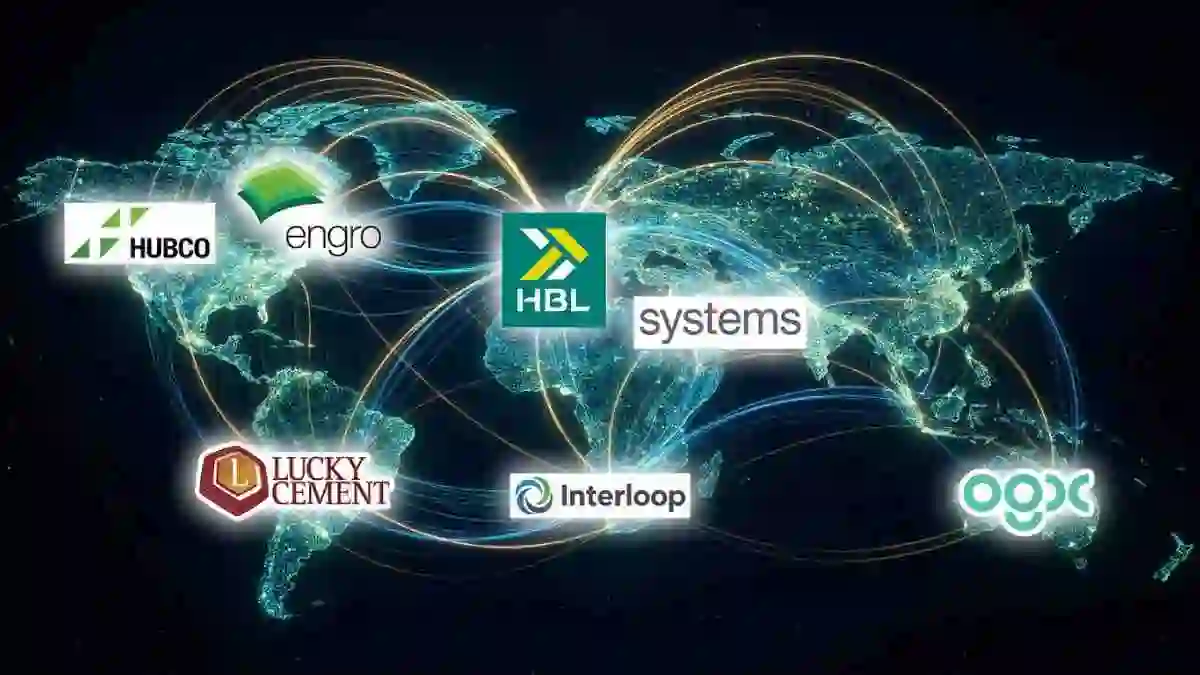
Pakistan’s corporate sector does not get the attention it deserves. While the country’s economy occupies most of the headlines for the wrong reasons — deficits, debt, IMF reviews — a set of Pakistani companies have been quietly building global market positions in textiles, energy, technology, cement, fertilizer and finance.
The numbers tell a story that most investors, analysts and career builders in Pakistan do not fully know. Here is the complete picture — company by company, sector by sector.
Pakistan Stock Exchange — The Market Behind the Companies
Before the companies, the market that houses them.
Pakistan’s equity market is increasingly dominated by a group of heavyweight stocks, with the top ten listed companies by market capitalisation now all valued at over $1 billion — a milestone reached by end of 2025. This strong performance was underpinned by robust corporate earnings, ample domestic liquidity, a central bank maintaining a pro-growth stance, and a revival in merger and acquisition activity and IPOs.
The Pakistan Stock Exchange’s KSE-100 index has delivered returns that rank among the top exchanges globally in multiple recent years, making it one of the world’s best-performing frontier markets exchanges. The PSX is classified under MSCI’s Frontier Markets designation — a tier that positions it alongside markets in Vietnam, Romania and Kazakhstan — and has consistently outperformed many exchanges in both emerging and frontier categories on total return metrics.
The market’s fundamental challenge is not performance. It is depth. Pakistan’s total stock market capitalisation remains a fraction of India’s, despite a population that is now over 240 million. The institutional investor base is thin, foreign participation is episodic, and the gap between what Pakistan’s best companies earn and what they are valued at is one of the most persistent anomalies in Asian capital markets.
OGDC — Pakistan’s Most Valuable Company and a London-Listed Energy Giant
Oil and Gas Development Company Limited has reached $4.15 billion in market capitalisation, making it the most valuable listed company on the Pakistan Stock Exchange. OGDC is the largest exploration and production company in Pakistan.
OGDC’s revenue stands at Rs401 billion — $1.4 billion — for fiscal year 2025, with net income of Rs169 billion ($610 million), operating income of $1 billion, and total assets of $5.9 billion. The Government of Pakistan owns 85.02 percent. OGDC employs 10,303 people and operates through subsidiaries including Pakistan Minerals Limited, Pakistan International Oil Limited and a 20 percent stake in Mari Petroleum.
OGDC is dual-listed — on the PSX and the London Stock Exchange — making it one of a tiny handful of Pakistani companies visible to international institutional investors through a major global exchange. Its LSE listing gives it access to capital and a profile among European fund managers that most Pakistani companies cannot reach.
The company dominates Pakistan’s upstream oil and gas sector, operating across exploration, drilling, production and field development services. Its scale, profitability and government backing make it the anchor of Pakistan’s energy security framework and the benchmark against which all other Pakistani E&P companies are measured.
Interloop — A Global Apparel Franchise Based in Faisalabad
Interloop is the largest listed apparel company on the Pakistan Stock Exchange and one of the world’s largest hosiery manufacturers, producing over 830 million pairs of socks annually. It employs more than 37,000 people from 15 nationalities, with manufacturing facilities in Pakistan, Sri Lanka and Egypt, and sales offices in the USA, the Netherlands, China and Japan.
Interloop supplies socks, hosiery and activewear to Nike, Adidas, Puma, H&M, Target, Marks & Spencer, Zara, Levi’s, Amazon and Uniqlo. Revenue reached Rs173 billion — approximately $620 million — in fiscal year 2025.
The company is the only Pakistani textile business ever included in the MSCI Frontier Markets Index — a distinction that has attracted foreign portfolio capital to a Pakistani stock for the first time in most institutional investors’ experience.
What began in 1992 with ten knitting machines bought from Italy and a few million rupees of family money has compounded at roughly a third per year in rupee terms since 2021. Interloop is not really a Pakistani textile company that exports. It is a global apparel-supply franchise that happens to be domiciled in Pakistan.
In October 2025, Interloop took its globalisation a step further. The company began building a $35 million hosiery manufacturing hub at Egypt’s Suez Canal Economic Zone, targeting $40 million in exports to the US, Europe, Africa and the GCC within three years. The Egyptian plant will reduce Interloop’s shipping time across regions by 20 days and cut production costs by 10 percent, while giving the company a 22 percent tariff advantage over Pakistan for certain export markets.
The scale is worth sitting with: a company from Faisalabad now makes socks for half the world’s most recognisable sportswear brands, runs plants across five countries, and is expanding into Africa to serve European and American customers more efficiently.
Read more: Nishat Group: Pakistan’s Most Diversified Business Empire — Who Owns What Across 10 Sectors
Lucky Cement — Pakistan’s Export Champion and a Global Builder
Lucky Cement’s revenue reached Rs449 billion — $1.6 billion — in fiscal year 2025, with net income of Rs76.96 billion ($280 million) and total assets of Rs729 billion ($2.6 billion). The company is owned by the Yunus Brothers Group and operates plants at Pezu, Nooriabad and Karachi.
Lucky Cement is Pakistan’s largest cement exporter, accounting for 3.4 million tons out of 9.2 million tons total exported from Pakistan in fiscal year 2025 — a 36.6 percent share of the country’s entire cement export volume. Export volumes grew 53 percent year on year. African markets now account for 62 percent of Lucky’s exports, with Ghana, Madagascar and Cameroon as leading destinations. Export prices averaged $41 per tonne for cement and $31 per tonne for clinker.
Lucky Cement has moved beyond exporting from Pakistan. The company has expanded its clinker production at its joint venture Najmat Al-Samawah plant in Samawah, Iraq, adding a new 1.82 million tonne per year line commissioned in May 2025, with a 0.65 million tonne per year grinding plant due in early 2026. Lucky Cement also has operations in the Democratic Republic of Congo. Total consolidated production capacity now stands at 21.48 million tonnes per year across Pakistan, Iraq and DRC.
Lucky Cement’s diversification extends well beyond cement through subsidiary Lucky Core Industries. Lucky Motor Corporation, another subsidiary, assembles and sells Kia vehicles in Pakistan with revenue of $290 million in 2023 and 71.55 percent Lucky Cement ownership.
Lucky Cement successfully shipped Pakistan’s first-ever clinker consignment to Brazil in 2025 — a historic marker of how far the company’s global reach has extended from its original domestic base.
Systems Limited — Pakistan’s Technology Export Engine
Systems Limited has been named Top Exporter in Services at the P@SHA ICT Awards for the fourth consecutive year in 2025, maintaining its position as Pakistan’s leading IT exporter. The recognition was presented by the Trade Development Authority of Pakistan.
87 percent of Systems Limited’s income comes from international clients. The MENA region is its dominant market, contributing 59 percent of total revenue in 2024, with Saudi Arabia as the single largest customer. The company serves banks, telecom operators, retailers, hospitals and enterprise technology buyers across the Gulf, Southeast Asia, Europe and North America.
Systems Limited’s gross profit margin runs consistently between 25 and 27 percent. Earnings per share are projected to grow 37 percent per year over the next five years. The company trades at approximately 12 times earnings for 2026, which analysts consider cheap relative to growth rates. Return on equity is expected to reach 27 to 28 percent in coming years.
The company’s market capitalisation stands at $790 million as of April 2026 — remarkable for a Pakistani technology business given the country’s historically shallow capital markets. Its subsidiaries include TechVista Systems in Qatar, Systems Arabia, NdcTech for banking technology, and Visionet for digital solutions.
Systems Limited represents the clearest proof of concept for Pakistan’s IT export ambitions: a company that has methodically built a global delivery model, won and retained Gulf enterprise clients at scale, and delivered compounding earnings growth in a sector where Pakistan has natural competitive advantages in talent density and cost.
HBL — Pakistan’s Most International Bank
HBL is Pakistan’s most geographically distributed financial institution. Its market capitalisation at the PSX stands at $1.68 billion, making it one of Pakistan’s three most valuable listed companies. aa
The bank operates in over 25 countries — including the UK, UAE, China, Bangladesh, Afghanistan, Bahrain, Kenya, Oman, Canada and the US — with more than 1,700 branches in Pakistan and a significant international network that captures remittance flows, trade finance and corporate banking business across the Pakistani diaspora’s most important geographies.
HBL’s international presence is not cosmetic. Its overseas branches contribute meaningfully to profitability and provide the bank with a foreign exchange and remittance capture franchise that no other Pakistani bank can match. In a country where remittances reached $38 billion in fiscal year 2025, HBL’s ability to intercept those flows at the source in Saudi Arabia, the UAE and the UK is a genuine structural advantage.
MCB Bank — Pakistan’s Most Profitable Private Bank
MCB’s market capitalisation at the PSX stands at $1.58 billion. MCB Bank reported profit before tax of Rs29.42 billion for the third quarter of 2025, with cumulative PBT for the nine months ended September 30, 2025 at Rs87.48 billion and profit after tax of Rs41.10 billion.
MCB consistently delivers among the highest returns on equity in Pakistan’s banking sector. Its loan book quality, cost efficiency and branch network management have made it the benchmark for private sector bank profitability in Pakistan. Maybank of Malaysia holds a 25 percent strategic stake — one of the most significant foreign institutional investments in Pakistan’s financial sector — giving MCB a window into Southeast Asian banking practices and capital markets.
Meezan Bank — Pakistan’s Islamic Banking Champion
Where the Islamic banking story belongs: Meezan Bank is Pakistan’s largest fully-fledged Islamic bank and a global leader in Shariah-compliant retail and corporate banking.
Pakistan’s Islamic banking system has reached Rs14.47 trillion in total assets — representing 22.9 percent of the country’s entire banking industry. Meezan commands the largest share of that pool. Its Profit After Tax reached Rs46.2 billion in the first half of 2025 alone. It operates the widest Islamic banking branch network in Pakistan and has expanded its digital banking infrastructure to serve Pakistan’s growing Muslim-majority customer base seeking Shariah-compliant alternatives to conventional finance.
Meezan’s success reflects a broader global trend: Islamic finance has grown to over $4 trillion globally, and Pakistan — as the world’s second-largest Muslim population — is positioned to be one of the most important Islamic banking markets in Asia over the coming decade.
Read more: Pakistan Fintech Enters New Era in 2026 with Digital Banks and RAAST Expansion
Engro — Pakistan’s Agricultural and Energy Conglomerate
Engro Fertilizers holds approximately 35 percent of Pakistan’s domestic fertilizer market — the single largest share of any company. Revenue stands at $798 million on a trailing twelve-month basis as of mid-2025, with total assets of $580 million and 3,031 employees.
Engro Corporation’s group revenue reached $1.82 billion, spanning fertilizers through subsidiary Engro Fertilizers, LNG terminal management through Engro Elengy, polymer and PVC manufacturing through Engro Polymer, power generation, and telecommunications infrastructure through Engro Enfrashare.
Engro was Pakistan’s first company to become a signatory of the UN Global Compact. It was originally established in 1965 as Esso Fertilizer — a joint venture with Exxon — which makes it one of Pakistan’s oldest large-scale industrial enterprises. The Dawood family’s Engro Holdings now owns the group after the IFC holds an 11.9 percent stake in Engro Fertilizers specifically, bringing World Bank group capital into Pakistan’s agriculture supply chain.
Engro’s fertilizer operations at Daharki and Port Qasim represent one of Pakistan’s largest single-site manufacturing investments, commissioned at a cost of $1.1 billion in 2011 under Pakistan’s fertilizer policy framework.
Hub Power — Where Pakistan’s Private Energy Sector Began
HUBCO pioneered independent power production in Pakistan. It built and now operates thermal and hydro power plants that have been part of Pakistan’s national grid since the 1990s, making it the foundational private sector energy company in the country.
As Pakistan’s energy mix evolves — adding CPEC-linked coal plants, expanding hydro capacity, and beginning a renewable energy transition — HUBCO has expanded its portfolio to include coal generation at Thar and Hub, hydro investments in Azad Kashmir, and equity participation in multiple CPEC energy projects.
HUBCO’s dividend track record makes it one of the most widely held income stocks on the PSX. For retail investors seeking regular dividend income alongside capital appreciation in Pakistan’s energy sector, it has been a benchmark holding for over two decades.
The Scale Gap — and Why It Matters
Pakistan’s best companies are genuinely world-class in their specific domains. The gap that holds them back is not quality — it is scale and listing.
India’s Adani Group has a market capitalisation exceeding $200 billion. Reliance Industries exceeds $250 billion. The largest Pakistani companies top out at $4 billion. This is not a reflection of the underlying businesses — it reflects the size of the capital market available to price them, the depth of institutional investor participation, and the cost of capital that constrains how fast Pakistani companies can reinvest and grow.
The structural solution is visible: more companies going public, more international dual listings on exchanges like the LSE and NYSE, more private equity investment from Gulf and Asian institutional funds, and a financial sector that can channel Pakistan’s $38 billion in annual remittances toward the equity market rather than only property and bank deposits.
Interloop’s MSCI inclusion is the template. The moment an international index includes a Pakistani company, global passive funds are required to buy it. That demand raises the valuation. The higher valuation lowers the cost of equity. The lower cost of equity enables faster growth investment. The faster growth attracts more analysts, more coverage, more institutional interest — a virtuous cycle that Pakistan’s corporate sector has barely begun.
Frequently Asked Questions (FAQs)
Q: Which is Pakistan’s most valuable listed company?
OGDC — Oil and Gas Development Company Limited — holds the top position with a market capitalisation of $4.15 billion as of end-2025. It is Pakistan’s largest exploration and production company, 85 percent government-owned, and dual-listed on the Pakistan Stock Exchange and the London Stock Exchange. HBL at $1.68 billion and MCB at $1.58 billion are second and third respectively.
Q: Which Pakistani company is most internationally recognised?
Interloop is the most globally embedded Pakistani company by brand association. Supplying Nike, Adidas, Puma, H&M, Target and Levi’s with hosiery and activewear, it is present in the supply chains of brands that sell in over 100 countries. It is also the only Pakistani company in the MSCI Frontier Markets Index, giving it visibility among international institutional investors that no other Pakistani company currently holds.
Q: What is Systems Limited and why is it significant?
Systems Limited is Pakistan’s largest listed IT company and its top IT exporter for four consecutive years. It earns 87 percent of its revenue from international clients, with 59 percent from the MENA region. Its market cap of $790 million, projected 37 percent annual EPS growth, and 25-27 percent gross margins make it the benchmark for Pakistan’s technology export ambitions. It serves Gulf banks, hospitals, telecom operators and retailers at enterprise scale.
Q: How big is Pakistan’s Islamic banking sector?
Pakistan’s Islamic banking assets reached Rs14.47 trillion by December 2025 — representing 22.9 percent of the total banking industry. Meezan Bank is the country’s largest fully-fledged Islamic bank. The sector’s deposit base stands at Rs11 trillion, with Islamic banking now accounting for 38.1 percent of all financing in the country. Pakistan is one of the fastest-growing Islamic banking markets globally.
Q: Why are Pakistani companies undervalued compared to Indian or Gulf peers?
The primary factors are market depth and institutional participation. Pakistan’s total stock market capitalisation is a fraction of India’s despite comparable industrial sectors. Low foreign institutional investor participation, episodic currency risk, MSCI Frontier classification rather than Emerging Markets, and a thin domestic institutional investor base all compress valuations. Many Pakistani blue-chips trade at 8-12 times earnings against 20-30 times for comparable South Asian or Gulf peers — a gap that represents both the challenge and the opportunity for long-term investors.
Q: What is Lucky Cement’s global footprint?
Lucky Cement operates manufacturing plants in Pakistan, Iraq and the Democratic Republic of Congo, with a combined capacity of 21.48 million tonnes per year. It is Pakistan’s largest cement exporter with a 36.6 percent share of Pakistan’s total cement exports. Its export markets span Africa, the Middle East, South Asia, South America and beyond — including Pakistan’s first-ever clinker shipment to Brazil completed in 2025.

Join the Conversation
Share your thoughts, questions, or feedback below.