
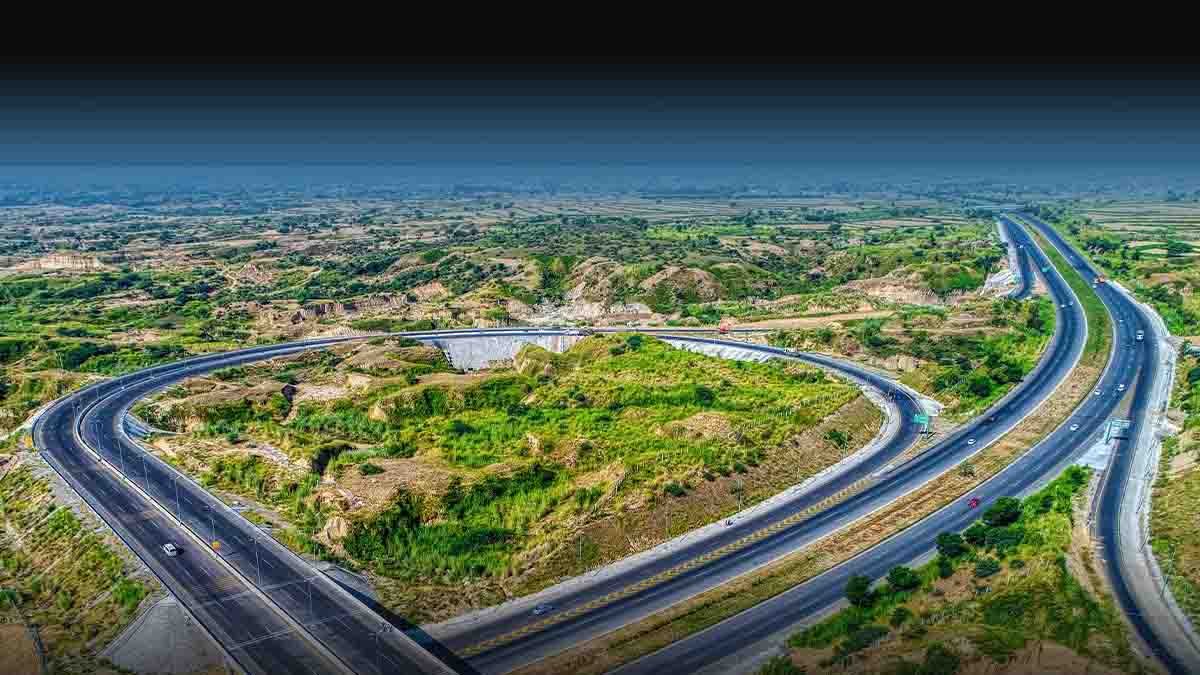
The Rawalpindi Ring Road crossed the halfway mark in April 2025 and has since accelerated to 85% completion as of early 2026. Half of the construction work on the Rawalpindi Ring Road (RRR) has been completed as authorities push to meet the December 2025 deadline set by Punjab’s chief minister. That December deadline has since been pushed — first to March 2026, and now to mid-April 2026 — while costs have ballooned from Rs 33 billion to Rs 50 billion.
Despite the delays, the 38.3-kilometer, six-lane highway from Baanth on GT Road to Thalian Interchange on the M-2 Motorway is finally taking shape after more than three decades of planning, scandals, and false starts.
Current Construction Status
The Rawalpindi Ring Road, a 38.3‑kilometer controlled‑access, six‑lane corridor designed for speeds up to 120 km/h, is now reported at over 80% completion, with major bridge work and asphalt surfacing well underway.
The project has progressed through several milestones:
- September 2024: 29% complete
- December 2024: ~40% complete
- April 2025: 50% complete
- November 2025: 70% complete
- December 2025: 75% complete
- February 2026: Over 80% complete
Earthwork is reported to be 100% finished, and structural work is progressing steadily at about 60%. The Rawalpindi Development Authority (RDA) reported that around 70% of construction has been completed, with major progress on road surfacing, bridges, protective embankments, and key sections from Banth on GT Road to Thallian Interchange.
Route and Key Features
The R3 project is being developed as a six-lane, controlled-access road with a design speed of 120 km/h and a 90-metre-wide right of way. The RRR will connect Baanth Mor on GT Road to Thalian Interchange on the Motorway, featuring five interchanges, two river bridges, a railway bridge, stormwater bridges, underpasses, overpasses, and 53 culverts.
The five interchanges are located at:
- Baanth Interchange (N-5 GT Road) — eastern starting point
- Maira Mohra Interchange (Chak Beli Khan Road)
- Khasala Interchange (Adyala Road)
- Kolian Parrh Interchange (Chakri Road)
- Thalian Interchange (M-2 Motorway) — western terminus near Islamabad Airport
The Ring Road connects big highways like GT Road, M-1, and M-2 with many towns and housing societies.
Project Cost: From Rs 26 Billion to Rs 50 Billion
The Rawalpindi Ring Road has seen one of the most dramatic cost escalations of any Punjab infrastructure project. Initially awarded to the Frontier Works Organization (FWO) for PKR 26 billion, the contract has undergone multiple revisions. In May 2024, the RDA filed an amended PC-I of PKR 32.9 billion, which was later increased to PKR 39 billion after accounting for inflation.
The Punjab government has revised the Rawalpindi Ring Road project’s PC-I, increasing costs from Rs33 billion to Rs50 billion after approving a redesigned Thallian Interchange to accommodate future traffic needs. The expansion of the Thallian Interchange has added Rs17 billion to the project cost but ensures the corridor can handle future traffic demands.
So far, 8,992 kanals of land have been acquired for the project, with over Rs5.90 billion already released in compensation.
Read more: Rawalpindi Ring Road cost rises to Rs 50 billion, completion deadline pushed to March 2026
Why the Deadline Keeps Moving
The Ring Road has missed every deadline set for it. Originally scheduled to finish by December 30, 2025, and later pushed to March 30, 2026, the new expected completion date is now mid-April 2026.
Initially, Chief Minister Maryam Nawaz had set a target to complete the project by December 2025. However, the need to redesign the Thallian Interchange for long-term traffic management made the original deadline impossible.
Rs 12 billion was released by the Punjab government in January, of which Rs 7 billion has been spent. The remaining Rs 5 billion will be used by June, and the rest of the funds will be allocated in the next fiscal year.
The Thallian Interchange Redesign
The primary cause of the latest delay is the complete redesign of the Thalian Interchange. Construction on the Rs. 5 billion Thalian Interchange, a critical junction of the Rawalpindi Ring Road, is scheduled to begin next week, officials confirmed, as land acquisition accelerates.
The under-construction Thallian Interchange will be expanded into a broad-based interchange under future planning, requiring the acquisition of an additional 1,134 kanal and 18 marla of land under Section 4.7 This interchange connects the Ring Road directly to the M-2 Motorway and the New Islamabad International Airport, making it the most critical junction in the entire project.
Phase II: Thalian to Sangjani
With Phase I nearing completion, planning for Phase II has begun. Director General Kinza Murtaza told Dawn that the joint venture of Nespak and ACE Private Limited started the feasibility study for the Rawalpindi Ring Road Phase II from Thalian to Sangjani to connect it with the China-Pakistan Economic Corridor (CPEC).
The feasibility study for Ring Road Phase Two, extending from Thalian Interchange on the M-2 Motorway to the GT Road (M-5), will incur an estimated cost of Rs52 million and is expected to be completed by March 2026.
However, Phase II faces uncertainty. The Rawalpindi Development Authority (RDA) has asked the Punjab government to drop the Rawalpindi Ring Road Project Phase-II after the merger plan for traffic on the motorway was approved. The National Highway Authority (NHA) has submitted a Rs17 billion project to add two more lanes to the motorway from Thalian to G.T. Road to accommodate the increasing traffic expected after the completion of Phase II of Rawalpindi Ring Road.
Whether Phase II proceeds as a separate road or as a motorway lane expansion remains undecided.
Economic Zones Along the Ring Road
The Ring Road is being positioned as an economic corridor, not just a bypass. Officials said the economic zones planned along both sides of the Rawalpindi Ring Road would include logistics and education centres, a health city, a dry port, industrial and business hubs, transport terminals, wholesale markets, amusement parks and residential communities.
Authorities have decided to declare land along both sides of the Ring Road as commercial, allowing three- to ten-storey buildings and plazas. Service roads will also be constructed along the route. The project includes plans to plant around 300,000 trees along the road, develop recreational spaces, and install computerised LED screens for corporate advertising.
Project History and Challenges
Rawalpindi Ring Road (RRR) was first proposed as early as 1991 under the government of Nawaz Sharif. However, due to various political and economic hurdles, the project remained in limbo for decades.
The Rawalpindi Ring Road project has been in the pipeline for over three decades, facing delays and modifications under various governments. During the administration of Imran Khan, the project became embroiled in a financial scandal that led to the arrests of several officials, including a former commissioner. After this controversy, the project was limited to its original route and was finalised during the tenure of the Pakistan Democratic Movement (PDM) government.
While the project faced a temporary halt and an inquiry into an alleged route change in April 2021, work on the highway formally commenced in March 2022. The Frontier Works Organization (FWO) is leading the construction, with the Rawalpindi Development Authority (RDA) overseeing the project.
What Comes Next
Despite the delays, officials report that the project is progressing steadily on the ground. “The Ring Road remains on track for completion by March 2026 and will serve as a transformative corridor for the Rawalpindi Division,” said RDA Director General Kinza Murtaza.
The most immediate milestones include completing the Thalian Interchange, finishing the remaining 20% of road surfacing and bridge work, resolving the Phase II route question, and finalizing the economic zone framework.
Once operational, the Ring Road will divert heavy commercial traffic away from Rawalpindi’s congested center, connect GT Road directly to the M-2 Motorway and Islamabad Airport, and create a new development corridor that is already driving property values up across the twin cities. After three decades of waiting, Rawalpindi’s most important road is finally within months of opening.


Join the Conversation
Share your thoughts, questions, or feedback below.