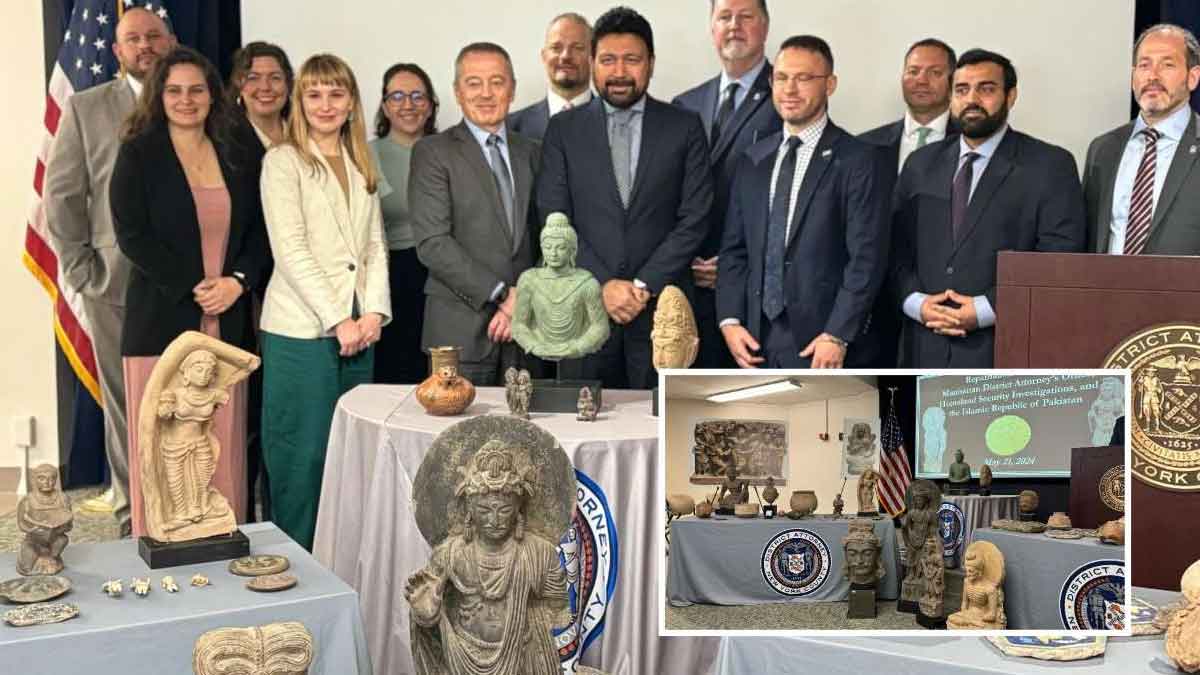
On May 13, 2026, the United States formally returned more than 450 cultural artefacts to Pakistan — collectively valued at over $23 million — during a ceremony at the Islamabad Museum. It was the largest single cultural repatriation in Pakistan’s history, and the culmination of a decade-long effort involving two governments, multiple law enforcement agencies, and criminal prosecutions on both sides of the Atlantic.
The United States formally repatriated more than 450 cultural artifacts to Pakistan during a ceremony held at the Islamabad Museum, reaffirming the shared commitment of both countries to combat illicit trafficking of antiquities and protect cultural heritage.
For Pakistan, this was not just a handover of old objects. It was the recovery of identity.
A Decade of Recovery: Six Phases, One Mission
The May 2026 ceremony was not the first time the United States has returned stolen Pakistani artefacts. It was the latest chapter in a repatriation effort that began in 2007. Since 2007, a total of 513 cultural artifacts of Pakistani origin had been successfully repatriated from the United States in different phases — **39** in 2007, **46** in August 2021, **104** in September 2023, **191** in February 2025, and **133** in August 2025.
Over the past decade, the Antiquities Trafficking Unit, with support from the U.S. Department of Homeland Security, has recovered and repatriated to Pakistan 514 antiquities worth nearly $23 million.
Each phase built on the last — more objects recovered, more networks dismantled, and a bilateral relationship increasingly anchored in legal frameworks rather than one-off goodwill gestures.
The Legal Foundation: January 30, 2024 Bilateral Agreement
The acceleration in repatriations after 2024 is no coincidence. It followed the signing of a landmark bilateral agreement. On January 30, 2024, the United States and Pakistan signed a cultural property agreement to restrict the importation of certain archaeological objects belonging to Pakistan into the United States, and to facilitate the return of those objects.
The agreement commits both parties to work together to counter theft and trafficking of cultural objects, promote a clean market for Pakistani art and antiquities in the United States, and increase opportunities for U.S. museums and the American public to learn about Pakistan’s history.
The Agreement entered into force on January 30, 2024, and enables promulgation of import restrictions on certain categories of archaeological material ranging in date from the Lower Paleolithic Period (approximately 2,000,000 Years Before Present) through A.D. 1750, as well as certain categories of ethnological material associated with Pakistan’s diverse history from A.D. 800 through 1849. The 2024 Hold Harmless Release Agreement had opened new avenues for collaboration in heritage protection, capacity building and technical cooperation.
May 13, 2026: The Largest Repatriation in Pakistan’s History
The Ceremony at Islamabad Museum
The United States formally returned more than 450 looted antiquities valued at over $23 million to the people of Pakistan during a ceremony at the Islamabad Museum, marking one of the largest cultural repatriations in recent years. U.S. Assistant Secretary Paul Kapur joined Pakistan’s Minister for National Heritage and Culture, Aurangzeb Khan Khichi, to inaugurate an exhibition titled “Legacy Returns Home.”
The Antiquities Trafficking Unit (ATU) of the Manhattan District Attorney’s Office recovered all these antiquities. District Attorney Alvin Bragg announced their return to Pakistan following investigations by the ATU into smuggling networks, including foreign-operated criminal organizations.
Key Official Statements
Kapur said “These artifacts represent chapters of Pakistan’s history, connecting generations to their heritage. Each of these objects tells a story. Each belongs to the people of Pakistan. And each now is home.” Speaking at the inauguration, Federal Minister Aurangzeb Khan Khichi said the repatriation of priceless Pakistani antiquities from the United States reflected a deepening cultural partnership, calling the returned artifacts “a part of Pakistan’s soul, history and civilisational identity.”
He said the recovered objects were not merely artifacts but symbols of ancient civilisations, artistic excellence and historical continuity, adding that illicit trafficking of antiquities was a “crime against humanity.” Assistant Secretary Kapur, attending as guest of honour, said the United States was celebrating 250 years of independence and had successfully preserved its historical heritage, adding that bilateral relations with Pakistan remained strong across multiple sectors.
Read more: Rs 2.90 billion allocated for restoration of seven historic Cholistan forts
The Most Significant Artefacts Returned
Buddhapada Sculpture: $1.1 Million, Stolen in the 1980s
Among the most remarkable items returned is a rare 2nd-century C.E. Buddhapada sculpture, valued at $1.1 million, which was looted in the 1980s and later trafficked into New York.
A Buddhapada is a carved representation of the Buddha’s footprints — one of the earliest symbolic forms in Buddhist art, predating figurative representations of the Buddha himself.
Mehrgarh Terracotta Figurines: 3,500–2,600 BCE
Among the artifacts are terracotta figurines that are more than four thousand years old. “These figurines are among the earliest human-crafted representations in the world and offer insights into some of the region’s first settled communities.”
Mehrgarh — located in present-day Balochistan — is one of the earliest known farming settlements in South Asia, with continuous occupation dating back to 7000 BCE.
The Gold Strato I Coin and Gandharan Masterpieces
The collection also includes a Gandharan frieze depicting Buddhist figures, ancient Mehrgarh terracotta figurines from 3500–2600 B.C.E., a statue of the Bodhisattva Maitreya, and a Gold Strato I coin dating back to 105–85 B.C.E., recovered as recently as 2023. The displayed collection spans multiple historical periods and includes rare stone and stucco Buddhist sculptures, relic caskets, narrative reliefs of the Gandhara civilisation, a rare gold coin from the Indo-Greek period, as well as terracotta figurines and painted pottery from Balochistan dating back to 7,000 BC.
“Legacy Returns Home”: On Display at Islamabad Museum
The special exhibition “Legacy Returns Home”, inaugurated at the Islamabad Museum, brought together a remarkable collection of antiquities repatriated from the United States after being intercepted in illicit trafficking networks. More than a ceremonial display, the exhibition highlights cultural cooperation between Pakistan and the US and the recovery of stolen heritage items.
The artifacts are now housed in Islamabad’s Sir Syed Memorial Museum, including 150 highlighted items such as Buddha statues, Gandhara masterpieces, and other historically significant relics. The exhibition at the Islamabad Museum will remain open to the public, allowing Pakistanis to view repatriated treasures that had been smuggled abroad, some for decades.
Who Recovered These Artefacts: ATU, HSI, and 17 Convictions
The massive recovery effort was led by the Antiquities Trafficking Unit (ATU) of the Manhattan District Attorney’s Office, working alongside the U.S. Department of Homeland Security. Over the past decade, this coordinated operation resulted in the recovery and repatriation of more than 500 Pakistani antiquities, collectively valued at nearly $23 million. Authorities confirmed that the investigations targeted complex international smuggling networks and led to multiple criminal convictions.
The Subhash Kapoor Case
Kapoor, 76, was convicted of running a $100 million international smuggling racket, including stealing 19 ancient idols and illegally transferring them to his art gallery in Manhattan. Since its creation in 2017, the Antiquities Trafficking Unit has convicted 17 individuals of cultural property-related crimes, recovered more than 6,000 antiquities valued at more than $470 million, and returned more than 5,500 of them to 30 countries.
Beyond the US: Italy, France, and the UK
The repatriation effort extends far beyond the United States. A collection of ancient artefacts recovered in Italy was returned to Pakistan. The artefacts — belonging to the prehistoric Kuli and Naal cultures of Balochistan and dating back nearly 5,000 years — arrived in Pakistan from Rome on October 30, 2025. Earlier in 2025, France, the U.S., and the U.K. also repatriated hundreds of artefacts back to Pakistan. While these attempts to bring back stolen artefacts are laudable, Pakistani authorities must do more to ensure they are not smuggled out of the country in the first place.
The Five-Year Action Plan: What Comes Next
Kapur underscored the significance of the fully ratified U.S.-Pakistan Cultural Property Agreement, which includes a five-year Action Plan designed to prevent illegally exported artifacts from entering the U.S. art market. The plan also promotes museum exchanges, professional training in conservation and collections management, and new partnerships between universities and research institutions in both countries.
The assistant secretary warned that illicit trafficking in antiquities is a multibillion-dollar global criminal enterprise that fuels organized crime and, in some cases, finances extremist networks. “No country can confront this challenge alone,” he said, highlighting ongoing U.S. cooperation with INTERPOL, customs agencies, museums, and academic institutions worldwide.
Pakistan’s Cultural Heritage: What Is at Stake
Pakistan, home to the Indus Valley Civilisation and the Gandhara artistic tradition, possesses one of the world’s richest cultural legacies, which continues to attract historians, researchers and scholars globally, and must be safeguarded against illegal excavation, theft and smuggling. The exhibition helps raise greater public awareness regarding the devastating impact of illicit trafficking of antiquities and the importance of protecting archaeological heritage.
The illegal antiquities trade remains a multi-billion-dollar global industry, while the Organized Crime and Corruption Reporting Project has identified the illicit trade as a major source of financing for criminal and militant networks involved in smuggling operations worldwide.
The 514 artefacts now back in Pakistan represent far more than objects in glass cases. They represent the closing of chapters in a long story of cultural plunder — and the opening of a more protected future for the civilisations buried beneath Pakistani soil.