
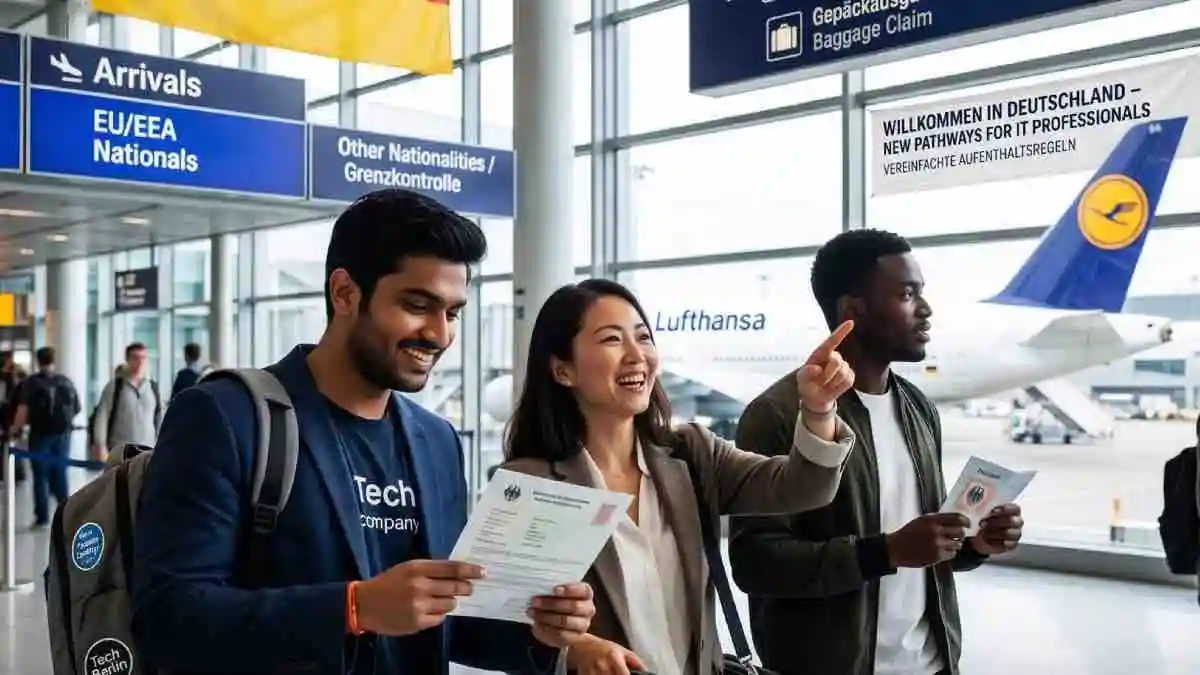
Germany has a problem it cannot solve alone — and Pakistani professionals may be part of the answer.
Europe’s largest economy is aging faster than it can replace its workforce. Factories need engineers. Hospitals need doctors and nurses. Tech companies need software developers. Construction sites need trained tradespeople.
And Germany, for the first time in its modern history, has rewritten its immigration laws from the ground up to fill the gap. Germany’s immigration system has undergone its biggest overhaul in decades. The reforms to the Fachkräfteeinwanderungsgesetz (Skilled Immigration Act), rolled out in phases from November 2023 through March 2026, fundamentally change how companies can hire international talent.
For Pakistanis with the right qualifications — and the right strategy — the window is wide open.
Why Germany Is Facing a Demographic Emergency
This is not a temporary hiring blip. It is a structural collapse decades in the making. Germany suffers from an ageing workforce and a lack of workers in construction, health, and IT. Labour Minister Hubertus Heil said seven million skilled workers would be needed by 2035. Germany needs around 400,000 skilled immigrants annually — some estimates suggest 288,000–390,000 — to stabilize the workforce amid an aging population and hundreds of thousands of unfilled jobs, especially in tech, engineering, healthcare, and STEM.
The scale of the existing shortage is already visible in the numbers. When the Skilled Immigration Act entered into force on 1 March 2020, just over 200,000 third-country nationals held residence permits tied to a German employment contract. By June 2025, the figure had climbed to 420,000 — an increase of 110 percent.
More than half arrived on the EU Blue Card, whose minimum-salary threshold was cut in 2023, making it accessible to a wider pool of graduates and IT specialists. Germany, facing persistent shortages of skilled workers across multiple sectors, is reorganizing its labor-migration framework to make entry more efficient, predictable, and digital.
The government has even launched what it calls a flagship digital initiative. Chancellor Merz described the new Work-and-Stay Agency as the largest digital transformation project of the current legislative period. Its goal: to create a modern, efficient, and transparent entry path for skilled workers — a stark contrast to the cumbersome and decentralized processes and red tape that have long frustrated employers and applicants alike.
Read more: EU Migration Pact Takes Effect June 2026 — What Pakistanis Need to Know
What Changed in Germany’s Immigration Law — And Why It Matters for Pakistanis
The old immigration process for skilled workers from third countries wishing to move to Germany had often been criticized for being slow, rigid, and too bureaucratic. Fundamental improvements were needed if Germany wanted to compete with the world’s top immigration destinations such as Canada. Therefore, at the end of 2023, the Skilled Immigration Act was redesigned and, since June 2024, all of its amendments are in full force and effect.
Here is what the new law actually changed:
Qualifications no longer need to match exactly. Professionals from third countries are no longer restricted to seeking employment only in the narrow field of their expertise. They are now allowed under the new regulation to pursue any qualified job.
Experience now counts as much as a degree. More value is now given to practical work experience than it has been in the past. This is a game-changer for Pakistani professionals who built their skills on the job rather than in a formal postgraduate program.
IT professionals can skip the degree requirement entirely. IT specialists with 3+ years of experience can now get a Blue Card without a university degree. This is one of the most significant rule changes of the entire reform package.
The shortage occupation list has expanded. The expanded shortage occupation list now includes more engineering sub-fields, healthcare roles, and skilled trades.
Employer rights protections now come with the job. From January 1, 2026, employers must inform third-country nationals recruited abroad in writing about free counseling on labor and social law rights by their first working day.
The Three Pathways Pakistanis Can Use to Move to Germany in 2026
🔵 Pathway 1: The EU Blue Card — For Degree Holders With a Job Offer
The EU Blue Card is Germany’s premium route for highly qualified professionals. It is designed for highly qualified professionals with a university degree and a job offer with a high salary. The Skilled Immigration Act significantly lowered the salary requirements for the EU Blue Card. The minimum gross annual salary is now €50,700 for standard occupations and €45,934.20 for shortage occupations (2026 figures).
This means Pakistani engineers, doctors, IT specialists, and finance professionals who secure a German job offer above these thresholds qualify directly. The Blue Card also provides a fast track to permanent residency — one of the most attractive features for those planning long-term settlement.
Best suited for: Software engineers, medical doctors, electrical engineers, data scientists, finance professionals, and researchers.
🟡 Pathway 2: The Chancenkarte (Opportunity Card) — Move First, Find a Job Later
This is the most transformative new visa for Pakistani professionals and the one that removes the single biggest barrier — needing a job offer before you arrive. The Chancenkarte is a residence permit under Section 20a of the German Residence Act. It allows skilled workers from non-EU countries to come to Germany and look for a qualified job for up to one year, even without having a job offer in hand.
Unlike the old Job Seeker Visa, the Chancenkarte uses a transparent points-based system, allows part-time work during your job search, and is open to candidates with vocational qualifications — not just university degree holders. The Germany Opportunity Card for Pakistanis is a points-based visa system inspired by the Canadian model.
Conventionally, a Pakistani citizen had to sign an employment contract in order to obtain a work visa. The new Skilled Immigration Act eliminates this impediment to skilled workers who can demonstrate their potential through a transparent points system. 1 In 2026, the system requires a minimum of 6 points, supporting entry without a prior job offer for up to one year, extendable.
How to earn your 6 points:
Points are awarded across the following categories:
- Professional qualification — A degree recognized in Germany or a vocational certificate
- Work experience — Relevant years of professional experience in your field
- German language skills — Higher language levels earn more points
- Age — Younger applicants (under 35) typically score higher
- Previous connection to Germany — Study, training, or prior work experience in Germany
Applying in Pakistan is a simplified procedure through the German Consulate in Karachi or the Embassy in Islamabad. Steps include checking your degree through the ZAB (Central Office of Foreign Education) and proving funds. You must show that you can sustain yourself during your job search — usually through a Blocked Account (Sperrkonto) with approximately €12,000 in it.
Best suited for: IT professionals, engineers, tradespeople, healthcare workers, and experienced professionals who have not yet secured a job offer.
Read more: Germany’s KSB plans to establish large-scale manufacturing plant in Pakistan
🟢 Pathway 3: Ausbildung (Vocational Training) — For Fresh Graduates and Young Professionals
This is Germany’s best-kept secret — and one of the most underused pathways by Pakistanis. Germany’s dual vocational training system offers Pakistani students a practical alternative to traditional university education. With over 60,000 unfilled Ausbildung positions across Germany and growing demand for skilled workers, Pakistani nationals have genuine opportunities to build careers in Europe’s largest economy.
Pakistani students have several compelling reasons to consider Ausbildung in Germany: the training is free of charge, with training costs covered by the employer. Trainees receive a monthly stipend ranging from €900–€1,200 in 2026, which increases each year of training.
The Ausbildung pathway leads directly to a German work permit on completion — making it a structured, financially supported route into permanent employment. For young Pakistanis aged 18–30 with a decent education and basic German skills, this is arguably the most accessible and underutilized entry point into the German job market.
Best suited for: Young graduates aged 18–30 seeking hands-on training in trades, healthcare support, IT, logistics, and hospitality.
The Sectors Where Pakistani Professionals Have the Best Chances
Germany’s shortages are concentrated in specific industries. Pakistani professionals should target these sectors first:
💻 Information Technology Germany’s tech sector cannot fill its open roles fast enough. Germany has launched new visa pathways for IT professionals, offering simplified residency options, lower barriers for experienced workers, and expanded opportunities for Pakistani tech talent. The reforms are intended to address Germany’s growing shortage of skilled technology workers and strengthen the country’s position as a leading destination for global IT talent.
🏥 Healthcare and Nursing The need is especially acute in the care sector, where Germany relies heavily on foreign staff. More than 300,000 care workers have arrived in recent years, and almost one in four nursing-home employees is a foreign national. Researchers warn that without migrant labor, the sector would collapse.
Pakistani doctors, nurses, pharmacists, and healthcare technicians are increasingly in demand. Those with a German language certificate at B2 level or above have a significant competitive advantage.
⚙️ Engineering From automotive to energy to infrastructure, Germany’s engineering shortfall spans multiple sub-disciplines. From technology to healthcare to engineering, there is a growing demand for qualified professionals. Electrical engineers, mechanical engineers, and mechatronics specialists from Pakistan are particularly well-positioned.
🏗️ Construction and Skilled Trades Germany faces a shortage of workers in construction, healthcare, and IT. Plumbers, electricians, civil engineers, and construction managers are all listed under Germany’s shortage occupations — meaning lower salary thresholds and faster processing through the Blue Card route.
What You Need to Prepare Before You Apply
Whether you are going the Blue Card, Chancenkarte, or Ausbildung route, the preparation steps are largely the same:
Step 1 — Get Your Degree Recognized Check if your qualifications are recognized in Germany using the ANABIN database. This is the single most important step — and many Pakistanis skip it, causing delays of months.
Step 2 — Learn German German language skills earn you points under the Chancenkarte system and are often mandatory for healthcare and trades roles. A1/A2 suffices for many work visa categories, but B1/B2 opens significantly more doors — and speeds up your path to permanent residency.
Step 3 — Open a Blocked Account (Sperrkonto) You must show that you can sustain yourself during your job search — usually through a Blocked Account (Sperrkonto) with approximately €12,000 in it. For Ausbildung applicants, proof of financial resources requires a blocked account with a minimum of €11,904 for 2026.
Step 4 — Get Health Insurance You must provide proof of travel insurance with a minimum of €30,000 for medical coverage, and include proof that you have valid health insurance for after you enter the country — either purchased from a private company in Pakistan or from a private provider in Germany.
Step 5 — Apply Through the Right Channel Applying in Pakistan is done through the German Consulate in Karachi or the German Embassy in Islamabad. You can make your appointment through the portal “Make it in Germany” — the official government portal for qualified professionals.
An Important Caution: Short-Term vs Long-Term Outlook
The opportunity is real — but the timing has nuance. Just years ago, Germany was sounding the alarm over a crippling skilled worker crisis, actively courting talent from around the globe to keep its powerful economy running. Today, the situation has reversed sharply.
Across the country, companies are hitting the brakes on hiring, scaling back recruitment drives, and in many cases implementing widespread pauses in new job creation. Germany’s underlying demographic crisis — with more people retiring than entering the workforce — has not disappeared. It has merely been eclipsed by present economic challenges.
This means the best strategy for Pakistani professionals is to use the current slower period to prepare — learn German, get qualifications recognized, build a portfolio, and position yourself to move when Germany’s economy rebounds. When the economy eventually rebounds, labor shortages are expected to return strongly, likely triggering a renewed push for skilled immigration. Those already in position — with German-recognized qualifications and language certificates — will be first in line.
The Bottom Line for Pakistani Professionals
Germany has rewritten its immigration rulebook in favor of skilled workers from countries like Pakistan. The Chancenkarte removes the job-offer barrier. The EU Blue Card has lower salary thresholds than ever before. The Ausbildung system pays you to train. And IT professionals can qualify for premium visas without a degree. Germany needs skilled workers — and the Chancenkarte is proof that the country is actively trying to make it easier for people to come and contribute. If you are a Pakistani professional scoring 6 or more points, there has never been a better time to make your move to Germany.
The combination of a structural demographic crisis, the most liberal skilled immigration law in German history, and a growing Pakistani diaspora already embedded in German industry creates a rare alignment of opportunity.
Prepare now. Move smart. Germany is waiting.
❓ Frequently Asked Questions
Q1: Does Germany need skilled workers from Pakistan in 2026? Yes — structurally and urgently. Germany needs around 400,000 skilled immigrants annually to stabilize its aging workforce. Sectors including IT, engineering, healthcare, and construction have critical shortages that Germany cannot fill from within the EU alone. Pakistani professionals are actively being targeted through multiple new visa channels.
Q2: What is the Germany Opportunity Card (Chancenkarte) and how does it work for Pakistanis? The Chancenkarte is a points-based residence permit that allows skilled workers from non-EU countries, including Pakistan, to enter Germany for up to one year and search for a job — without needing a job offer first. You need a minimum of 6 points, which you earn through your qualifications, work experience, age, language skills, and any prior connection to Germany. It also allows part-time work of up to 20 hours per week during your stay.
Q3: Can Pakistani IT professionals get a German Blue Card without a university degree? Yes — this is one of the most significant rule changes in Germany’s 2026 immigration reform. IT specialists with 3 or more years of relevant professional experience can now qualify for an EU Blue Card without a university degree. This opens a premium residency pathway to a large pool of self-taught and bootcamp-trained Pakistani developers who previously had no route.
Q4: What salary do I need to qualify for the EU Blue Card in Germany? The minimum gross annual salary thresholds for 2026 are €50,700 for standard occupations and €45,934 for shortage occupations, which include most engineering, healthcare, and IT roles. These thresholds are lower than the pre-2023 requirements, making the Blue Card accessible to a wider range of Pakistani professionals.
Q5: What German language level do I need to work in Germany? It depends on the pathway and sector. For the work visa, A1 or A2 is often sufficient to start. For healthcare and nursing roles, B2 is typically required. For the Chancenkarte points system, higher language levels earn you more points, increasing your chances of qualifying. For long-term integration and permanent residency, B2 or above is strongly recommended.
Q6: How do I get my Pakistani degree recognized in Germany? Use the ANABIN database — Germany’s official qualification recognition tool — to check whether your degree is already listed. For vocational qualifications, contact the relevant German authority in your field. Some professions (especially healthcare) require formal recognition through state-level authorities, which can take several months. Starting this process early is the single most important step Pakistanis can take.
Q7: What is Ausbildung and is it available to Pakistanis? Ausbildung is Germany’s dual vocational training system — a structured, employer-funded apprenticeship that combines practical workplace training with vocational school. It is free of charge, pays trainees a monthly stipend of €900–€1,200 in 2026, and leads directly to a German work permit on completion. With over 60,000 unfilled positions, it is one of the most accessible and underused routes for young Pakistani professionals aged 18–30.
Q8: Where do Pakistanis apply for a German visa in Pakistan? Applications are submitted through the German Embassy in Islamabad or the German Consulate in Karachi. Appointments are booked through the official government portal “Make it in Germany.” Documents must include degree recognition proof, a blocked account showing approximately €12,000 in funds, valid health insurance, and relevant qualification certificates translated into German.


Join the Conversation
Share your thoughts, questions, or feedback below.