
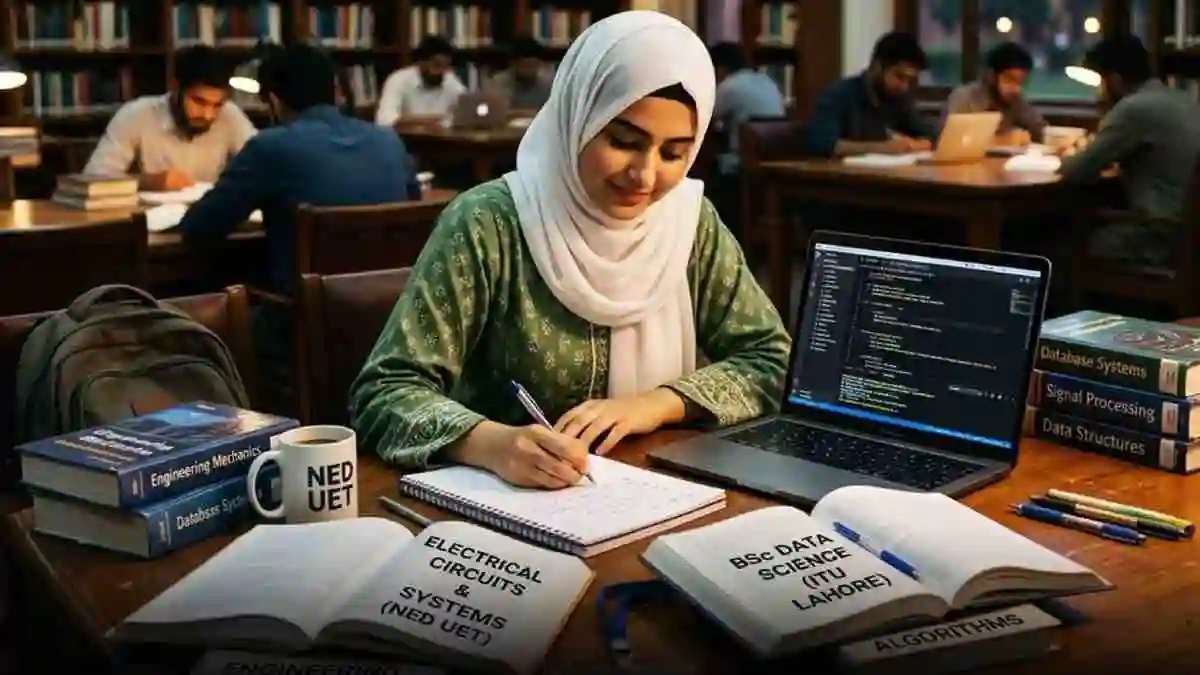
For decades, Pakistani parents were told the same thing: get your child a degree, and the future will take care of itself.
That promise is now broken. A 2024 review by the Pakistan Institute of Development Economics (PIDE) reported that over 31% of young graduates remained unemployed. Even more alarming, bachelor’s degree holders face a 10.9% unemployment rate, while those with advanced degrees — master’s, MPhil, or PhD — face an even higher 11.7% unemployment rate.
The government has finally acknowledged what millions of families already know. Federal Minister for Planning Ahsan Iqbal has directed the Higher Education Commission (HEC) to immediately conduct a comprehensive review of university degree programs — ones that provide jobs instead of sit-at-home graduates.
The question every student and parent in Pakistan is now asking is simple: which degrees are actually worth it in 2026?
Why Pakistan’s Education System Is Producing Unemployed Graduates
The problem is not a lack of universities. It is a lack of alignment. The ongoing crisis of unemployment of educated youth in Pakistan is mainly because of the curricula of degree programmes offered by higher education institutions. Most of these degree programmes focus on academic knowledge without a clear link with the job market and impart limited practical skills.
While many nations have moved toward cohesive, innovation-focused systems that encourage creativity and adaptability, Pakistan remains stuck in outdated structures that emphasise rote memorisation over practical skills — producing degree holders who are unprepared for the job market and continuing a cycle of underemployment. Unemployment has jumped by 31% — from 4.5 million in 2020–21 to 5.9 million in 2024–25 — and outdated curricula are a direct contributor.
Ahsan Iqbal noted that rapid advances in artificial intelligence, robotics, automation, biotechnology, quantum computing, advanced manufacturing, and digital technologies are reshaping labour markets worldwide, and that many traditional occupations are becoming obsolete while new professions are emerging — making higher education reforms essential.
Read more: The top 10 degrees Pakistanis are chasing — and the 5 that actually pay off
Degrees That Are No Longer Compatible With Today’s Job Market
Before listing what to study, it is important to be honest about what no longer works. Tens of thousands of students now earn postgraduate degrees each year in disciplines such as political science, public administration, sociology, and international relations — fields once heralded as essential to nation-building. Yet today, these educated individuals face a job market that cannot absorb them.
These are the degree categories that carry the highest risk in 2026:
❌ Generic Arts and Humanities (BA in History, Philosophy, Sociology)
These degrees carry strong academic value but near-zero market demand in Pakistan’s current economy. Without a specialized postgraduate qualification or a clear professional path, employment prospects are extremely limited.
❌ General Public Administration and Political Science
Government hiring freezes and a shrinking public sector have dramatically reduced the number of available positions. Businesses have restricted hiring, government departments have instituted recruitment freezes, and industrial contraction has become common — further limiting opportunities for degree-holding young adults.
❌ Mass Communication (Traditional Print Focus)
The traditional media industry has collapsed globally, and Pakistan is no exception. A general mass communication degree without digital and social media specialization offers little employment value.
❌ General Business Administration (Without Specialization)
Generic business degrees can work — but outcomes improve significantly only when students specialize or stack credentials like CA, CFA, data analytics, or growth marketing. A plain BBA from a mid-tier university with no specialization is no longer enough on its own.
❌ Agriculture Sciences (General)
Despite Pakistan being an agricultural country, graduates in agriculture sciences are more unemployed in rural regions, indicating that Pakistan — despite being an agricultural economy — is not offering enough opportunities to its highly educated graduates in this sector.
The Degrees Worth Studying in Pakistan Right Now
Pakistan’s future competitiveness depends on equipping young people with the skills and knowledge needed in a technology-driven and innovation-led global economy. These are the degrees that deliver on that promise in 2026.
✅ 1. Artificial Intelligence (AI) & Machine Learning
This is the single most future-proof degree available in Pakistan right now. Artificial Intelligence is rapidly reshaping the job market in Pakistan. What once seemed like an advanced technical field is now becoming a core skill across multiple industries — from software houses and digital agencies to banks, hospitals, and startups.
AI engineers and data scientists in Pakistan can command substantially higher compensation compared to entry-level general developers, especially if they combine strong technical skills with project experience. The national rollout of the National Artificial Intelligence Policy 2025 signals a major push to integrate AI across public services, agriculture, education, health, and technology sectors.
Best universities: NUST leads in AI research, especially through SEECS, while COMSATS University Islamabad offers strong programs in computer science, AI, and data science. LUMS is best for those targeting international careers.
✅ 2. Computer Science / Software Engineering
For students seeking the fastest route to financial independence, CS/SE remains unmatched. However, the market has matured — generic coding skills are no longer enough; specialization is key. Pakistani developers working remotely for US/EU clients can earn $1,500–$3,000/month starting out, significantly outpacing local inflation. Among all degree fields, computer sciences stands out as the exception to Pakistan’s graduate unemployment crisis — making it arguably the safest academic investment a family can make today.
Read more: British Council Launches Fully Funded STEM Scholarships for Pakistani Women
✅ 3. Data Science & Cybersecurity
Computer science, IT, artificial intelligence, data science, business administration, engineering, and healthcare-related degrees are among the best choices for future careers in Pakistan.
Data science and cybersecurity sit at the intersection of Pakistan’s growing digital banking, fintech, and e-commerce sectors. Both fields face a severe global skills shortage, meaning Pakistani graduates can compete for remote international roles from day one. CS/SE, Data/AI, and Security offer the widest remote and freelance options, especially with strong English and a visible portfolio.
✅ 4. Electrical Engineering & Mechatronics
Engineering remains strong — but only in the right specializations. Software engineering, electrical engineering, mechanical engineering, civil engineering, and mechatronics can lead to technical jobs in Pakistan and abroad. Of these, electrical engineering and mechatronics carry the highest demand in Pakistan’s manufacturing, energy, and automation sectors — industries that are actively expanding.
The key caveat: for engineering, accreditation matters. Always verify that the program is PEC-accredited before enrolling.
✅ 5. Medicine (MBBS) — With Realistic Expectations
MBBS remains one of Pakistan’s most respected degrees — but it demands realistic expectations.
The degree takes five years plus a house job year, and private medical college fees have risen sharply. However, the healthcare sector continues to face a significant doctor shortage, both domestically and internationally. Pakistani-trained doctors are increasingly emigrating to the UK, Canada, and Gulf states where earnings are multiple times higher. For 2026, the strongest career choices are linked with technology, healthcare, business, finance, and data. Medicine, studied at an accredited institution, remains firmly on that list.
✅ 6. Finance, Accounting & CA/CFA
The demand for qualified finance professionals in Pakistan’s growing banking, fintech, and investment sectors is rising steadily. A chartered accountancy (CA) or CFA qualification layered on top of a finance degree dramatically increases earning potential. With inflation impacting household budgets and the job market shifting towards digitalization, the best degree is no longer defined solely by traditional prestige — it is defined by return on investment (ROI), employability speed, and adaptability. CA and CFA qualifications score exceptionally well on all three measures.
✅ 7. Biotechnology & Pharmaceutical Sciences
Ahsan Iqbal specifically highlighted biotechnology as one of the rapidly advancing fields reshaping labour markets worldwide. Pakistan’s pharmaceutical industry is expanding, and the global biotech sector offers well-paying research and development roles that Pakistani graduates are increasingly being hired for.
This degree is high-commitment and scientifically demanding — but graduates who excel are entering one of the world’s fastest-growing industries.
What Pakistan’s Government Is Doing About It
The HEC reform directive is a significant policy moment. Ahsan Iqbal has directed HEC to immediately conduct a comprehensive review of university degree programs with a clear instruction: degrees must lead to real employment, not just graduation ceremonies.
The call is clear — higher education must reorient curricula and create skill-development environments that integrate digital tools, freelancing training, AI literacy, and industry partnerships to enable students to start earning even before completing their degrees. The Higher Education Commission admitted in 2024 that fewer than 20% of postgraduate students completed structured internships or job-readiness training before graduation — a failure that the new directive is designed to correct.
Whether these reforms translate into real curriculum changes within the next academic cycle remains to be seen. But for students enrolling today, waiting for the system to fix itself is not a strategy.
The Bottom Line for Pakistani Students and Parents
Pakistan’s job market is evolving rapidly. Traditional degrees alone are no longer enough to secure high-paying roles. Employers now prioritize practical skills, adaptability, and AI knowledge. Choosing a degree in Pakistan isn’t just an academic choice — it’s a strategic career decision that will influence your opportunities for the next 5 to 10 years.
The degrees worth studying right now are the ones that sit at the intersection of global demand and digital skills: AI, computer science, data science, cybersecurity, electrical engineering, medicine, and finance with professional certifications.
Everything else requires serious scrutiny before you invest four to five years of your life — and your family’s money — into it. The decisions made by students, universities, and companies in the next three to five years will determine whether Pakistan becomes a regional powerhouse or falls further behind. The choice starts with what you decide to study.
❓ Frequently Asked Questions
Q1: Why did Ahsan Iqbal order HEC to review degree programs?
Federal Minister Ahsan Iqbal directed HEC to immediately conduct a comprehensive review of university degree programs because Pakistan’s future competitiveness depends on equipping young people with the skills needed in a technology-driven, innovation-led global economy — not producing sit-at-home graduates.
Q2: How many Pakistani graduates are currently unemployed?
Over 31% of young graduates in Pakistan remain unemployed, according to a 2024 PIDE review, with postgraduate degree-holders among the most affected.
Q3: Which degree has the best job prospects in Pakistan in 2026?
A BS in AI is considered the most future-proof degree available in Pakistan right now — if you graduate from a top-5 university or build a strong project portfolio. It requires genuine mathematical aptitude and programming commitment. Computer science is a close second with broader flexibility.
Q4: Can Pakistani tech graduates work remotely for foreign companies?
Yes. Pakistani developers working remotely for US/EU clients can earn $1,500–$3,000 per month starting out, significantly outpacing local inflation. With the right AI skills, professionals in Pakistan can compete globally without leaving the country.
Q5: Are arts and humanities degrees useless in Pakistan?
Not entirely useless — but extremely high-risk without a specialized postgraduate qualification. Fields like political science, public administration, sociology, and international relations face a job market that simply cannot absorb the number of graduates being produced each year.
Q6: Is MBBS still worth studying in Pakistan?
Yes — with realistic expectations. The healthcare sector faces a persistent doctor shortage domestically and internationally. However, the financial cost of private medical college, combined with the long study period, means MBBS requires careful financial planning. Healthcare remains one of the strongest career paths for 2026.
Q7: What is the biggest problem with Pakistan’s current university system?
Most degree programmes focus on academic knowledge without a clear link with the job market and impart limited practical skills. Beyond field-specific gaps, graduates often lack general skills like effective communication and problem-solving — which are highly valued by employers.
Q8: What reforms is HEC expected to make?
HEC must reorient curricula to create skill-development environments that integrate digital tools, freelancing training, AI literacy, and industry partnerships — enabling students to start building real-world experience long before graduation. The minister’s directive demands this happen immediately.


Join the Conversation
Share your thoughts, questions, or feedback below.