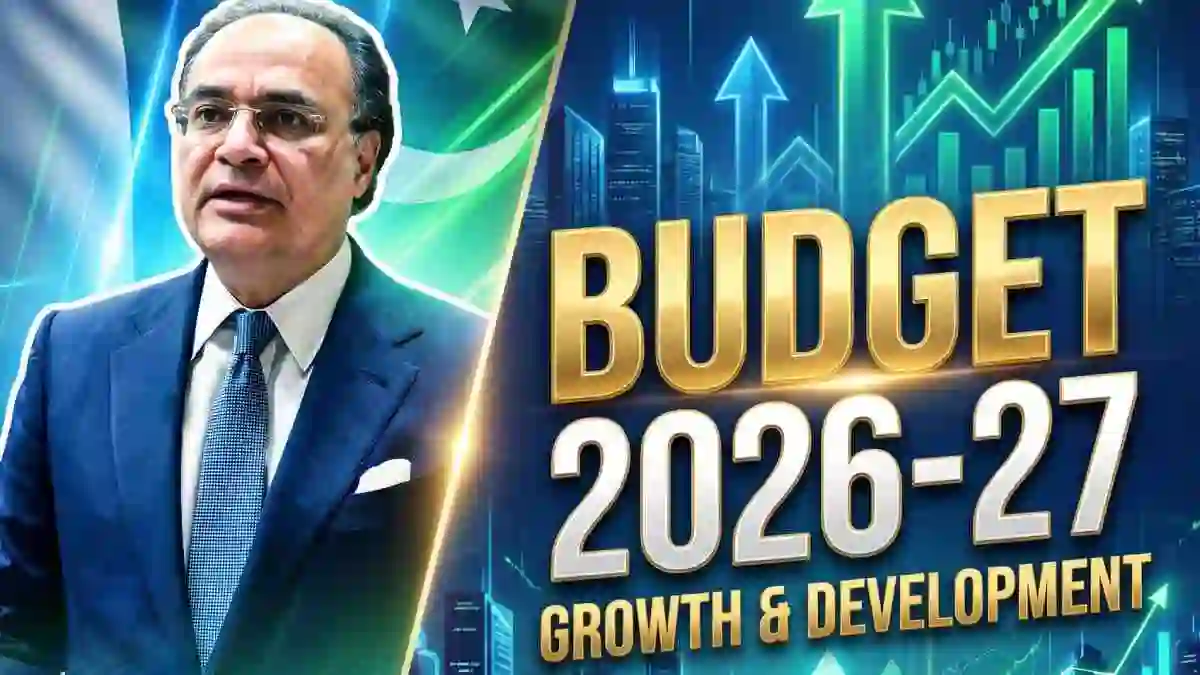
Finance Minister Muhammad Aurangzeb presented Pakistan’s Federal Budget 2026-27 in the National Assembly on June 12, 2026. The incumbent government’s third federal budget carries a total outlay of around Rs 18.77 trillion ($67 billion), reflecting a moderate increase from Rs 17.6 trillion in the previous year’s budget.
Here is every single thing that changes for Pakistani families from July 1.
The Big Picture
The government is targeting GDP growth of 4% and projecting inflation at 8.2%. The federal deficit is projected at Rs 7.02 trillion, or 3.6% of GDP, while the government targets a primary surplus of 2% of GDP. The government plans to collect more than Rs 15 trillion ($54 billion) in taxes. Pakistan’s economy expanded 3.7 percent and reached a record size of $452.1 billion in the outgoing fiscal year 2025-26, while average inflation eased to 6.7 percent during the July-May period from 23.4 percent in the previous fiscal year.
The budget arrives under tighter constraints than any in recent memory: an IMF programme requiring a primary surplus, an FBR revenue target of approximately Rs 15.3 trillion representing 14 percent growth over the current year, rising inflation driven by Middle East energy price pressures, and a debt servicing bill that consumed Rs 8.2 trillion in FY26 — nearly half the entire federal budget.
Salaries, Pensions, and Minimum Wage
Government employees will see a 7% increase in their salaries, and pensioners get the same 7% jump on their pensions. The minimum monthly wage has been increased by 10% to Rs40,700.
The 7% raise applies to basic pay. However, the income tax threshold of Rs 50,000 per month remained unchanged. That means anyone earning below Rs 50,000 per month — or Rs 600,000 per year — still pays zero income tax.
Income Tax — The Salaried Class Finally Gets Relief
This is the headline most salaried Pakistanis were waiting for. The finance minister said that the government proposed income tax relief in four slabs for salaried individuals and the abolition of surcharge on the salaried class.
Here is how the new slabs break down:
- Salaried people making between Rs 2.2 million and Rs 3.2 million per year would see their marginal tax rate drop from 23% to 20%.
- For those in the Rs 3.2 million to Rs 4.1 million bracket, the marginal rate is set to fall from 30% to 25%.
- Salaried earners between Rs 4.1 million and Rs 5.6 million would have their rate cut from 35% to 29%.
- The government has split the old “41 Lakh and above” bracket into two separate slabs: 41 to 56 Lakh and 56 to 70 Lakh.
The surcharge that was previously applied on top of salaried income has been scrapped entirely. For mid-range salaried workers earning between Rs 183,000 and Rs 340,000 per month, this is the most significant tax relief in years.
What Gets Cheaper
Air tickets are expected to become cheaper, with online ticket purchases set to attract lower taxes. The government has also eliminated the Federal Excise Duty (FED) on international business-class travel. Cosmetics and beauty products are also expected to see a price reduction. Prices of certain consumer products, including cosmetics, face powder, mascara, shampoo, and soap, may decline due to proposed tax adjustments. Cancer and other medicines are set to become cheaper after the budget.
The government has decided to abolish taxes on contraceptives. Solar panels will see no price increase, with the government maintaining existing exemptions for the sector. Import duty on parts used for local manufacturing may be reduced from 10% to 5%. Tax on imported auto parts for the local industry may be reduced from 20% to 10%.
What Gets More Expensive
Owners of vehicles above 2,000cc will face higher taxes, pushing prices up further in the large car segment. FED is being imposed on SUVs with engine sizes between 2,000cc and 3,000cc, and the FED on vehicles above 3,000cc is being increased further. Under the proposed changes, electric vehicles priced above Rs 2 crore will now be subject to FED, marking a notable shift in policy, as these high-end EVs were previously exempt from this tax.
The budget proposes the introduction of an Environmental Levy on luxury vehicles: 10% levy on petrol and diesel vehicles with engine capacities between 2,001cc and 3,000cc, and 19.5% levy on petrol and diesel vehicles exceeding 3,000cc. Duties on electronic cigarettes and liquids have also been increased. Fertilisers and pesticides will become more expensive following new levies.
Property — A Big Win for Buyers and Sellers
Under the proposed measures, the withholding tax on property purchases by tax filers has been reduced from 2.5 per cent to 1.25 per cent. Similarly, the withholding tax on property sales by filers has been cut from 5.5 per cent to 2.75 per cent, providing significant relief to the real estate sector. Capital value tax on foreign assets has been abolished entirely. Property transactions are likely to pick up following relief measures in the budget.
This is a significant incentive for tax filers, and it widens the gap between what filers and non-filers pay when buying or selling property.
Social Media Earners — Now in the Tax Net
In a significant new measure, income earned through social media will attract a 5% tax — a move that brings digital content creators into the tax net for the first time. Under the new system, any payments from social media platforms deposited into Pakistani bank accounts will automatically be subject to tax deduction. Banks will act as withholding agents, effectively cutting tax before creators can access their earnings.
This applies to earnings from YouTube, TikTok, Instagram, and other platforms. Whether you are a full-time creator or earn ad revenue on the side, this tax will be deducted at source from July 1.
Freelancers and IT Sector
The government announced the extension of the concessional 0.25 per cent tax rate on IT export income until 2029. The withholding tax on foreign transactions has dropped from 5% to 0.5%. At 0.5%, it becomes almost negligible. This should also be good news for Pakistan’s growing freelance and digital economy, where many professionals receive international payments or pay for international tools. Meanwhile, the government has decided to lower the tax collection on export proceeds from the existing 2% to 1.25%.
BISP and Social Protection
Rs 838 billion has been proposed for the Benazir Income Support Programme (BISP). The quarterly BISP stipend may be increased from Rs 13,000 to Rs 14,500. Subsidies for electricity and other sectors had been set at Rs 1.091 trillion. Grants worth Rs 2.68 trillion had been earmarked for BISP, Azad Jammu and Kashmir, Gilgit-Baltistan and the former tribal districts.
For Pakistan’s most vulnerable families, the BISP increase — while modest — provides a direct quarterly cash lifeline during a period of high food and energy costs.
Defence, Education, and Health
The defence budget has been set at Rs 3 trillion, reflecting the government’s focus on national security requirements. Pension expenditure for retired government employees is estimated at Rs 1.169 trillion. Under the ADP, Rs 46 billion has been allocated for higher education and research, which is higher than the Rs 34.9 billion allocated last year. The government has earmarked Rs 25.1 billion for the health sector under the Annual Development Programme 2026-27, including tertiary healthcare and critical care. The Public Sector Development Programme (PSDP) would receive Rs 1.1 trillion for federal development projects.
The Bottom Line
This budget delivers targeted relief — not sweeping transformation. The salaried class gets real tax cuts for the first time in years. Property buyers and sellers benefit from halved withholding rates. Freelancers and IT exporters keep their concessional regime until 2029. BISP beneficiaries see a modest stipend increase.
On the other side, luxury car owners, social media earners, and vape users pay more. The environmental levy on large vehicles signals a policy shift toward taxing consumption at the top. What the government does with the narrow fiscal space left after paying its debts, its defence obligations, and its provincial transfers will define the living standards of 245 million Pakistanis for the next twelve months.
The budget takes effect July 1, 2026.
Frequently Asked Questions (FAQs)
Has the minimum wage increased in the 2026-27 budget?
Yes, the federal minimum wage has been increased by 10 percent. Starting July 1, 2026, the legal minimum wage will rise from Rs 37,000 to Rs 40,700 per month.
Will government employees get a salary increase this year?
Yes, the budget includes up to a 10 percent salary increase for federal government employees. Additionally, government pensions have been increased by 7 percent.
What changes were made to real estate and property taxes?
For active tax filers, the withholding tax on property purchases has been halved from 2.5 percent to 1.25 percent. The tax on property sales has also dropped from 5.5 percent to 2.75 percent.
Why are electricity and gas bills expected to go up?
To meet international fiscal requirements, the government slashed general power and gas subsidies by 8 percent (roughly Rs 85 billion). This means the extra costs will be passed down to consumers through phased tariff increases starting in July 2026.