On April 30, 2026, at the naval base in Sanya on China’s Hainan Island, President Asif Ali Zardari stood at attention as Pakistan’s flag was raised on a submarine for the first time in over three decades.
The commissioning ceremony of the first Hangor-class attack submarine, PNS/M Hangor, was held in Sanya with President Zardari attending as chief guest and Chief of Naval Staff Admiral Naveed Ashraf also present. President Zardari described the commissioning as a historic milestone in the navy’s modernisation, affirming Pakistan’s resolve to maintain a robust, balanced and credible defence posture.
The submarine was the headline. But it was not the whole story.
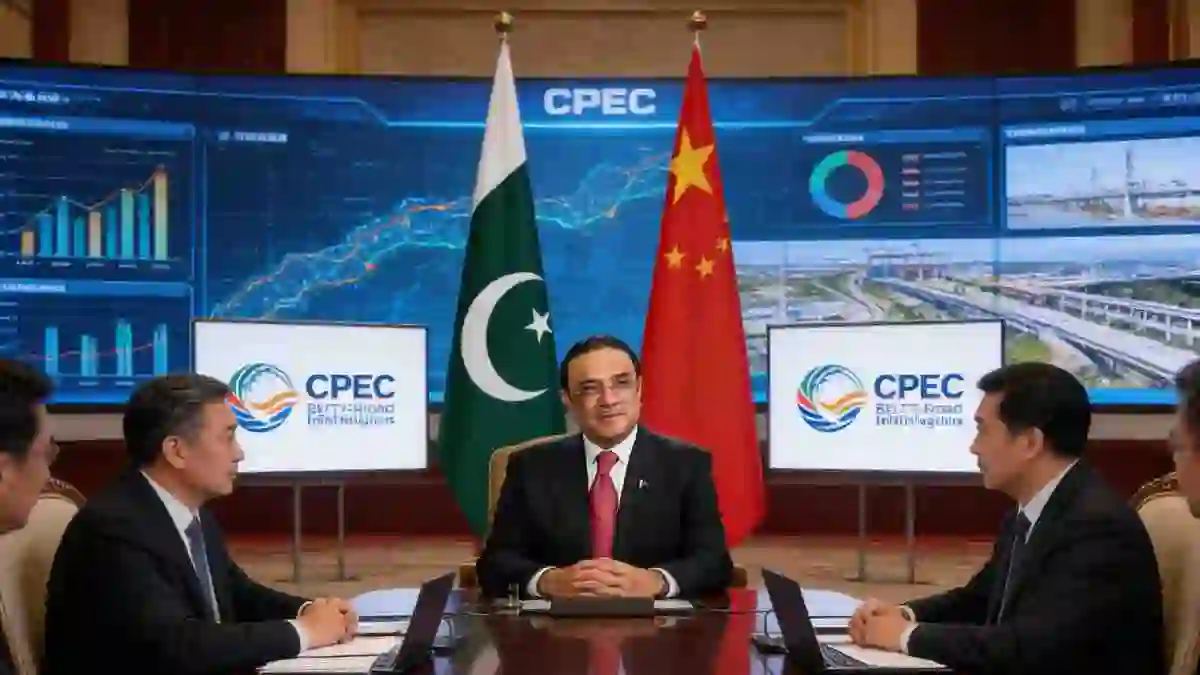
During the same five-day visit — which took Zardari from Changsha in Hunan Province to Sanya in Hainan — Pakistan and China signed agreements on construction machinery, animal vaccines, medical technology, desalination, agricultural cooperation and green industrial development. The agreements were described as part of efforts to expand practical cooperation in important sectors, with the visit centred on strengthening economic and trade relations, particularly under CPEC.
Together, the submarine and the MoUs tell a single story: the China-Pakistan relationship in 2026 is wider, deeper and more institutionalised than at any point in its 75-year history.
75 Years of Iron Brotherhood — and What It Has Built
The visit carries special significance as both countries mark the 75th anniversary of the establishment of diplomatic relations. It reflects the deep commitment of both sides to further consolidate their strategic cooperative partnership and deepen collaboration across key sectors.
What that partnership has produced is visible across Pakistan’s physical landscape. The China-Pakistan Economic Corridor includes the 392km Multan-Sukkur Motorway executed by China State Construction Engineering Corporation, the Orange Line Metro Rail Transit in Lahore jointly executed by China Railway and NORINCO with 26 stations across 27km, the 1,320MW Port Qasim Coal-fired Power Project with a total investment of $2.085 billion, and the KKH Phase II Havelian-Thakot highway contracted by China Communications Construction Company.
These are not plans. They are operational, revenue-generating assets that Pakistanis use every day.
The Submarine: Pakistan’s Most Consequential Arms Deal
The PNS/M Hangor is the most visible — and most strategically significant — product of China-Pakistan defence cooperation in history.
Pakistan’s Ministry of Defence ordered eight submarines from China in 2015 at an approximate cost of $4–5 billion, making it the largest arms export contract in Chinese military history. The Hangor-class submarines are being manufactured by a joint partnership of the China Shipbuilding Industry Corporation and the Karachi Shipyard & Engineering Works for the Pakistan Navy.
The submarine is built on a double-hulled configuration, stretching approximately 77.7 metres in length and 8.6 metres in beam width, with a displacement of around 2,550 tonnes. The design integrates a teardrop-shaped hull for hydrodynamic efficiency, capable of housing a crew of 38 alongside eight special forces personnel. The internal layout is methodically compartmentalised into six main sections.
The game-changing feature is the propulsion system.
The submarine’s most operationally significant feature is its Stirling-type air-independent propulsion system, allowing it to remain submerged for up to three weeks without surfacing. This gives it a major stealth advantage for covert patrol in the north Arabian Sea and the Indian Ocean.
The submarine can operate under AIP for about 20 days, covering 768 nautical miles, with extended ranges achievable by integrating diesel-electric propulsion, pushing operational limits to 2,000 nautical miles or 65 days. Maximum diving depth is around 300 metres, with a submerged top speed of 17 knots.
For armament: the submarine carries six 533mm torpedo tubes capable of firing heavyweight torpedoes such as the Chinese Yu-6, anti-ship cruise missiles including the YJ-82, and is believed to be configured for Pakistan’s Babur-3 submarine-launched cruise missile with a reported range of 450–500 kilometres — a weapon that provides a credible nuclear second-strike capability.
Read more: Pakistan and China launch second phase of CPEC, ink $8.5 billion deals
A Programme That Survived Every Obstacle
The path from contract to commissioning was anything but smooth — and understanding the obstacles makes the achievement more meaningful.
The program hit a major disruption when Germany refused to issue export licences for the MTU diesel engines originally specified for the submarines. The decision forced Pakistan and the Chinese developer CSOC to switch to Chinese-made CHD-620 diesel engines — a change that, while ensuring the program’s continuity, introduced delays as the propulsion package was re-engineered. The COVID-19 pandemic compounded those setbacks further.
The Chief Director of the programme revealed in August 2016 that the first four submarines would be delivered in 2022–2023. But the programme ran late, with the first submarine launched for sea trials in April 2024 and commissioned in April 2026.
Despite these delays, the eventual outcome is arguably better than the original specification. China’s development of a domestic AIP propulsion system reduced Pakistan’s dependence on European suppliers for a critical component — and in a period of Western sanctions pressure on Pakistan-China defence cooperation, that self-sufficiency has real strategic value.
Eight Submarines Coming — Pakistan’s Undersea Fleet Transforms
The commissioning of PNS/M Hangor is the beginning, not the end.
According to Admiral Ashraf, the Pakistan Navy is set to induct a total of eight Hangor-class submarines. The navy launched the first of the new submarines in April 2024, while the second, third and fourth were launched on March 15, August 15 and December 17 in 2025 respectively.
Given that all four Chinese-built boats were in the final stages of sea trials by late 2025, one can expect the remaining three — PNS/M Shushuk, PNS/M Mangro and PNS/M Ghazi — to follow in relatively quick succession, potentially within 2026 itself. That would double the Pakistan Navy’s AIP-equipped fleet from three Agosta 90B boats to seven within a single year — a pace of fleet expansion the Navy has not experienced in its modern history.
The agreement calls for four submarines to be built by Pakistan at Karachi Shipyard and Engineering Works under a technology transfer arrangement, with four built in China. This technology transfer element is one of the deal’s most consequential long-term features — it gives Pakistan’s domestic shipbuilding industry direct experience building advanced AIP submarines.
The name Hangor was chosen deliberately. In 1971, the earlier PNS Hangor became the first submarine since World War II to sink a warship, when it sank the Indian frigate INS Khukri. After being decommissioned, the original Hangor is now on display at the Pakistan Maritime Museum in Karachi. The new PNS/M Hangor carries that legend forward — now equipped with 21st-century technology.
CPEC 2.0: Beyond Roads and Power Plants
While the submarine dominated headlines, Zardari’s five-day visit reflected a broader evolution in what CPEC now means.
In September 2025, China withheld support for the Main Line-1 railway upgrade, a flagship CPEC project, during PM Shehbaz Sharif’s visit to Beijing. Instead, agreements worth about $8.5 billion were signed in sectors including agriculture, electric vehicles, solar energy, health and steel.
The message was clear: CPEC 2.0 is not primarily about megaprojects and concrete. It is about economic diversification, technology transfer, and sectoral integration — building a Pakistan that produces and exports rather than simply importing infrastructure built by Chinese labour.
During his Changsha visit, Zardari visited SANY Heavy Industry, a leading producer of heavy equipment, reviewing advanced machinery including unmanned counterbalanced forklifts. He expressed interest in bringing such technology to Pakistan and suggested local manufacturing opportunities. He also visited Hunan Tea Group to explore agricultural collaboration.
A trilateral MoU was signed between Al-Hassan Trade Establishment, Sany International Development, and Henan Jialong International Technology to enhance cooperation in the supply of construction machinery and related equipment associated with CPEC. The parties will also review investment prospects for establishing manufacturing facilities in Pakistan.
Vaccines, Water and Medical Technology: The Quiet Cooperation
Away from the geopolitical drama of submarines and railways, some of the most practically significant agreements signed during Zardari’s visit address everyday Pakistani needs.
The agreements cover construction machinery, animal health and medical technology. One MoU focused on animal vaccines — a sector critical to Pakistan’s livestock economy, which employs tens of millions of rural Pakistanis and is one of the country’s largest agricultural sub-sectors.
The visit also included agreements on desalination and water treatment technology — a critical need for Pakistan’s water-stressed south — and agricultural technology cooperation to improve productivity across Pakistan’s farming sector. These deals aim to improve infrastructure, agricultural productivity and water management systems.
Additional agreements were finalised in Sanya covering medical technology, along with a joint investment arrangement to promote private sector cooperation and cross-border investment. President Zardari also held meetings with provincial leadership in both Changsha and Sanya, focusing on region-specific opportunities in agriculture, manufacturing and marine development.
The Arabian Sea’s New Balance
Admiral Ashraf’s remarks at the Sanya commissioning ceremony were carefully calibrated — but pointed.
He highlighted that disruptions at critical maritime choke points increasingly threaten global trade and energy security, and that maintaining a stable, rule-based maritime order demands technologically advanced naval forces. He noted that Hangor-class submarines will play a pivotal role in deterring aggression and ensuring security of vital Sea Lines of Communication across the Arabian Sea and the wider Indian Ocean region.
The context was unmistakable. With the Strait of Hormuz blockaded, global oil supply chains disrupted, and Pakistan having deployed fighter jets to Saudi Arabia under its mutual defence pact — the Arabian Sea in 2026 is an active strategic theatre, not a quiet trading lane.
Pakistan’s eight Hangor-class submarines are being inducted into that environment. The commissioning of PNS/M Hangor is not simply a fleet addition. It is the beginning of a structural reorientation in how the Pakistan Navy prioritises its procurement spending, with seven more boats to follow.
A navy that could once patrol its coastline is building the capability to operate across the Indian Ocean. That transformation — funded by China, built in Wuhan, commissioned in Sanya — is perhaps the most consequential single outcome of the 75-year China-Pakistan partnership.
Frequently Asked Questions (FAQs)
Q: What is CPEC 2.0 and how does it differ from the original CPEC?
The original CPEC, launched formally in 2015 with a $64 billion price tag, focused primarily on energy plants, roads, and port infrastructure. CPEC 2.0 shifts toward technology transfer, manufacturing, agriculture, electric vehicles, solar energy and health cooperation. The emphasis is on building Pakistan’s productive capacity — creating exports and jobs — rather than just adding physical infrastructure.
Q: How many Hangor-class submarines will Pakistan eventually operate?
Pakistan has ordered eight Hangor-class submarines. The first, PNS/M Hangor, was commissioned on April 30, 2026. Three more — PNS/M Shushuk, PNS/M Mangro and PNS/M Ghazi — were launched in 2025 and are expected to be commissioned in 2026. The remaining four will be built at Karachi Shipyard & Engineering Works under a technology transfer arrangement.
Q: What makes the Hangor-class submarine significant from a military perspective?
The Hangor-class is equipped with air-independent propulsion technology, allowing it to remain submerged for up to three weeks without surfacing — dramatically increasing its stealth and endurance compared to conventional diesel-electric submarines. It can operate at depths of 300 metres, reach speeds of 17 knots submerged, and is believed to be configured for the Babur-3 submarine-launched cruise missile with nuclear capability. It represents a significant upgrade to Pakistan’s undersea deterrence.
Q: What agreements did Pakistan and China sign during President Zardari’s April 2026 visit?
Pakistan and China signed a joint venture agreement and multiple MoUs covering construction machinery manufacturing, animal vaccines, medical technology, desalination, agricultural technology, water management, and green industrial cooperation. These agreements expand CPEC cooperation into sectors that directly affect Pakistan’s farming, healthcare and manufacturing industries.
Q: Why has China delayed the Main Line-1 railway project under CPEC?
China withheld support for the ML-1 railway upgrade during PM Shehbaz’s September 2025 Beijing visit, choosing instead to sign $8.5 billion in sectoral agreements. Analysts cite shifting geopolitical dynamics — including Pakistan’s engagement with Washington, its US-Iran mediation role, and broader realignments — as factors influencing China’s recalibration of CPEC priorities toward economic diversification rather than large-scale infrastructure debt.
Q: What is the significance of CPEC extending into Afghanistan?
The May 2025 trilateral announcement extending CPEC into Afghanistan creates a potential land corridor from China through Pakistan to Afghanistan and beyond. Combined with Pakistan’s Iran transit corridor and growing Central Asia trade links, it could eventually form a continuous overland route linking China to the Gulf via Pakistan — making CPEC far more than a bilateral development project, and establishing Pakistan as the irreplaceable connective tissue of a new Eurasian trade geography.