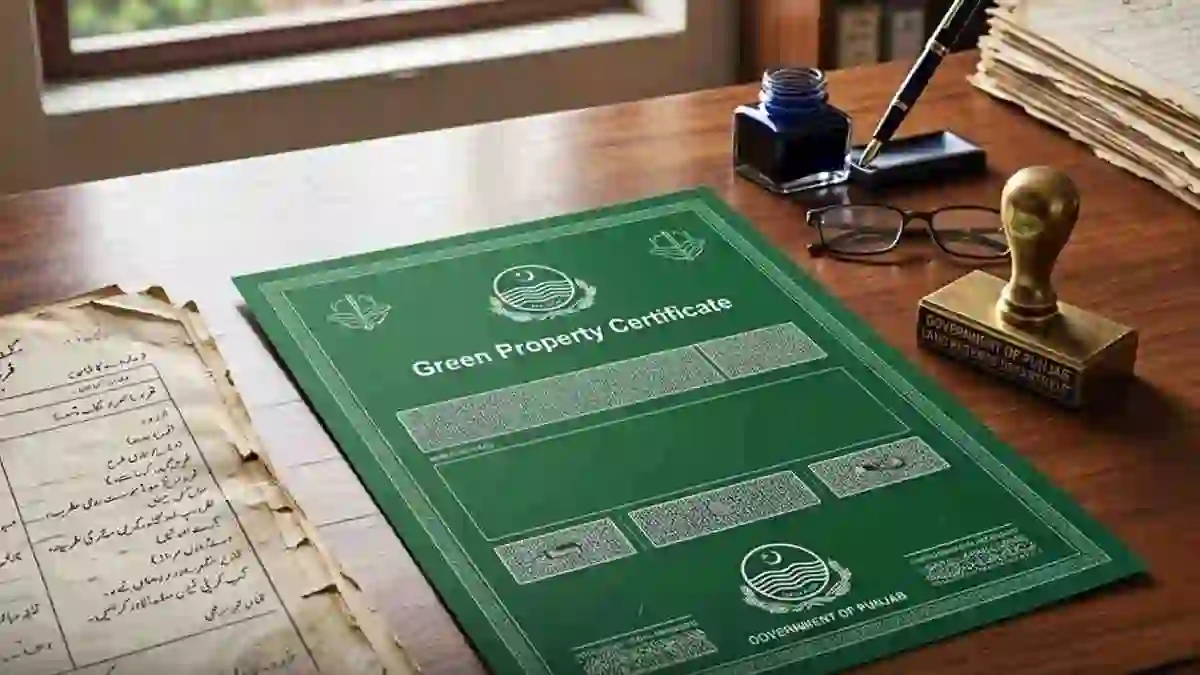
In 1540, the Mughal Emperor Sher Shah Suri introduced a system of land records across the subcontinent — hand-written registers that documented who owned what, where, and how much. For 485 years, successive empires, colonial administrations, and Pakistani governments maintained variations of that same system. The paper-based “Fard” that a landowner in Punjab receives today traces its lineage directly to that Mughal innovation.
That system is now being abolished.
Punjab’s 485-year-old manual property registration system, introduced in 1540, will be replaced with a fully digital system. From July 1, 2026, the sale and purchase of residential, commercial, and agricultural land will be prohibited without the Green Property Certificate. The existing Fard system will be abolished.
This is not an incremental reform. It is a complete replacement of the foundational document of property ownership in Pakistan’s largest province — affecting millions of landowners, buyers, sellers, and investors across 36 districts.
What the Green Property Certificate Actually Is
The Green Property Certificate is an official document issued by the Punjab Land Records Authority (PLRA) that verifies the ownership and legal status of a property. It ensures that the property is legally registered, free from disputes, and recognised by government records. This certificate provides citizens with confidence in their property rights, helps prevent land disputes, and allows property owners to use their land securely for legal or financial purposes.
The critical distinction from the old Fard system is scope. A traditional Fard confirmed basic ownership details — but it did not tell you whether the property had an outstanding bank mortgage, a pending court stay order, unpaid taxes, or an unresolved boundary dispute.
A property could have an outstanding bank loan or a pending court stay order that would not show up on a basic Fard record. The new certificate changes that by providing a comprehensive snapshot of the property’s legal standing, addressing three concerns simultaneously: confirming that the landowner is the genuine registered owner, verifying the property is free from encumbrances, and ensuring records are fully aligned with government databases.
Each certificate comes with a unique QR code that verifies real-time ownership data. Every certificate is digitally signed by PLRA, with cloud-based storage under government control. The tamper-proof format means no manual editing or overwriting is allowed — making the certificate impossible to forge or alter.
The Rollout: Sahiwal First, Province-Wide by July
The Punjab Land Records Authority has officially mandated the Green Property Certificate for all property transactions, beginning with a focused rollout in Sahiwal from April 30, 2026. This initiative, under the broader “Project for Land Records Animation” (PULSE), aims to eliminate the traditional manual Fard system. As of the mandatory deadline, property transactions in Sahiwal without the Green Certificate are legally void.
Preparations have been completed to launch the system at the Rawalpindi Land Record Centre next week, under the Punjab Land Records Authority and Board of Revenue. Authorities say citizens will be able to obtain the certificate using existing documents from next week.
Punjab authorities have announced that the Green Property Certificate will become mandatory for all land and real estate transactions starting July 1, 2026. No property — residential, commercial, or agricultural — can be bought or sold without this certificate after that date.
The phased rollout — Sahiwal first, then Rawalpindi, province-wide by July — gives property owners and the land records administration time to process the transition in manageable batches rather than triggering a single-day scramble across all 36 districts simultaneously.
The 10-Step Process: How to Get Your Certificate
Under the new system, citizens are required to follow a 10-step process to obtain the Green Property Certificate. Here is each stage explained:
Step 1 — Visit Your Arazi Record Center The citizen visits their nearest Arazi Record Center (ARC). After a token is issued, the Service Center Official begins the process for the Green Property Certificate.
Step 2 — Pay the Fee Provide complete property details and pay the required fee of Rs950 via the ARC’s Bank of Punjab counter or via online payment methods through e-Pay.
Step 3 — Identity Verification The citizen’s original CNIC is checked, and biometric verification is conducted via NADRA. Registered mobile numbers and record details including name and father’s name are also cross-referenced.
Step 4 — Ownership History Review A review of the property’s history is conducted to ensure the sale or purchase was legal and that there are no outstanding taxes, bank mortgages, or active court disputes.
Step 5 — Field Survey and Land Inspection A surveyor visits the site to inspect the land. Modern GPS technology is used to mark boundaries and measure the exact area.
Step 6 — Neighbouring Owners’ Verification Two neighbouring property owners whose records already exist in the PLRA system verify the citizen’s ownership and possession of the land.
Step 7 — Government Officer Verification A government officer of Grade 17 or revenue staff verifies the case in the system.
Step 8 — 15-Day Public Notice Following the field survey, a 15-day public notice is issued. This information is available on the PLRA website. If no objections are received within 15 days, the case moves to the final stage.
Step 9 — Final Review by Assistant Director An Assistant Director of Land Records reviews the case. If there are no disputes, the possession report is verified at two levels — Revenue Officer and Gazetted Officer.
Step 10 — Certificate Issuance Once all stages are cleared, the property is given “Green Status” and the ADLR issues the final Green Property Certificate, which serves as a guarantee of secure and transparent ownership.
Read more: Punjab Replaces Centuries-Old Paper Stamp With E-Stamp System
Online Application: The PULSE Zameen Portal
For those who prefer not to visit an ARC in person, PLRA has integrated the PULSE Zameen portal to facilitate digital applications.
Citizens can apply by visiting the official Punjab Land Record Authority website, creating an account, entering their property details, verifying their CNIC, and downloading their digital certificate after approval.
For those who are not tech-savvy, the Arazi Record Centers in Sahiwal and across other districts remain fully operational to assist with manual processing through digital kiosks.
The dual-channel approach — online portal and in-person ARC — is a deliberate design choice to ensure that rural and elderly property owners who are not digitally fluent are not excluded from the process.
What the Certificate Costs
In January 2026, the Punjab Land Records Authority increased the fee for the Green Property Certificate from Rs 700 to Rs 950.
At Rs 950, this is among the most affordable official property verification documents available anywhere in Pakistan. For context, informal middlemen previously charged many times this amount to facilitate Fard-related transactions — often without any guarantee of accuracy.
Payment can be made at the Bank of Punjab counter at any ARC or through the PLRA’s online e-Pay system.
Why This Reform Matters: The Fraud Problem It Solves
The Green Property Certificate is not a bureaucratic upgrade for its own sake. It is a direct response to one of the most persistent forms of financial crime in Pakistan — property fraud.
Land disputes and fraudulent transactions have continued to rise, making clarity, confidence, and legal certainty urgent priorities for the real estate ecosystem. The Green Property Certificate allows authorities to verify property ownership directly from the centralised digital land record system, ensuring fake documents cannot easily be used and buyers can verify property ownership before transactions.
For overseas Pakistanis, the certificate provides remote confidence that their property is safe and officially recognised. It can be accessed and verified online from anywhere in the world, eliminating the need to rely on agents or family members for basic ownership confirmation.
The QR code on every certificate enables real-time ownership verification by any party — buyer, bank, court, or government authority — without requiring the original document to be physically present.
What Happens If You Do Not Get One
After the mandatory deadline for each district, manual property transactions will be legally void. No property can be sold, bought or transferred without the certificate.
This means that from July 1, 2026, any property sale or purchase in Punjab conducted without a Green Property Certificate will have no legal standing. Buyers who proceed without one risk losing their investment entirely. Sellers who accept payment without one may face legal challenges to the transfer.
For property owners with disputed records, encumbrances, or outdated documentation, the 15-day public notice window built into the process is both an opportunity and a risk — it gives legitimate owners a chance to clear their records, but also invites objections from neighbours or creditors who have unresolved claims.
The advice from authorities is straightforward: begin the process now, well before the July 1 deadline, to allow sufficient time for the field survey, public notice period, and any dispute resolution that may be required.
What You Need to Bring
Property owners must provide their CNIC, property details, and ownership documents — existing Fard or Registry papers — to the ARC officer to begin the process.
For joint owners, both individuals must be present or provide authorised representation. For inherited properties, relevant succession documentation will also be required.
The Bigger Picture: Punjab’s Smart Land Governance Vision
This initiative not only secures homeowners from fraud but also contributes to Pakistan’s green governance vision by reducing paper usage and promoting sustainability. Under the leadership of CM Maryam Nawaz, Punjab has become the first province in Pakistan to digitise centuries-old land records into verified property certificates. Every home is now secure, every record is verifiable, and every citizen is part of a greener, smarter Punjab.
PLRA was established under the PLRA Act 2017 and operates under the Board of Revenue, Punjab. Its mission is to reform, modernise and digitalise land records to ensure transparency and citizen-friendly services. PLRA also allows overseas Pakistanis to verify ownership, obtain Fard, and perform land transactions remotely via digital platforms and MOFA embassies.
The Green Property Certificate is the most visible milestone yet in that mission — and the most consequential structural reform to Punjab’s land administration in nearly five centuries.
Frequently Asked Questions (FAQs)
Q: What is the deadline for getting a Green Property Certificate in Punjab?
Sahiwal district has an immediate mandatory deadline from April 30, 2026. Rawalpindi’s rollout begins in early May 2026. Province-wide, the Green Property Certificate becomes mandatory for all property transactions from July 1, 2026. Property owners are strongly advised to start the process at least 4–6 weeks before the deadline to allow time for the field survey and 15-day public notice period.
Q: Can I still sell property using my old Fard after July 1, 2026?
No. From July 1, 2026, all residential, commercial and agricultural property transactions in Punjab without a valid Green Property Certificate will have no legal standing. The Fard system is being abolished and will no longer be accepted as a transaction document.
Q: How much does the Green Property Certificate cost and where do I pay?
The current fee is Rs 950. It can be paid at the Bank of Punjab counter at any Arazi Record Center (ARC) or online through the PLRA’s e-Pay system. The fee was last revised in January 2026 from the previous rate of Rs 700.
Q: How long does the process take from application to certificate?
The process involves a field survey and a mandatory 15-day public notice period during which objections can be raised. Assuming no objections are filed and all documents are in order, the end-to-end process typically takes 3 to 4 weeks after initial application. Properties with disputes, pending taxes, or court orders will take longer.
Q: Can overseas Pakistanis apply for the Green Property Certificate?
Yes. PLRA has specifically designed the system to accommodate overseas Pakistanis. The PULSE Zameen online portal allows applications to be initiated remotely. For physical verification steps, authorised representatives can attend on the owner’s behalf. Once issued, the certificate can be verified online from anywhere in the world using the QR code on the document.
Q: What if my application is rejected?
If your application for a Green Property Certificate is rejected, you have the legal right to submit an appeal to the Deputy Commissioner’s office or the specialised PLRA complaint cell. Rejection reasons typically include record discrepancies, boundary disputes, outstanding bank mortgages, or incomplete documentation. PLRA’s helpline is available to assist property owners in resolving technical and record-related issues before or after application.