
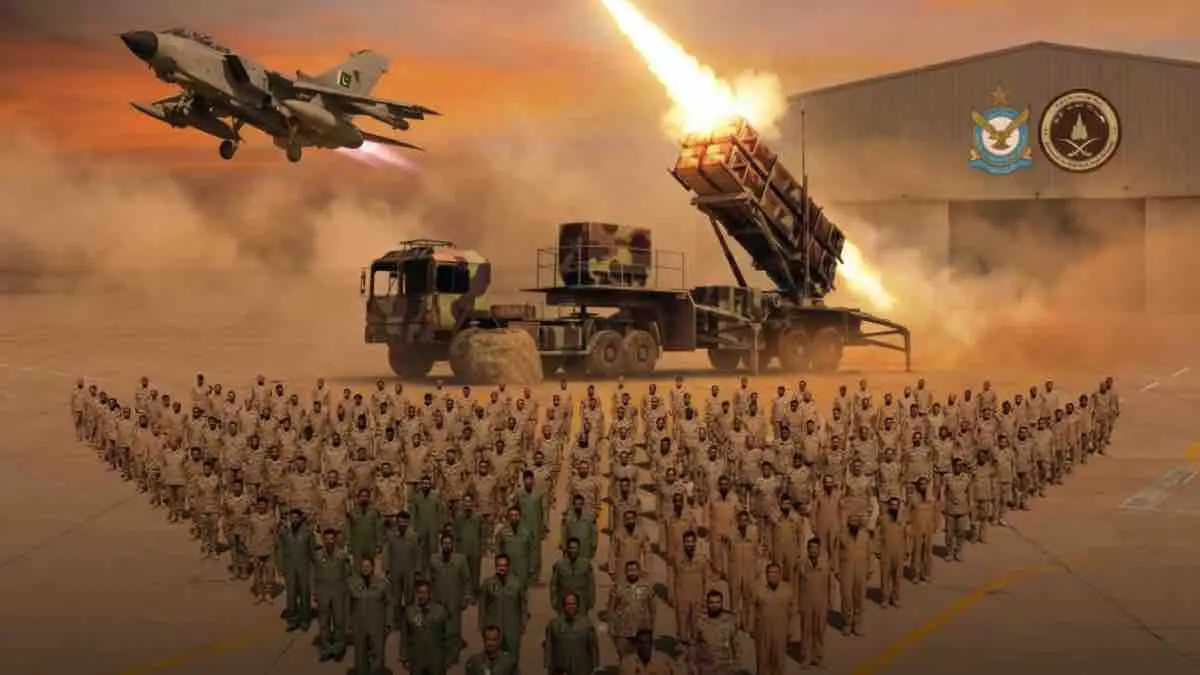
On Saturday, April 11, 2026, Pakistan Air Force fighter jets and support aircraft landed at King Abdulaziz Air Base in Saudi Arabia’s Eastern Province. Saudi Arabia’s Ministry of Defence announced their arrival publicly, confirming what officials in Islamabad described as the first major military execution of a bilateral strategic defence pact signed just seven months earlier.
The deployment landed at the most sensitive possible moment: Pakistan was simultaneously hosting direct US-Iran negotiations in Islamabad aimed at converting a fragile two-week ceasefire into something more lasting. Jets were touching down in Riyadh while diplomats were talking in Islamabad — and both moves carried the same message.
The Pact Behind the Planes
In September 2025, Pakistan and Saudi Arabia signed a landmark Strategic Mutual Defence Agreement, under which “any aggression against either country shall be considered an aggression against both.” The pact was signed during Prime Minister Shehbaz Sharif’s visit to Riyadh at the invitation of Crown Prince Mohammed bin Salman.
The joint strategic defence agreement establishes a framework for closer military cooperation between Saudi Arabia and Pakistan, including joint training exercises, the exchange of expertise, and the deployment of personnel and assets. The pact aims at enhancing interoperability and strengthening the operational readiness of both countries’ armed forces in response to evolving regional security challenges.
Saturday’s deployment was the first time that framework moved from paper to operational reality — making it one of the most consequential activations of Pakistan’s defence commitments in decades.
What Was Deployed and Where
Saudi Arabia’s Ministry of Defence confirmed that a military contingent from Pakistan had arrived at King Abdulaziz Air Base in the Eastern Province, including fighter and support aircraft from the Pakistan Air Force. The deployment aims to enhance operational readiness and improve joint capabilities between the armed forces of both nations.
Reports put the deployment at approximately 13,000 soldiers and between 10 and 18 fighter jets — the first major execution of the joint strategic defence agreement signed between the two nations.
An international affairs expert told Press Trust of India that the movement of troops and aircraft had actually taken place last month, with the information made public only recently by Saudi authorities. Nearly 10,000 Pakistani soldiers were already stationed in Saudi Arabia before this latest deployment, bringing the total personnel under the defence arrangement to a significantly higher level.
King Abdulaziz Air Base in the Eastern Province sits within reach of Iranian missile and drone strike capabilities — a geographic reality that gave the deployment an unmistakable strategic weight.
Why Now: Iranian Strikes on Saudi Energy Infrastructure
The timing of the public announcement was no accident.
The planes were sent after Iranian strikes hit key energy infrastructure in Saudi Arabia and killed a Saudi national, three sources including a senior Pakistani government official told Reuters. They were “not there to attack anyone,” the official said.
An Iranian strike on Saudi Arabia’s sprawling Jubail petrochemicals complex on Monday had raised concerns in Pakistan that the Gulf kingdom might retaliate — potentially jeopardising the Iran peace talks in Islamabad.
Pakistan found itself in a precise bind: it had brokered the ceasefire with Iran’s trust, while simultaneously holding a mutual defence obligation to Saudi Arabia — a country Iran had been actively striking. The deployment was Islamabad’s answer to both.
Imtiaz Gul, an Islamabad-based security analyst, told Al Jazeera the deployment was not a military escalation but an attempt to communicate Pakistan’s commitments to Iran. Michael Kugelman of the Wilson Center said: “This is Pakistan signalling to Iran that if Iran is not willing to make the types of concessions that lead to a deal and the conflict resumes and escalates, there is a chance that Pakistan could move itself closer to Saudi Arabia and conceivably invoke the mutual defence pact.”
Munir’s Role: Architecture and Execution
The deployment did not materialise overnight. Its foundations were laid weeks earlier.
Army chief Field Marshal Asim Munir flew to Riyadh in early March to discuss measures to halt Iranian strikes under the pact’s framework. Four days before Saturday’s fighter jet deployment, Sharif called Crown Prince Mohammed bin Salman to pledge Pakistan would stand “shoulder to shoulder” with the kingdom. The two countries also agreed to expedite a pledged Saudi investment package for Pakistan worth $5 billion.
Earlier on Saturday, Saudi Finance Minister Mohammed al-Jadaan had met Prime Minister Sharif in Islamabad alongside Deputy PM Dar and Field Marshal Munir — a remarkable scene: Saudi Arabia’s finance minister in Islamabad pledging economic support on the same day Pakistani jets were landing at a Saudi air base.
Read more: How Pakistan turned JF-17 Thunder fighter jet into its biggest defence export success
Decades of Military Ties, Now Formalised
The deployment is new in scale and legal framework, but Pakistan-Saudi military relations run deep.
Military cooperation between both countries dates to the 1960s, with Pakistan helping in the training of Saudi pilots and its fighter jets stationed in the kingdom at crucial periods of its history. In January 2026, Pakistan ordered F-16 fighter aircraft to King Abdulaziz Air Base for a multinational air combat exercise called Spears of Victory-2026, which involved Saudi Arabia, Pakistan, France, Italy, Greece, Qatar, Bahrain, Jordan, the UK and the US.
In 2018, Riyadh announced a $6 billion support package for Pakistan, including a $3 billion deposit at the central bank and $3 billion worth of oil supplies on deferred payment. Saudi Arabia is home to some 2.5 million Pakistani workers whose remittances help sustain Pakistan’s fragile economy.
The economic and security relationship between the two countries is genuinely mutual — each needs what the other provides.
PM Shehbaz’s Diplomatic Offensive
The fighter jet deployment coincided with PM Shehbaz Sharif preparing a three-nation Gulf tour to consolidate Pakistan’s diplomatic gains and shore up regional alliances.
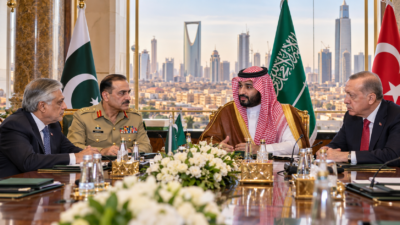
Shehbaz Sharif is expected to visit Saudi Arabia in the coming days to hold high-level talks with Crown Prince Mohammed bin Salman on regional and global developments. Discussions are expected to focus on the Middle East situation, the US-Iran engagement, broader de-escalation efforts, and bilateral cooperation. Following the Saudi visit, the prime minister is also expected to travel to Türkiye.
The visit comes at a critical time following the stalling of US-Iran negotiations. The focus is expected to be on defence and economic collaboration as Pakistan seeks to strengthen its ties with key regional partners.
This follows an already intensive diplomatic schedule. Shehbaz previously travelled to Saudi Arabia on March 12 for detailed discussions with the Crown Prince on the state of regional security and bilateral relations, accompanied by Deputy PM and Foreign Minister Ishaq Dar. The visit was described by the PM Office as highlighting “Pakistan’s positive role in the diplomatic arena.”
A New Regional Power Bloc Taking Shape
The deployment and diplomatic activity are unfolding inside a broader geopolitical realignment.
Pakistan, Turkey, Egypt and Saudi Arabia have emerged as a potential new regional power bloc. The four countries all have political and economic ties with the US and are members of Trump’s Board of Peace.
Together they bring distinct strategic assets: Pakistan has nuclear weapons, Saudi Arabia holds the world’s second-largest oil reserves, Egypt controls access to the Suez Canal, and Turkey is a NATO member. With a combined population of 500 million, they represent the most politically and militarily influential Muslim-majority grouping in the world.
Pakistan’s Minister for Defence Production, Raza Hayat Harraj, confirmed to Reuters that a Pakistan-Saudi Arabia-Turkey trilateral defence agreement is “already in the pipeline.”
The deployment of Pakistani jets to Saudi Arabia is therefore not just a bilateral military move — it is a building block in a new security architecture that may reshape the Middle East’s balance of power for years to come.
Frequently Asked Questions (FAQs)
Q: How many Pakistani troops and jets were deployed to Saudi Arabia in April 2026?
Reports indicate approximately 13,000 soldiers and between 10 and 18 fighter jets arrived at King Abdulaziz Air Base in Saudi Arabia’s Eastern Province under the Strategic Mutual Defence Agreement. Around 10,000 Pakistani personnel were already stationed in the kingdom before this deployment.
Q: What is the Pakistan-Saudi Arabia Strategic Mutual Defence Agreement?
It is a bilateral pact signed in September 2025 during PM Shehbaz Sharif’s visit to Riyadh. It states that any aggression against either country shall be considered an aggression against both — establishing a collective defence commitment similar in principle to NATO’s Article 5.
Q: Why were Pakistani jets deployed while peace talks were happening in Islamabad?
The deployment was triggered by Iranian strikes on Saudi energy infrastructure, including the Jubail petrochemicals complex, that killed a Saudi national. Pakistan deployed the contingent to honour its defence obligations to Riyadh while simultaneously signalling to Iran that continued attacks risked pulling Pakistan away from its mediator role and toward invoking the full mutual defence clause.
Q: Was this deployment a military escalation against Iran?
Pakistani officials and analysts described it as strategic messaging, not military escalation. A senior Pakistani official told Reuters the forces were “not there to attack anyone.” Analysts said the deployment was designed to communicate Pakistan’s defence commitments and apply pressure on Iran to negotiate in good faith.
Q: Where is PM Shehbaz Sharif travelling as part of his regional diplomatic push?
PM Shehbaz is undertaking a three-nation visit that includes Saudi Arabia and Turkey, focused on regional security, bilateral economic cooperation, and follow-up diplomacy after the Islamabad talks. Saudi Finance Minister al-Jadaan also visited Islamabad on the same day as the jet deployment to reaffirm financial support for Pakistan.
Q: Is a broader Pakistan-Saudi Arabia-Turkey trilateral defence pact coming?
Pakistan’s Minister for Defence Production confirmed to Reuters that such a trilateral agreement is already in the pipeline. Combined with the existing bilateral pact between Pakistan and Saudi Arabia, this points toward a formalised new regional security grouping involving the Muslim world’s most powerful states.

Join the Conversation
Share your thoughts, questions, or feedback below.