
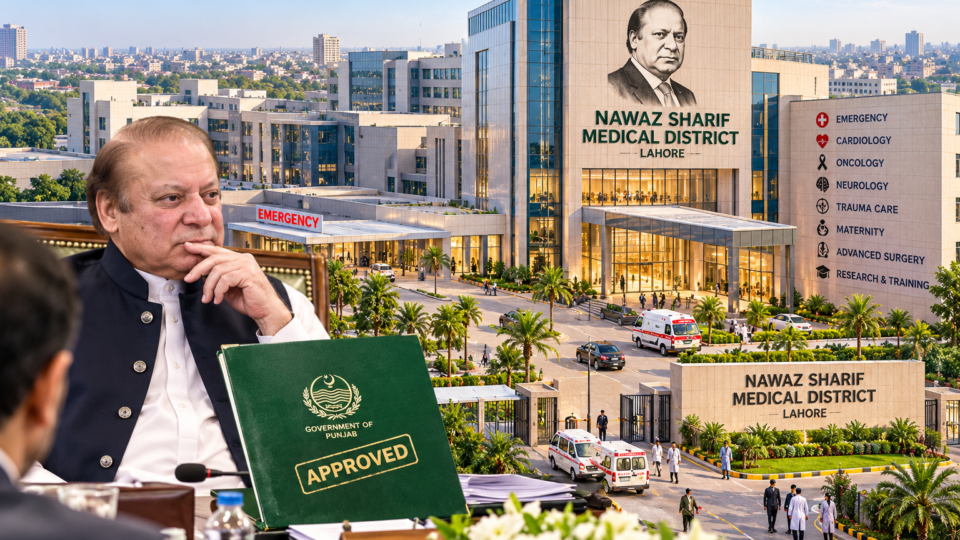
The Punjab government has approved a major healthcare development project worth approximately Rs18.78 billion for the establishment of the Nawaz Sharif Medical District in Lahore. The approval was granted by the Provincial Development Working Party (PDWP) during its 11th meeting of the current financial year, chaired by Planning and Development Board Punjab Chairman Dr Naeem Rauf. The project is intended to strengthen specialised medical services and expand healthcare infrastructure in the provincial capital.
The approved scheme is associated with the Sharif Institute of Orthopedics, Spine and Rehabilitation in Lahore. Its stated focus includes improving specialised treatment facilities for patients requiring orthopaedic care, spinal treatment and rehabilitation services. The development forms part of a wider provincial effort to expand healthcare capacity, improve access to specialised treatment and strengthen the facilities available to patients with complex medical needs.
The approval was announced on October 28, 2026, following the PDWP meeting, during which 10 development schemes with a combined estimated value of approximately Rs60 billion were approved across different sectors. Although the Rs18.78 billion allocation marks an important administrative step, detailed information about the project’s construction schedule, service capacity, staffing requirements and opening date has not yet been fully specified. The project’s eventual impact will depend on how the approved scheme is implemented and when the planned facilities become operational.
What Is the Nawaz Sharif Medical District Project?
The Nawaz Sharif Medical District is a major healthcare development planned for Lahore, with the wider initiative intended to bring specialised medical facilities and supporting infrastructure together in a coordinated development area. The broader plans have included different types of hospitals, specialist treatment centres, diagnostic services and medical education facilities.
The latest approval concerns a scheme associated with the Sharif Institute of Orthopedics, Spine and Rehabilitation. This distinction is important because the Rs18.78 billion approval should not automatically be interpreted as the final cost of every facility proposed for the wider medical district.
The project is intended to strengthen specialised healthcare services in Lahore and improve the capacity available for patients who require advanced treatment. Orthopaedic conditions, spinal disorders and rehabilitation needs can require specialist doctors, diagnostic equipment, surgical facilities and extended recovery support.
A dedicated medical development area can help coordinate services that might otherwise be spread across separate locations. If the facilities are planned and managed effectively, patients may benefit from better coordination between diagnosis, treatment, surgery and rehabilitation.
However, the precise layout of the newly approved scheme, the number of buildings to be constructed under this specific allocation and the detailed distribution of funds will depend on the formal project documents.
Rs18.78 Billion Approved for Healthcare Development
The approved cost of Rs18,786 million is equivalent to approximately Rs18.786 billion. The amount represents a substantial investment in specialised healthcare infrastructure and was included among the development schemes cleared during the PDWP’s 11th meeting of the current financial year.
The meeting reviewed projects across multiple sectors, including healthcare, roads, industrial development, renewable energy and water resources. Together, the 10 approved schemes were valued at approximately Rs60 billion.
The medical district project was among the healthcare initiatives considered during the meeting. Its approval moves the scheme forward through Punjab’s development process, although further administrative, procurement and construction steps may be required before the facilities can be completed and opened to patients.
Large healthcare projects involve several expenditure categories. These can include construction, electrical and mechanical systems, medical equipment, specialised installations, utilities and supporting infrastructure. The precise allocation across these categories has not been fully detailed in the available announcement.
The final value of the project will also depend on implementation arrangements and any formally approved revisions made during the development process.
Focus on Orthopaedics, Spine Treatment and Rehabilitation
One of the central objectives of the approved scheme is to strengthen orthopaedic, spinal and rehabilitation services. These areas of medicine address a broad range of conditions that can affect mobility, independence and quality of life.
Orthopaedic services treat problems involving bones, joints, ligaments, tendons and the musculoskeletal system. Patients may need specialist care following road accidents, workplace injuries, sports injuries or complications involving joints and bones.
Spinal treatment is another important area of specialised healthcare. Conditions affecting the spine can cause pain, reduced mobility, nerve problems and difficulties carrying out everyday activities. Some patients require surgery, while others may benefit from medication, physiotherapy and long-term rehabilitation.
Rehabilitation services support patients as they recover from injuries, operations or medical conditions that affect their movement and daily functioning. Depending on individual needs, rehabilitation may involve physiotherapy, occupational therapy, mobility training and other forms of professional support.
Developing these services within a specialised medical setting could help improve coordination between clinical teams. However, the number of specialists, treatment units and rehabilitation facilities to be provided under the approved scheme has not been confirmed in the available project announcement.
Why Lahore Needs Specialised Healthcare Facilities
Lahore is a major population centre in Punjab and serves patients from the city as well as surrounding districts. People frequently travel to the provincial capital for specialist consultations, diagnostic tests, surgery and treatment that may not be readily available in their local areas.
Demand for specialised healthcare can place pressure on existing hospitals. Patients may experience long waiting periods, difficulty obtaining appointments or the need to visit multiple facilities for different stages of treatment.
Specialised medical infrastructure can help address some of these challenges by increasing treatment capacity and improving access to dedicated clinical services. For patients with orthopaedic or spinal conditions, timely assessment and appropriate treatment can be particularly important for preventing further complications and supporting recovery.
The effectiveness of a new medical facility depends on more than its physical construction. Hospitals also need qualified doctors, nurses, technicians, rehabilitation specialists, reliable equipment, medicines and efficient patient-management systems.
The Punjab government will therefore need to ensure that the approved investment translates into services that patients can actually access. The eventual benefits will depend on operational planning, staff recruitment, equipment availability and the arrangements made for referrals and patient admissions.
Wider Plans for the Nawaz Sharif Medical District
Earlier reporting on the wider medical district described plans for a range of specialised healthcare and medical education facilities. These proposals have included additional children’s healthcare capacity, facilities for genetic and blood disorders, specialised surgical and rehabilitation services, nursing education and other specialist treatment institutions.
Previously reported plans have also referred to a cardiac hospital, a medical university and advanced diagnostic facilities. These elements indicate the broader ambition associated with the medical district, but they should be distinguished from the specific Rs18.78 billion scheme approved at the latest PDWP meeting.
The full medical district may involve multiple projects, implementation stages and separate funding arrangements. As a result, the cost of the latest approved scheme should not be assumed to represent the entire cost of every proposed hospital or facility within the wider development.
Likewise, earlier plans do not establish that all proposed institutions have already been completed or are ready to receive patients. Their status must be assessed individually through formal approvals, construction updates and operational announcements.
A coordinated healthcare district could potentially improve the availability of specialist treatment in Lahore by bringing different medical services into a more connected setting. The actual scope and timing of that benefit will depend on which facilities proceed and when they become operational.
How the Project Could Benefit Patients
The planned expansion of specialised medical services could benefit patients who need treatment for bone, joint, spinal and mobility-related conditions. Access to appropriate specialist care can help patients receive more accurate diagnoses and treatment suited to their medical needs.
For people with serious injuries, the availability of orthopaedic surgery and rehabilitation services can influence the recovery process. A coordinated care pathway may allow patients to move more efficiently from initial assessment to treatment and follow-up care.
Rehabilitation is particularly important for patients recovering from major injuries or operations. Recovery may require several stages, including pain management, physiotherapy, exercises to improve strength and mobility, and guidance on returning to everyday activities.
A dedicated medical facility could also provide opportunities for clinical teams to work together across different specialities. Such coordination may help reduce fragmentation in treatment, although the results will depend on how the hospital’s services are organised.
Patients may also benefit indirectly if additional specialist capacity reduces pressure on existing institutions. Nevertheless, it is too early to determine how many patients the new scheme will serve each year or whether it will reduce waiting times across Lahore.
Those outcomes can be assessed only after the project details, operational capacity and patient-access arrangements are established.
Importance of Medical Equipment and Specialist Staff
Modern healthcare infrastructure requires more than hospital buildings. The effectiveness of an orthopaedic, spinal and rehabilitation centre depends on the availability of qualified professionals and appropriate medical technology.
Orthopaedic and spinal treatment can require advanced diagnostic imaging, surgical equipment, sterile operating environments and specialised post-operative care. Rehabilitation services may need dedicated therapy spaces, mobility equipment and facilities suited to patients with different levels of physical impairment.
Recruiting and retaining trained staff is equally important. Doctors, nurses, physiotherapists, technicians and other healthcare professionals all contribute to patient care. A facility cannot deliver its intended services at full capacity if the necessary workforce is unavailable.
The project will also require reliable electricity, water, infection-control systems, waste management, medical supplies and maintenance arrangements. These supporting services are essential for keeping healthcare facilities safe and operational.
The latest approval announcement does not provide a complete equipment list, staffing plan or service-capacity breakdown. Those details will become important as the scheme moves towards procurement, construction and operational preparation.
Construction, Procurement and Implementation
Following development approval, large public-sector healthcare schemes generally require further steps before patients can begin receiving treatment. These may include finalising the project design, confirming implementation arrangements, conducting procurement, awarding contracts and completing construction.
The responsible departments and executing agencies must coordinate the work to ensure that buildings, utilities, equipment and clinical spaces are delivered in a suitable sequence.
Healthcare projects can face implementation challenges involving construction costs, procurement timelines, equipment delivery and the availability of specialist contractors. Delays in any of these areas may affect when a facility can open.
The latest announcement confirms the PDWP’s approval of the scheme but does not provide a definitive completion date or a detailed construction timetable. It would therefore be premature to state when the full project will be ready to receive patients.
Regular progress updates will help the public understand whether the project is advancing according to plan. Important milestones would include contract awards, commencement of construction, completion of major structures, installation of equipment and the start of clinical operations.
The quality of implementation will be as important as the size of the financial allocation. Facilities must meet appropriate construction and healthcare standards before they can deliver safe and effective services.
Healthcare Investment and Punjab’s Development Priorities
The approval of the Nawaz Sharif Medical District scheme reflects the provincial government’s continued investment in public infrastructure. Healthcare development is particularly significant because hospitals and specialist centres require substantial capital investment before they can provide services to the public.
Punjab’s development programme also includes projects in transport, industrial skills, renewable energy and water resources. The PDWP’s approval of 10 schemes worth approximately Rs60 billion demonstrates the range of sectors included in the province’s development planning.
Within healthcare, investments in specialist facilities can address needs that differ from those served by general hospitals. Dedicated institutions may provide services requiring advanced equipment, experienced clinical teams and coordinated treatment pathways.
However, the success of public healthcare spending should ultimately be measured by the services delivered to patients. Construction progress, operational readiness, affordability, treatment quality and patient access are all relevant indicators.
The medical district’s long-term value will depend on whether the approved investment creates functioning healthcare capacity that meets the needs of Lahore and patients travelling from other parts of Punjab.
What Has Been Confirmed and What Remains Unclear?
The confirmed information from the latest approval announcement includes the estimated cost of Rs18.786 billion, the approval by the Provincial Development Working Party and the project’s association with the Sharif Institute of Orthopedics, Spine and Rehabilitation in Lahore.
The stated objective is to strengthen specialised orthopaedic, spinal and rehabilitation services. The scheme was approved as part of a wider group of 10 development projects valued at approximately Rs60 billion.
Several important details remain unclear in the public information available so far. These include the final number of beds, the exact list of services to be introduced under this specific allocation, the number of specialist doctors and other staff, the construction schedule and the date on which patients will be admitted.
The approval also does not, by itself, establish that every institution previously proposed for the wider medical district is included within this particular scheme or will open at the same time.
These distinctions matter when assessing the project’s scale and expected benefits. Further formal announcements and implementation documents will be needed to establish the complete scope, schedule and operational arrangements.
Conclusion
The Punjab government has approved a Rs18.78 billion scheme for the Nawaz Sharif Medical District in Lahore, marking a new step in the development of specialised healthcare infrastructure in the provincial capital.
The scheme is associated with the Sharif Institute of Orthopedics, Spine and Rehabilitation and is intended to strengthen treatment capacity in these specialist areas. It was approved by the Provincial Development Working Party during a meeting that cleared 10 development schemes worth approximately Rs60 billion.
The wider medical district has been associated with plans for additional specialised hospitals, diagnostic services and medical education facilities. However, the latest financial approval should be understood as a specific development scheme rather than confirmation that every element of the wider plan is complete or operational.
For patients, the project’s potential value will depend on the availability of qualified staff, modern equipment, accessible services and effective clinical management. Its progress will become clearer as implementation details, construction milestones and operational plans are announced.
The Rs18.78 billion approval establishes an important development commitment, but the ultimate measure of success will be the quality and accessibility of the healthcare services delivered to the public.



Join the Conversation
Share your thoughts, questions, or feedback below.