
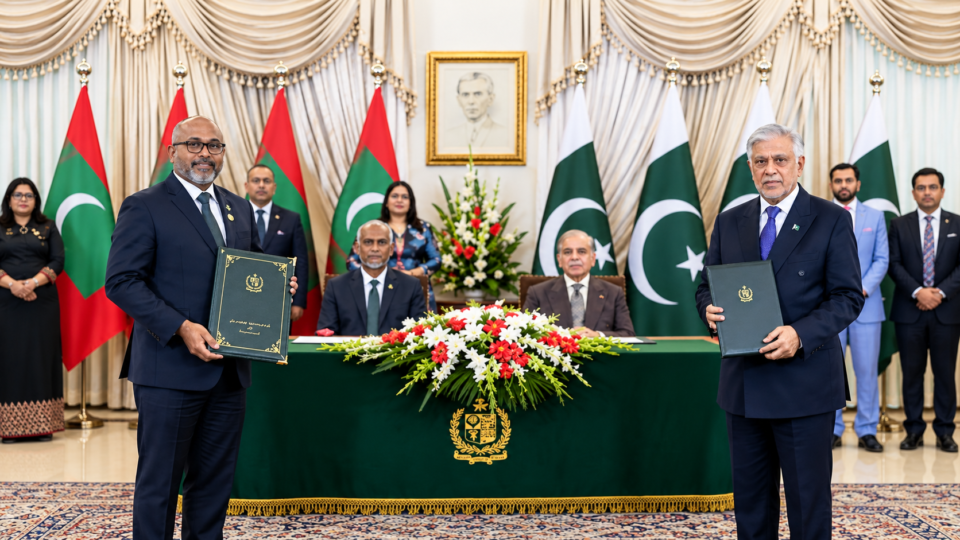
Pakistan and the Maldives have signed and exchanged 20 memorandums of understanding (MoUs) to strengthen bilateral relations and expand cooperation across trade, defence, information technology, healthcare, education, agriculture, tourism, and several other important sectors. The agreements were exchanged in Islamabad on October 21, 2026, during the state visit of Maldivian President Dr Mohamed Muizzu. The two countries have also agreed to increase bilateral trade from approximately $130 million to $200 million within the next two years, setting an ambitious target for stronger economic cooperation.
The visit marks an important development in relations between Pakistan and the Maldives, which established diplomatic ties in 1966. As both countries celebrate 60 years of diplomatic relations, their governments are seeking to turn longstanding friendship into a broader economic and strategic partnership. The agreements are intended to encourage institutional cooperation, strengthen business connections, improve technical collaboration, and create new opportunities for people and businesses in both countries.
Pakistan and Maldives Agree to Increase Bilateral Trade
One of the most significant outcomes of the visit is the agreement to raise bilateral trade to $200 million within two years. Prime Minister Shehbaz Sharif announced the target following discussions with President Muizzu, highlighting the need to transform friendly relations into stronger commercial ties. The two countries currently have bilateral trade worth approximately $130 million, meaning they will need to expand commercial activity considerably to achieve the new target.
Reaching the target will require greater engagement between businesses, exporters, importers, investors, and government institutions. Both countries will need to identify products and services that can be traded more efficiently, address commercial barriers, and develop reliable arrangements for moving goods between their markets. Stronger cooperation between public and private organisations could help businesses understand market demand and establish long-term trading relationships.
Pakistan has an established agricultural, pharmaceutical, textile, food-processing, and manufacturing base that could provide opportunities for expanded exports. The Maldives, meanwhile, has an economy closely connected to tourism, hospitality, fisheries, and the services sector. These differences create potential opportunities for complementary trade, although actual growth will depend on commercial demand, competitive prices, logistics, and agreements between businesses.
The $200 million target is therefore an important objective, but it is not a guarantee that the increase will automatically occur. Both governments will need to support practical business activity and monitor progress to determine whether the agreed target is being achieved.
Twenty Agreements Cover Key Areas of Cooperation
The 20 MoUs cover a wide range of areas, reflecting the two countries’ intention to strengthen relations beyond traditional diplomatic engagement. The agreements include defence cooperation, maritime security, information technology, cybersecurity, artificial intelligence, healthcare, education, agriculture, fisheries, tourism, environmental cooperation, and institutional development.
The agreements also address social protection, technical and vocational training, youth development, sports, air connectivity, and cooperation between public institutions. This broad agenda gives both governments several areas in which they can pursue practical projects and exchange expertise.
The signing ceremony was witnessed by Prime Minister Shehbaz Sharif and President Mohamed Muizzu, with representatives from both countries exchanging the agreements. The wide scope of the MoUs reflects a shared interest in expanding cooperation in sectors that can contribute to economic development, public services, institutional capacity, and regional engagement.
However, an MoU generally establishes a framework for cooperation rather than automatically creating a completed project or a guaranteed financial commitment. The results will depend on follow-up arrangements, implementation plans, funding where required, and continued coordination between the relevant organisations.
Information Technology, Artificial Intelligence and Cybersecurity
Information technology is one of the important areas covered by the agreements. Pakistan and the Maldives have agreed to strengthen cooperation in IT, cybersecurity, artificial intelligence, digital skills, technology, and innovation. These areas are increasingly important as governments, businesses, and public institutions adopt digital systems to improve services and support economic growth.
Pakistan has a growing technology services sector, with professionals working in software development, application development, digital solutions, IT consulting, and related fields. Cooperation with the Maldives could create opportunities for knowledge exchange, technical assistance, training, and partnerships between technology companies and institutions.
The Maldives could benefit from access to technical expertise, digital capacity-building programmes, and collaboration in areas where specialist skills are needed. Cooperation in cybersecurity could also support efforts to strengthen digital systems, improve awareness of cyber risks, and develop institutional capabilities for responding to digital threats.
Artificial intelligence and technology innovation offer further possibilities in areas such as public administration, tourism services, business operations, and data management. Nevertheless, specific projects, financial commitments, or implementation timelines will need to be established separately.
The emphasis on digital skills is also important because technology partnerships require trained professionals who can develop, operate, and maintain digital systems. Joint training initiatives and institutional exchanges could help build the workforce needed to support future technology projects.
Defence Cooperation and Maritime Security
Defence cooperation and maritime security are also included in the agreements, highlighting the importance of collaboration between two countries connected to the wider Indian Ocean region. Maritime security is particularly relevant to the Maldives, an island nation whose transport, tourism, fisheries, and economic activities depend heavily on the surrounding sea.
Pakistan also has significant maritime interests and experience in naval operations, maritime security, and professional training. Cooperation between the two countries could provide opportunities for institutional engagement, knowledge exchange, and training in areas of shared interest.
Maritime security involves a broad range of responsibilities, including protecting sea routes, supporting safe maritime activity, strengthening coordination between relevant authorities, and addressing unlawful activities at sea. Cooperation in these areas can contribute to regional stability and help both countries develop their institutional capabilities.
Defence-related cooperation can also include professional exchanges and training arrangements, subject to the terms agreed upon by the relevant authorities. The precise activities, schedules, and implementation details will depend on subsequent decisions by both governments.
The inclusion of these sectors demonstrates that the relationship is not limited to trade and development. It also encompasses areas connected to national security, professional cooperation, and shared regional interests.
Healthcare Cooperation and Professional Recruitment
Healthcare is another major area addressed during the visit. Pakistan and the Maldives have agreed to strengthen health cooperation, including arrangements involving healthcare professionals and collaboration between regulatory authorities.
Pakistan has a substantial medical education sector and trains doctors, nurses, and other healthcare professionals who work in the country and abroad. The Maldives can potentially benefit from cooperation in medical staffing, professional training, technical knowledge, and institutional capacity-building, depending on its healthcare requirements.
The two countries also signed an arrangement concerning the recruitment of healthcare professionals. Such cooperation could help address staffing needs and provide employment opportunities for suitably qualified professionals, subject to applicable licensing, recruitment, and employment requirements.
Cooperation between the Maldives Food and Drug Authority and Pakistan’s Drug Regulatory Authority is another component of the agreements. Regulatory collaboration can help institutions exchange expertise concerning medicines, product standards, regulatory procedures, and public health protection.
Pakistan and the Maldives have already developed connections through education and healthcare services. Prime Minister Shehbaz Sharif noted that Pakistani doctors and allied healthcare professionals were serving in the Maldives and expressed a willingness to continue supporting the country’s requirements.
Further cooperation could strengthen these connections, but its success will depend on practical arrangements, professional standards, staffing requirements, and the effective implementation of agreed measures.
Education, Vocational Training and Skills Development
Education and professional training form another important part of the bilateral partnership. The agreements include cooperation in education, technical and vocational education and training, youth development, sports, and collaboration between higher education institutions.
Pakistan has universities, colleges, technical institutes, and professional training organisations that could support educational exchanges and capacity-building programmes. Cooperation could help students and professionals gain access to academic opportunities, specialised training, and institutional partnerships.
Technical and vocational education is especially important because countries need workers with practical skills in healthcare, information technology, engineering, tourism, business operations, and other industries. Joint programmes could help institutions share training methods, develop professional skills, and improve links between education and employment.
The agreements also involve cooperation between Pakistan’s Higher Education Commission and the relevant Maldivian education authorities. Such institutional engagement can provide a framework for further discussions on academic collaboration and educational development.
Youth development and sports cooperation could offer additional opportunities for exchanges, training, and interaction between young people. These activities can strengthen people-to-people ties and help build a longer-term relationship beyond government-level meetings.
The actual benefits will depend on the programmes established after the agreements, including the number of participants, available funding, eligibility requirements, and the ability of educational institutions to work together.
Agriculture, Fisheries and Food Trade
Agriculture and fisheries are important parts of the agreements because they offer opportunities to expand commercial activity and exchange technical knowledge. Pakistan has a broad agricultural sector that produces cereals, fruits, vegetables, and other food products. The Maldives, as an island country, has particular requirements related to food supply, fisheries, tourism, and hospitality.
An MoU between the Maldives State Trading Organisation and Pakistan’s Trading Corporation of Pakistan is intended to support cooperation in the trade of agricultural commodities, food, and other products. This arrangement could help establish stronger commercial connections between the two countries and provide a framework for exploring additional trading opportunities.
Pakistan’s agricultural and food-processing industries may be able to supply products suited to Maldivian demand. However, expanding trade will require attention to product quality, food safety, shipping costs, storage, delivery schedules, and the specific needs of importers.
Fisheries cooperation could also create opportunities for exchanging expertise and supporting the development of the sector. Both countries have interests in fisheries and marine resources, although their geographical circumstances and production requirements differ.
Practical collaboration could involve institutional exchanges, technical knowledge, and discussions on sustainable sector development. Any future projects would need to be assessed according to their commercial viability and environmental requirements.
Tourism, Air Connectivity and Cultural Relations
Tourism is a natural area for stronger cooperation between Pakistan and the Maldives. The Maldives is internationally known for its island destinations and hospitality industry, while Pakistan offers a variety of landscapes, historical sites, cultural attractions, and opportunities for domestic and international tourism.
The two countries have included tourism cooperation among the areas covered by the agreements. Greater engagement could help tourism organisations exchange information, develop partnerships, and explore opportunities to encourage travel between the countries.
Air connectivity is also important for tourism, business travel, educational exchanges, and official visits. An agreement concerning air connectivity provides a framework for cooperation, although it does not by itself confirm that a new direct flight route or additional service has been launched.
Improved travel options, if developed through subsequent arrangements, could make it easier for business representatives, students, tourists, and professionals to visit each country. Airlines and relevant authorities would still need to consider passenger demand, operational costs, route approvals, and commercial feasibility.
The agreements also cover arts, culture, and heritage. Cultural cooperation can help promote mutual understanding, preserve historical traditions, and encourage interaction between communities.
Together, these areas could support a more connected relationship in which diplomatic ties are reinforced through tourism, travel, business, and cultural exchange.
Environmental Cooperation and Social Protection
Environmental cooperation and social protection are also part of the bilateral agenda. These areas are relevant to both countries, although their priorities may differ according to their economic conditions, geography, and public policy requirements.
As an island nation, the Maldives faces particular challenges associated with climate change, coastal vulnerability, and environmental sustainability. Pakistan also faces significant environmental concerns, including water management, extreme weather, and pressure on natural resources.
Cooperation could provide opportunities for sharing institutional knowledge, exchanging policy experience, and exploring suitable environmental initiatives. The precise scope of any future activity will depend on the arrangements developed by the relevant authorities.
Social protection cooperation may provide another avenue for exchanging information on public welfare systems and institutional approaches to supporting vulnerable communities. Such engagement can help government institutions learn from each other’s experiences and identify areas where collaboration may be useful.
While these agreements establish opportunities for engagement, specific programmes and measurable outcomes will require further planning and implementation.
Institutional Cooperation and Public Administration
Several agreements focus on cooperation between government institutions, demonstrating an effort to strengthen administrative and professional links between Pakistan and the Maldives.
The agreements include cooperation involving police training institutions, civil service organisations, and public administration academies. These arrangements can provide a foundation for professional exchanges, training programmes, and the sharing of institutional knowledge.
Cooperation between law enforcement training institutions could support professional development and exchanges of experience in areas relevant to policing and public safety. Similarly, collaboration between civil service organisations may help officials learn about administrative practices, public-sector training, and institutional development.
Such arrangements can strengthen the working relationship between government departments and create channels for continued engagement after the presidential visit concludes.
Institutional cooperation is often less visible than major trade announcements, but it can be important for ensuring that bilateral agreements translate into sustained activity. Regular communication, clear responsibilities, and follow-up mechanisms will be necessary to maintain progress.
Importance of President Mohamed Muizzu’s State Visit
President Mohamed Muizzu arrived in Pakistan on October 20, 2026, for a state visit scheduled from October 20 to 22. The visit is particularly significant because it is the first visit by a Maldivian president to Pakistan in 11 years and coincides with the 60th anniversary of diplomatic relations between the two countries.
During the visit, President Muizzu held discussions with Prime Minister Shehbaz Sharif and other Pakistani officials. The meetings focused on strengthening bilateral relations and exploring opportunities in trade, investment, education, healthcare, tourism, agriculture, defence, and maritime security.
The visit also provided an opportunity for business representatives from both countries to engage through the Maldives-Pakistan Business Forum. Business-to-business discussions can be important for identifying commercially viable projects and building connections between private-sector organisations.
Prime Minister Shehbaz Sharif welcomed the visiting president and reaffirmed Pakistan’s commitment to strengthening relations with the Maldives. He also highlighted the importance of cooperation in education and healthcare, including the role of Pakistani professionals serving in the Maldives.
The visit reflects a shared interest in expanding bilateral engagement and creating practical opportunities for cooperation. Its long-term significance will depend on how effectively the two governments and their institutions implement the agreements reached during the meetings.
What the Agreements Mean for Businesses
For businesses in Pakistan and the Maldives, the agreements create a broader framework for exploring new commercial relationships. Companies involved in food supply, agriculture, pharmaceuticals, healthcare services, information technology, education, tourism, and other covered sectors may find opportunities to engage with partners in the other country.
The proposed increase in bilateral trade could encourage businesses to investigate new markets and assess demand for their products and services. Pakistani exporters may explore opportunities to supply suitable goods to Maldivian importers, while Maldivian organisations may seek additional partnerships in areas relevant to their economy.
However, the agreements do not mean that every business will automatically receive new contracts or that trade volumes will immediately increase. Companies will still need to evaluate prices, market demand, regulations, payment arrangements, logistics, and the reliability of potential partners.
Government institutions can support the process by providing relevant information, facilitating business discussions, and helping organisations understand the rules that apply to cross-border trade. Continued engagement between the private sectors of both countries will be important in converting diplomatic commitments into commercial activity.
The most meaningful measure of success will be the emergence of sustainable trade, investment, services, and partnerships that continue beyond the state visit.
Challenges in Achieving the $200 Million Trade Target
Although the new trade target represents an important ambition, achieving it will require consistent effort from both countries. Trade growth depends on a range of factors, including the availability of suitable products, competitive pricing, shipping arrangements, market access, and the ability of businesses to establish dependable supply relationships.
Geographical distance and transport costs can influence the price of traded goods. Businesses may also need to meet specific product standards, documentation requirements, and regulatory procedures before entering a new market.
Another challenge is ensuring that the agreements lead to practical activity rather than remaining formal statements of intent. Clear implementation plans, responsible institutions, regular progress reviews, and cooperation with businesses will help maintain momentum.
The two governments will also need to identify which sectors offer the strongest potential for expanding trade within the two-year period. Prioritising commercially realistic opportunities could help produce measurable progress toward the target.
Ultimately, the $200 million objective will depend on the combined efforts of policymakers, public institutions, exporters, importers, service providers, and private investors.
Conclusion
Pakistan and the Maldives have taken an important step towards strengthening their bilateral partnership by signing and exchanging 20 MoUs covering trade, defence, information technology, cybersecurity, healthcare, education, agriculture, fisheries, tourism, and several other sectors. The agreement to raise bilateral trade from approximately $130 million to $200 million within two years gives the relationship a clear economic objective.
President Mohamed Muizzu’s visit also carries diplomatic significance as the two countries mark 60 years of relations. The agreements provide a framework for expanding cooperation, strengthening institutional links, and exploring opportunities for businesses and professionals in both countries.
The next stage will be turning these commitments into practical outcomes. Greater business engagement, effective implementation, improved commercial connections, and sustained cooperation will be essential to achieving the trade target.
If the two countries successfully translate the agreements into long-term projects and stronger commercial relationships, the partnership could create new opportunities in technology, healthcare, education, agriculture, tourism, and other important sectors. The success of the initiative will ultimately be measured by the results delivered to both countries and their people.


Join the Conversation
Share your thoughts, questions, or feedback below.