
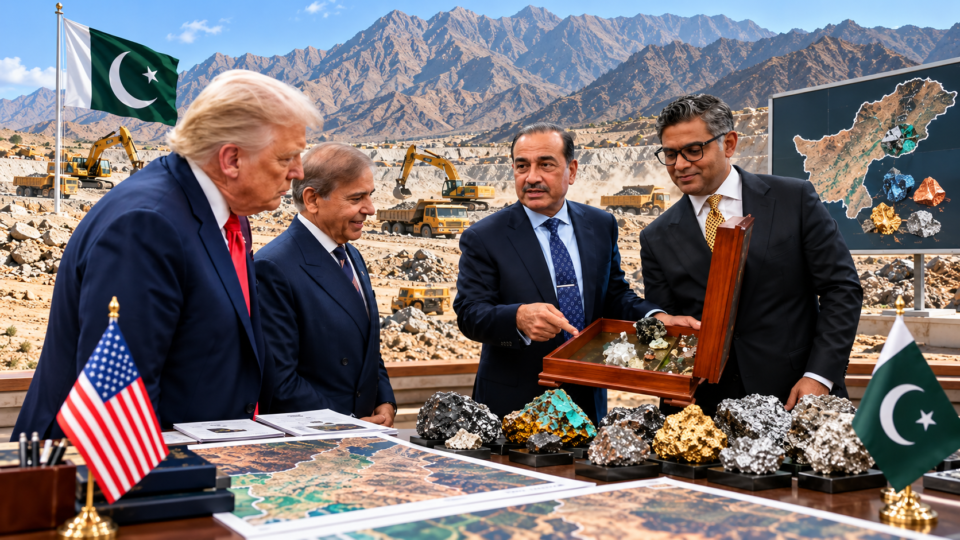
Pakistan is actively courting U.S. investment to develop its vast but underexploited mineral wealth in Balochistan. In late 2026 the government announced a Pakistan Minerals Investment Forum (PMIF26) for November 12–13, explicitly targeting U.S. companies. Officials – including commerce ministry and BOI representatives – have publicly urged Washington to be a “preferred partner” and to lead investment in Balochistan’s copper, gold, antimony, rare earths and other critical minerals. This follows landmark U.S. engagement in 2025–26: a $500 million MoU between Pakistan’s military engineers (FWO) and U.S. Strategic Metals for rare earths and antimony, and a U.S. EXIM Bank commitment of $1.25 billion in project finance. The government projects Balochistan’s untapped reserves at roughly $8 trillion, with crucial new projects (notably the Reko Diq copper-gold mine) poised to double annual mineral export revenue.
However, successful U.S. entry faces major hurdles: security and insurgency risks in Balochistan, uncertain local consent, and the need to align new deals with China-backed CPEC projects. To mitigate these, experts recommend robust local partnerships, strong environmental and social governance, and clarity on legal frameworks. U.S. agencies (State, EXIM, DFC) have signalled interest in supporting critical minerals worldwide, and have sponsored high-level dialogues (e.g. a critical minerals ministerial). A US company should carry out thorough due diligence (security, legal, market) and can leverage Pakistan’s foreign investment regime (100% foreign ownership allowed, tax holidays, free repatriation, BIT protections). Pakistani authorities are advised to expedite permits (ESIAs, land access, security clearances), improve data transparency, and ensure local benefit-sharing to attract credible investment.
Key takeaways: Pakistan’s pitch to U.S. investors is backed by formal events, publicity, and finance commitments. The most advanced project is Reko Diq (50:50 Barrick-Pakistan JV), which has proven reserves of ~7.3Mt Cu and 13Moz Au (resource estimate ~40Mt Cu, 50Moz Au). Other important minerals include Saindak copper-gold (China-operated), newly discovered antimony, and distributed rare-earth deposits (e.g. in Chagai monazite sands). U.S. industry analysts caution that many cited reserves (the oft-quoted “$6–8 trillion”) reflect in-situ values of unverified deposits. Realistic exploitation will require years of exploration and investment. This report compiles the latest official statements, news reports, and technical estimates to inform U.S. firms and Pakistani policymakers.
Map of Pakistan (with Balochistan shaded), the province rich in copper, gold, antimony and rare earths targeted by investment invitations. (Source: Wikimedia Commons)
Official Invitations and Announcements
In mid-2026 the Pakistan government publicly signaled a push to attract U.S. miners. The state-run press reported meetings between Pakistani officials (finance and investment ministries) and U.S. Embassy representatives, emphasizing U.S. expertise and partnership in mining. An Oct 2026 Tribune report describes Islamabad “urging Washington to lead investment in Balochistan’s minerals”. Plans were announced for a Pakistan Minerals Investment Forum 2026 (PMIF26) on 12–13 November to showcase resource projects to global investors, explicitly including U.S. companies. At that forum, officials are expected to highlight major projects and incentives (see below).
Pakistan’s military establishment – which runs key mining entities – has also spoken out. In Apr 2025 Army Chief Gen. Asim Munir urged foreign firms to invest in Pakistan’s minerals, saying “we welcome international organizations to seek opportunities”. Similarly, the Board of Investment and Planning Commission have outlined mining as a priority; for example PDWP (planning development) approvals have been given for various mines and processing projects in Balochistan (though detailed citations are scarce). The Frontier Works Organisation (FWO), a military-run engineering group, signed MoUs in Sept 2025 with Missouri’s US Strategic Metals (USSM) for developing Balochistan rare-earths, antimony, copper and gold. The Prime Minister’s Office confirmed these partnerships, noting exports of “readily available” minerals (antimony, copper, gold, tungsten, rare-earths) to the U.S. in Phase I.
On the U.S. side, officials have not explicitly promised to invest, but engagement is evident. The U.S. EXIM Bank publicly approved up to $1.25 billion for financing critical-mineral projects in Pakistan (implicitly Reko Diq/Cu and related). The U.S. Embassy in Islamabad noted this could spur $2 billion of U.S. exports of mining equipment and services. The FPCCI (private sector) also met U.S. officials in Oct 2026 to pitch “investment opportunities… in copper, gold, gemstones, rare earths and industrial minerals”, underscoring domestic business support. No major American mining company had announced a stake by late 2026; however, firms like US Strategic Metals and earlier news about US Eximbank and DFC indicate Washington’s financial and strategic interest in diversifying supply chains.
Balochistan’s Mineral Wealth
Balochistan is geologically rich. Key minerals and locations include:
- Copper & Gold: Reko Diq (Chagai District) is the most celebrated deposit. A Barrick-led JV is advancing this project. Proven+Probable reserves (2024 study) are ~1.4–1.5 billion tonnes grading ~0.48% Cu and 0.28 g/t Au – roughly 7.3 million tonnes of copper and 13 million ounces of gold. (An earlier feasibility report gave a higher 15 Mt Cu/26 Moz Au number, but Barrick’s recent data should be used.) Resource estimates (including lower-confidence material) run much higher (40 Mt Cu, 50 Moz Au). Reko Diq construction (phase I) plans ~45 Mt/year ore for ~240,000 t Cu and 297,000 oz Au annually, with production by ~2028. Saindak (Chagai) is a smaller Chinese-operated mine (MCC Ltd), currently producing ~20,000 t Cu and 1.5 t Au per year. Saindak’s reserves are far smaller and it is already in production, but illustrates Chinese presence. Other copper prospects (e.g. Marwar, Mashkel) exist but are less advanced.
- Lithium: To date, Pakistan has not formally announced quantified lithium deposits in Balochistan. Some pegmatite regions (e.g. in Chagai) may contain lithium-bearing minerals, but estimates are speculative. (“$6–8 trillion” value cited by officials appears to include hypothetical lithium; independent analyses warn such figures lack reliable surveys.) Unless new data emerges, lithium is an unproven opportunity.
- Rare-Earth Elements (REEs): Pakistan’s REE resources are scattered and underexplored. Geological surveys identify carbonatite complexes in Chagai (rich in light REEs like Ce, La, Nd) and monazite-bearing sands along the Makran coast. An Oxford SFA analysis estimates total recoverable rare-earth oxides might be 100–500 thousand tonnes. Crucially, Pakistan has no formal JORC/NI 43-101 reserve reports, so these remain resource estimates. Nonetheless, in Oct 2025 the first shipment of Pakistani antimony-copper-REE concentrates (including neodymium/praseodymium) went to USSM, indicating active REE exploration.
- Antimony (Sb): A new antimony deposit was discovered in central Balochistan (circa 2025) and is treated as a top priority. Antimony is rare globally and China dominates production. The US imports all its antimony, making Pakistan’s deposit strategically attractive. No official reserve figures are public yet, but the FWO–USSM MoU specifically targets antimony exports.
- Chromite: Balochistan holds the bulk of Pakistan’s chromite (chrome-ore) deposits – historically mined in the Muslimbag/South Balochistan belt. Reserve estimates (semi-official) suggest tens of millions of tonnes of chromite ore at 30–50% Cr2O3. Chromite is essential for stainless steel but not a “critical mineral” per U.S. definitions, so it gets little U.S. attention. Current operators are small local firms; the government sometimes auctions blocks to investors.
- Other Minerals: There are coal, marble, copper-polymetallic (manganese, zinc, etc) deposits, but these are mostly of secondary interest here. Tungsten occurrences are noted in Chagai and Kalat districts, but again at modest scale. Any investor should focus on copper/gold/REE as “critical” minerals per U.S. policy; others can be by-products.
A convenient way to compare principal minerals:
| Mineral | Location (Balochistan) | Reserves/Grade (est.) | Current Operator/Developers |
|---|---|---|---|
| Copper (Cu) | Reko Diq (Chagai) – and smaller Saindak | Prob. reserves ~~1.4–1.5B t, 0.48% (7.3M t Cu); resources ~40M t Cu | Barrick Gold (50%) + Balochistan Gov (25%) + CPPA & others (25%) |
| Gold (Au) | Reko Diq, Saindak (as above) | Same ore as Cu: ~13M oz gold (probable reserves); resources ~50M oz | Barrick/Vaver (JV) at Reko; MCC at Saindak. |
| Lithium (Li) | Chagai region (granite/pegmatites) | Not yet defined; some spodumene-bearing pegmatites known, estimates not public. | — (exploration phase) |
| Rare Earths | Chagai carbonatites; Makran coast placer sands | Estimate 0.1–0.5M t REO in place (no certified reserves yet) | Pakistan gov’t (FWO/Geol Survey) partnership with USSM; no producer yet |
| Antimony (Sb) | Central Balochistan deposit (new) | New discovery – likely millions of tonnes @ ~70–80% Sb (media reports, unconfirmed) | Frontier Works Org / USSM (MoU) |
| Chromite | South Balochistan (Muslimbag, etc.) | ~50M tonnes inferred at ~40% Cr₂O₃ (per GSP 1970s data) | Local mines (some by PSM) |
| Tungsten (W) | Chagai/Kalat | Minor pockets (prospects with ~0.3–0.5% WO₃) | None commercial |
| Others | Coal (Makran, Quetta); Copper-Pb-Zn etc. | Various coal basins (hundreds of millions t) | Local/Chinese coal mining |
Table: Key minerals in Balochistan – reserves, locations and operators. (Sources: official reports, Barrick data and news accounts.)
Legal and Regulatory Framework
Pakistan’s investment regime allows 100% foreign ownership in most sectors including mining. Foreign miners can secure exploration licenses and mining leases from federal or provincial authorities (Balochistan’s Mines & Minerals Department). There is no nationality restriction, subject to approval by the Board of Investment (BOI). Profits and dividends are fully repatriable under the Foreign Exchange Regulation Act, and Pakistan has a Bilateral Investment Treaty with the U.S. (1992) offering protections like compensation on expropriation (though USD currency risk remains).
Key incentives include (from Pakistan Investment Policy 2013 and Balochistan Mineral Policy):
- Tax breaks: New industrial projects often get 5–10 year tax holidays (investment zones), accelerated depreciation on plant/equipment, and zero tariffs on imported mining machinery and inputs. Exports of minerals are not subject to excise or export taxes.
- Royalties and fees: Balochistan may charge royalties typically in the range of 7.5–12.5% of gross mineral value (exact rate varies by mineral and lease terms). For gold/copper, recent Reko Diq deals indicate royalties around 7.5–10%. Companies also pay surface rents and may share equity in rare cases (as with Reko Diq’s 25% Balochistan stake).
- Local participation: The Balochistan government often requires some local shareholding or social development funds, though no strict local-partner rule as in some countries. Reko Diq’s JV structure (50% foreign) demonstrates openness.
- Approvals: Mining leases require environmental and social impact assessments (ESIAs) approved by the Pakistan Environmental Protection Agency (Pak-EPA) and Balochistan EPA. Land access/rights of way need tribal and local community engagement. Mines must meet federal and provincial regulations (e.g. Mines Act, Pakistan Penal Code for safety).
In practice, regulatory clarity has improved but can still be uneven. Observers note the need for updated mining laws; Pakistan lacks a single comprehensive Minerals Code. Many investments proceed via discretionary agreements (e.g. model concession documents for Reko Diq and Saindak). Security clearances are required for foreign staff. Processing projects (e.g. a refinery) may seek Special Economic Zone status or specific “industrial mining zone” permits for extra incentives – an idea under discussion at PMIF.
Recent Exploration and Studies
Exploration data is still limited. Aside from Reko Diq’s exhaustive feasibility study (completed 2025) and Saindak’s bankable studies (1990s), most Balochistan resources are at early stages. The Geological Survey of Pakistan (GSP) and academic geologists have mapped dozens of anomalies, but few modern drill programs exist outside Reko Diq. The FWO/USSM MoU suggests systematic exploration has begun for REEs/antimony since 2025. A few junior mining companies (US and Australian-listed) are reported exploring pegmatites for lithium and REEs, but data is scarce. International institutions (WB, Asian Development Bank) have funded preliminary mineral resource surveys and GIS database development.
What is clear from feasibility studies: Reko Diq’s 2025 update (by Barrick) projects a 37-year mine life at ~240kt Cu/yr and 300koz Au/yr (Phase I). JVs with IFIs have produced publicly available executive summaries (e.g. US DFC 2012 Reko Diq file) that outline technical features. Infrastructure studies highlight the need for a tailings dam, power plant, and slurry pipeline to port (Reko Diq is near coastal highway). Detailed data (NI 43-101 equivalent) will be needed for any new projects.
Major Projects and Timelines
Reko Diq (Copper-Gold)
The flagship Reko Diq project is advancing toward production. Barrick Gold (Canada) now holds 50% (increased from 37.5% in 2023), with Balochistan 25% and federal state companies 25%. After legal delays, Barrick completed an updated Feasibility Study in Feb 2025. Key figures from that study: 37-year life, $8.83 billion total capex, with Phase I requiring $5.6–6.0 billion. Phase I ore processing is 45 Mt/yr, yielding ~240kt Cu and ~297k oz Au/yr by ~2028. Phase II (starting ~2034) doubles throughput to 90 Mt/yr, raising output to ~460kt Cu and 520k oz Au/yr for a decade. Probable reserves are stated at 3 billion tonnes, 15 Mt Cu, 26 Moz Au (note: Barrick’s internally reported reserves are lower). The project has secured ~$2.6 billion in loans from IFC, ADB, and others, and is expected to begin production in late 2028. This is far and away the largest mining project in Balochistan.
Saindak Copper-Gold
Saindak Mine (Chagai district) is already operating (since 2002) under a lease to China’s MCC (Metallurgical Corp. of China). It produces roughly 20 kt Cu and 1.5 t Au per year from a small open pit. Its remaining reserves are limited (a few million tonnes of ore), and it serves as a demonstration of mining in Balochistan. It is not a new target for U.S. investment, but its existence shows that extraction is feasible if security is managed.
U.S.-Pakistan Rare-Earth and Antimony Plant
Under the 2025 MoU, US Strategic Metals plans to build a “flexible poly-metallic processing plant” in Pakistan (likely near Gwadar or Karachi) to handle antimony, copper and REE concentrates. The initial deal involves exporting Pakistan’s raw concentrates (antimony, copper) in exchange for project investment (phase I: $500m). This timeline suggests early years (2026–29) focus on resource consolidation and concentrate shipments, with plant construction thereafter. No binding timeline is public yet, but government sources say dedicated teams will explore resources and build the refinery as part of a multi-year plan.
Other Exploration Projects
Several junior or state initiatives are likely in early stages (2027–2030 timeline). For example, an Australian firm reported meeting Pakistan’s BOI about rare earth projects in 2025, but details are scarce. Commercial-scale lithium or chromite ventures would require drilling (2025-2028), then permits (2028-30), and development (post-2030). Given low baseline infrastructure, all major projects will likely require multi-year build phases (3–5 years) after finance is secured.
Infrastructure Needs
Developing Balochistan’s mines will demand significant infrastructure:
- Transport: Remote deposits need roads or raillinks. Reko Diq plans a slurry pipeline to port, but new mines may need paved access roads and possibly railway spurs. Gwadar and Karachi ports will be key for exports. Federal upgrades (via CPEC/ML-1) may help, but last-mile access is largely unfunded.
- Power: Balochistan has chronic power shortages. Mines can use diesel or build captive plants (coal, gas, or renewable hybrids). For example, Reko Diq envisions a 300 MW coal plant on-site (with mine mouth coal) and backup gas power. U.S. firms may consider solar or LNG solutions (Pakistan’s LNG terminals at Gwadar/Karachi can supply).
- Water: Almost no surface water exists; mines rely on desalination or groundwater. Reko Diq will need a large tailings storage facility. Any new projects must plan brackish/seawater treatment or pipelines.
- Communications: Mobile/internet connectivity is sparse outside urban centers. Secure satellite links or new towers are needed, often funded by the projects.
In summary, most critical-metal projects in Balochistan will be “greenfield” developments requiring integrated infrastructure planning. The involvement of U.S. agencies (e.g. U.S. EXIM or DFC) could mobilize export credit for equipment (e.g. power plants) and help de-risk some of this investment.
Security and Geopolitical Risks
Balochistan has long-standing insurgencies and ethnic grievances. Security is the foremost risk cited by investors. Militant groups (Baloch separatists, some Islamist factions) have occasionally targeted security forces and Chinese project convoys. The Pakistani military has stepped up operations, and at Reko Diq a special security plan with air support and paramilitary was agreed by mid-2024. However, any foreign worker presence would require armed guards and possibly relying on Frontier Corps units. Insurance costs (e.g. kidnap & ransom, political violence) are high; the U.S. government may require firms to take appropriate security measures or even deploy risk mitigation advisors.
Geopolitically, U.S. involvement in Balochistan touches on China’s sphere. Many locals fear Western moves undermine CPEC gains. To mitigate this, Islamabad will likely emphasize that U.S. deals complement (not replace) Chinese projects. Indeed, Reko Diq is already a Chinese-backed mine (MCC’s earlier part), and China is involved in coal, port and pipelines. U.S. investors should be prepared to coordinate or at least coexist with Chinese stakeholders, perhaps via joint working groups. Washington’s desire to diversify away from China could encourage diplomatic support (EXIM and DFC).
Provincial consent and local impact are also contentious. Baloch communities have historically seen little revenue. Any U.S. investment will require active community engagement: local hiring, shared infrastructure (schools, clinics), and possibly revenue-sharing (special funds or trusts). Environmental and social safeguards – though not yet fully institutionalized in Pakistan – are expected by Western financiers. IFC/ADB loans already demand strict EIAs. The Reko Diq IFC summary notes resettlement plans for local villages and wildlife management. U.S. companies should insist on international-standard ESIAs to avoid future delays or social backlash.
Environmental and Social Safeguards
Major projects in Pakistan now routinely undergo Environmental and Social Impact Assessments (ESIAs), often financed by lenders. For example, Reko Diq’s ESIA covers tailings dam safety, water sourcing from Gwadar Sea, biodiversity offsets, and community resettlement. Pakistan’s law requires EPA approval, public consultations and environmental bonds. U.S. firms may need to comply with both local and OECD guidelines. Key concerns include water use in arid zones, dust/air pollution from processing, and seismic stability (Balochistan is earthquake-prone).
Socially, companies must secure a “social license”: hire local labor where possible, train Pakistani engineers, and respect tribal land claims. The Pakistani Supreme Court has occasionally intervened to protect Baloch rights (e.g. requiring benefit sharing). New investors should plan for a portion of revenues to benefit local districts (as with some mining codes in other countries). The government is aware of this: PMIF26 materials emphasize “sustainability” and community benefit.
Economic Impact
If developed fully, Balochistan’s minerals could transform Pakistan’s economy. Current mining (minerals) is only ~3% of GDP; robust investment could double export earnings. For instance, Reko Diq alone may generate $2.8 billion/year in mineral exports when ramped up. Officials project overall mineral exports could rise from ~$3 billion to $8 billion annually with governance reforms. This implies GDP growth acceleration of ~3 percentage points (to ~6% overall). Jobs in mining and downstream services (refineries, smelters) could be tens of thousands.
For Balochistan, benefits include infrastructure development (roads, schools funded by mine revenues), and employment for skilled roles (engineers, geologists). However, these gains depend on prudent revenue management. The Reko Diq project has a built-in 12% corporate tax for Balochistan’s share plus dividends, but critics argue revenue distribution must be transparent. Export scenarios: Pakistan may refine some ores domestically (polymetallic plant) to capture value-added, then export metal products to US and other markets. If global demand (for EVs, renewables) holds up, price risk could be modest, but commodity prices do fluctuate; stable long-term offtake agreements (e.g. DFC-backed purchase guarantees) might be needed for financing.
U.S. Response and Company Interest
To date, U.S. government bodies have indicated strategic interest but no turnkey solutions. U.S. EXIM Bank’s $1.25b is a major carrot – the first time EXIM has embraced a project of this size in Pakistan (likely contingent on US exports participation). The U.S. Development Finance Corporation (DFC) has a $500m allocation for Pakistan infrastructure (power, environment) which may cover supporting facilities. State Dept’s new Critical Minerals Initiative (2025/2026) views Pakistan as an emerging partner. However, U.S. companies remain cautious. Aside from USSM (rare earths) and Chevron (looking at gas), no Fortune 500 miner has announced a commitment. In 2023, a U.S. investor visit to Reko Diq drew interest but no decision was publicized.
Likely approaches for U.S. investors: Joint ventures with existing players (Barrick for expansion, or FWO/Geoservices for REE). Also through EPC contracts (Bechtel- or Fluor-type engineering for plant construction). Suppliers of mining equipment and services will see opportunities if finance is secured. On the policy side, U.S. Department of State and Commerce should be encouraged to facilitate delegations and ensure that import restrictions (e.g. for tech) do not hinder the partnership.



Join the Conversation
Share your thoughts, questions, or feedback below.