
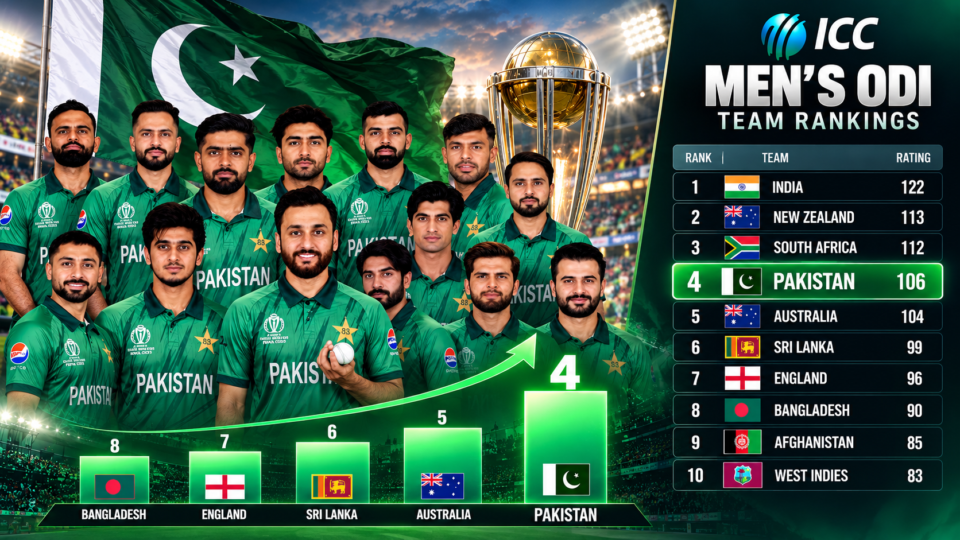
Pakistan has moved up to fourth position in the latest ICC Men’s One Day International (ODI) team rankings, overtaking Australia following consecutive victories against Sri Lanka and England in the ongoing ODI tri-series at Rawalpindi Cricket Stadium. The improvement marks an encouraging moment for Pakistan cricket as the team builds momentum in the 50-over format. Pakistan now has 103 rating points, placing it just one point behind third-ranked South Africa, while Australia has slipped to fifth position with 102 points.
The rise follows Pakistan’s impressive 87-run victory over England on October 20, 2026. The national team produced a strong all-round performance, recovering from a challenging position during its innings before delivering an effective bowling display to dismiss England for 215 runs. The result strengthened Pakistan’s position in the rankings and increased confidence ahead of the remaining matches in the tri-series.
Pakistan Climbs to Fourth in ICC ODI Rankings
Pakistan’s move into fourth place reflects the impact of its recent performances in international cricket. According to the latest reported rankings, India leads the table with 115 rating points, followed by New Zealand with 109. South Africa occupies third position with 104 points, while Pakistan has climbed to fourth with 103 points. Australia follows closely behind in fifth place with 102 points.
The narrow gap between the teams makes the rankings particularly competitive. Pakistan is only one point behind South Africa and one point ahead of Australia, meaning subsequent results could influence the order of the leading teams. Maintaining consistent performances will be important if Pakistan wants to strengthen its position and move closer to the top three.
The rankings are calculated using a team’s results over a defined period, with the strength and consistency of performances influencing its rating. As a result, winning important matches can improve a team’s standing, although changes also depend on the results and rating calculations of other teams.
For Pakistan, the latest improvement provides a positive indication of its progress in ODI cricket. The team will now aim to continue winning matches and demonstrate that its recent results reflect sustained performance rather than a temporary rise.
Arafat Minhas Leads Pakistan to Victory Over England
All-rounder Arafat Minhas delivered a standout performance in Pakistan’s 87-run victory over England. He scored 59 runs from 58 deliveries before producing career-best bowling figures of six wickets for 40 runs. His contributions with both bat and ball played a decisive role in helping Pakistan secure the win.
Minhas provided valuable runs when Pakistan needed to recover from a difficult position and then helped dismantle England’s batting line-up. His performance demonstrated the value of all-round contributions, particularly in a match where Pakistan needed players to deliver under pressure in both innings.
With the ball, Minhas claimed important wickets and disrupted England’s attempt to chase the target. His dismissal of Will Jacks and Adil Rashid in successive deliveries added further pressure on the visitors. He also contributed to the dismissal of Gus Atkinson through a run-out, completing an impressive overall performance.
The match was an important opportunity for Pakistan’s players to demonstrate their ability to respond to challenging situations. Minhas’s performance stood out because it combined meaningful batting contributions with a decisive bowling display.
Hasan Nawaz Anchors Pakistan’s Batting Innings
Pakistan’s batting performance was another key factor in the victory. Hasan Nawaz top-scored with 79 runs from 74 deliveries, helping the team build a competitive total after losing several wickets during the innings.
Pakistan experienced difficulties early on and found itself at 81 for four. The position placed pressure on the remaining batters to rebuild the innings and ensure the team posted a total that could challenge England. Hasan Nawaz’s contribution helped stabilise the batting effort and provided a foundation for the lower order to add important runs.
Saad Baig also made a valuable contribution, scoring 35 runs. His innings helped Pakistan maintain progress during a crucial phase of the match. Faheem Ashraf then supplied a late boost with a quickfire 39 from 26 deliveries, adding valuable runs towards the end of the innings.
Together, these contributions helped Pakistan reach 302 for nine in its allotted overs. Recovering from 81 for four to post more than 300 runs showed the importance of partnerships, patience, and timely acceleration in ODI cricket.
The total gave Pakistan a challenging target to defend and allowed the bowling attack to put England under sustained pressure during the chase.
Pakistan’s Bowlers Restrict England to 215 Runs
England struggled to keep pace with Pakistan’s target and was eventually dismissed for 215 runs. Despite contributions from Tom Banton, who scored 57, and Ben Duckett, who added 45, England could not build the partnerships needed to remain in contention.
Pakistan’s bowlers maintained pressure through key phases of the innings, taking wickets that prevented England from establishing control of the chase. Minhas was the leading performer, claiming six wickets for 40 runs and repeatedly breaking England’s batting momentum.
The visitors needed a strong and sustained batting effort to chase 303, but the loss of wickets made the task increasingly difficult. Pakistan capitalised on the pressure and completed a convincing victory by 87 runs.
The result highlighted the importance of balanced team performance in the ODI format. A competitive total, timely contributions from several batters, and an effective bowling attack combined to give Pakistan control of the match.
For the national side, such performances can provide confidence as it continues to compete against strong international opponents.
Australia Slips to Fifth Position
Australia’s move to fifth place is one of the notable changes in the latest rankings. The team has a long record of success in international cricket and remains a major competitor in the ODI format. However, rankings reflect results and ratings across the applicable period rather than reputation or historical achievements alone.
Pakistan’s rise to fourth has come at Australia’s expense in the table, with the two teams separated by just one rating point. This close margin means the positions could change again as further matches are played and the rankings are recalculated.
For Pakistan, overtaking Australia is an encouraging development because it places the team ahead of one of the strongest sides in international cricket. However, remaining above Australia will require consistent results and continued improvement in batting, bowling, and fielding.
The latest rankings also underline the competitive nature of international ODI cricket, where small differences in rating points can determine the order of teams near the top of the table.
India and New Zealand Continue to Lead the Rankings
India remains at the top of the ICC Men’s ODI team rankings with 115 rating points. New Zealand holds second position with 109 points, while South Africa occupies third place with 104 points.
Pakistan’s 103 points put it within striking distance of South Africa, creating an opportunity to move higher if the team continues to produce strong results. The one-point difference between Pakistan and South Africa means the contest for third position remains close, although future ranking movements will depend on the relevant results and rating calculations.
The leading positions demonstrate that maintaining a high ranking requires consistent performance across international matches. A successful run can help a team gain ground, but it must continue collecting positive results to remain competitive.
Pakistan’s immediate objective will be to build on its recent victories and convert the improved ranking into sustained progress in the format.
Importance of the ODI Tri-Series for Pakistan
The ongoing tri-series in Rawalpindi provides Pakistan with an opportunity to test its squad, build combinations, and gain valuable match experience. Competing against Sri Lanka and England gives the team a chance to assess its strengths and identify areas that need improvement.
Recent victories have provided momentum, but the remaining matches will be important in determining how effectively Pakistan can maintain its form. Consistency at the top of the batting order, stability in the middle order, and the ability of bowlers to take wickets at crucial moments will remain important factors.
The performances of emerging players can also strengthen the team’s options for future international assignments. Contributions from players such as Arafat Minhas, Hasan Nawaz, Saad Baig, and Faheem Ashraf demonstrate how different members of the squad can influence a match.
A successful tournament could provide additional confidence to the team and help establish combinations for upcoming ODI commitments. Nevertheless, the broader objective is to maintain strong performances beyond a single tournament.
What Pakistan Needs to Maintain Its Ranking
Pakistan’s latest rise is a positive development, but the close competition among the leading teams means the position cannot be taken for granted. To maintain or improve its ranking, Pakistan will need to produce consistent performances against a range of opponents.
A reliable batting approach will be important, particularly when the team loses early wickets. The recovery against England showed how middle-order and lower-order contributions can help Pakistan reach a competitive total even after a difficult start.
The bowling unit will also need to maintain discipline and take wickets at important moments. Minhas’s six-wicket performance demonstrated the impact a bowler can have when pressure is applied consistently. However, Pakistan will need contributions from the wider bowling group to avoid relying on individual performances alone.
Fielding, fitness, decision-making, and the ability to adapt to different match situations will also influence results. Strong teamwork across these areas can help the team turn promising performances into a more consistent record.
Pakistan’s immediate challenge is to sustain its current momentum while continuing to improve its overall performance in international ODI cricket.
Conclusion
Pakistan’s move to fourth position in the latest ICC Men’s ODI team rankings is an encouraging milestone for the national cricket team. Consecutive victories over Sri Lanka and England in the Rawalpindi tri-series have helped Pakistan overtake Australia, bringing it to 103 rating points and within one point of third-ranked South Africa.
The 87-run victory over England was particularly important, with Arafat Minhas delivering an outstanding all-round performance by scoring 59 runs and taking six wickets for 40. Hasan Nawaz’s 79, Saad Baig’s contribution, and Faheem Ashraf’s late scoring also helped Pakistan post a competitive total of 302 for nine.
Although the ranking improvement reflects recent success, the competition remains tight. Pakistan will need to maintain its form, strengthen its team combinations, and deliver consistent performances if it wants to hold fourth place and challenge the teams above it.
For Pakistan cricket supporters, the latest development offers a reason for optimism as the team looks to build momentum, develop its players, and establish a stronger position in international ODI cricket.


Join the Conversation
Share your thoughts, questions, or feedback below.