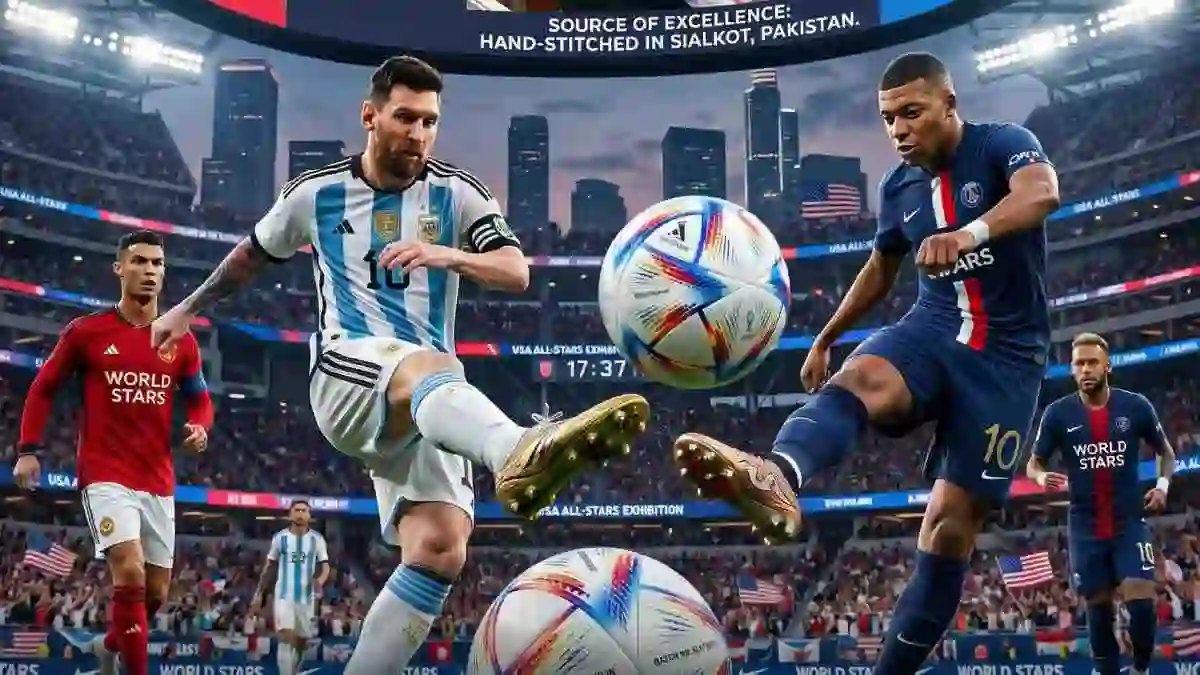
The biggest football tournament in history kicks off this month across the United States, Canada, and Mexico. Forty-eight teams will compete for the first time, making it the biggest FIFA World Cup ever. The expanded format increases the total schedule to 104 matches, up from the traditional 64-game model.
Pakistan is not one of those 48 teams. It has never qualified for the FIFA World Cup. But every single ball kicked in every single match was made there.
Pakistan Does Not Play at the World Cup. It Makes the Ball.
The tournament balls are made at the Forward Sports factory in Sialkot, Punjab, Pakistan, even though the country does not actually participate in the World Cup. Sialkot factories produce roughly 70% of the world’s premium soccer balls, supplying the elite equipment that dictates the pace of modern professional play.
The city — otherwise known as the football capital — hosts about 1,000 factories. Sialkot-based Forward Sports has been chosen to manufacture Trionda, the official match ball for the FIFA World Cup 2026. Adidas handled the ball’s design, while a manufacturing facility in Pakistan manages its production.
What Is the Trionda?
The Adidas Trionda is a football produced by Adidas and is the official match ball of the 2026 FIFA World Cup, hosted by Canada, Mexico, and the United States. It was introduced on October 2, 2025. The name ‘Trionda’ translates to ‘three waves’ in Spanish, symbolising the three host countries of the 2026 FIFA World Cup. The ball’s colour scheme and symbols are inspired by the iconography of the three nations — red with a maple leaf for Canada, green with a golden eagle’s head for Mexico, and blue with a five-pointed star for the United States.
The ball is thermally bonded together from just four panels, the smallest number yet for a FIFA World Cup ball. Its surface is textured with debossed macro and micro patterns meant to improve the ball’s flight stability, swerve and grip in wet conditions. The ball also features “connected ball technology,” a side-mounted inertial measurement unit (IMU) chip inside one of the four panels to provide the video assistant referee (VAR) with highly accurate ball movement data within seconds.
The sensor captures data 500 times per second, recording critical information such as the exact point of contact, ball speed, spin rate, trajectory, and direction of movement. To keep the technology running throughout matches, the ball must be charged before every game. Reports suggest the battery can last up to six hours on a full charge, comfortably covering warm-ups and match time.
Read more: Pakistan unveils probables for AFC Asian Cup 2027 qualifier against Syria
Inside the Forward Sports Factory
Forward Sports is a Pakistani multi-national company based in Sialkot, Punjab, specializing in the manufacture of sports equipment, primarily soccer balls. The company produces balls for prominent brands including Adidas. Founded in 1991 by Khawaja Masood Akhtar, Forward Sports began its partnership with Adidas in 1994.
The company initially operated with a small workforce of around 50 employees amid intense market competition in the football manufacturing sector. Today, it is a different story. As the world’s largest football manufacturer, Forward Sports combines three decades of expertise with cutting-edge technology to produce over 20 million footballs annually. The company ensures flawless quality through advanced artificial intelligence and computer vision.
Forward Sports proudly employs 1,364 female workers, reflecting a strong commitment to women’s empowerment, with a 94.6% retention rate. Khawaja Masud Akhtar was awarded the Sitara-i-Imtiaz on 23 March 2019 and the Hilal-i-Imtiaz on 23 March 2023 — two of Pakistan’s highest civilian honours — for his contribution to the sports manufacturing industry.
44 Years: From Tango to Trionda
The stitching and artisan skills of the employees were so good that, for the first time, in 1982, the city of Sialkot was awarded a contract to manufacture footballs for the FIFA World Cup. Saga Sports (then known as Sandal Sports) produced the iconic Tango España football. This marked the first time a Pakistani manufacturer had ever delivered on such a global scale.
That was 44 years ago. The craft has never left the city. Sialkot’s industrial relationship with Adidas and FIFA tournaments spans more than four decades. Here is the timeline:
- 1982 (Tango España): Marked the early expansion of Sialkot-sourced hand-stitched balls onto football’s grandest international stage.
- 2014 (Brazuca): Forward Sports stepped in to manufacture the official match ball for the tournament in Brazil.
- 2018 (Telstar 18): Sialkot factories produced the structurally revamped tournament ball used across Russia.
- 2022 (Al Rihla): Sialkot fabricated the match balls deployed in Qatar, introducing an internal suspension system to support real-time VAR tracking data.
- 2026 (Trionda): The latest milestone confirms Sialkot will produce the official match balls for the expanded 48-team tournament.
The Workers Behind the Ball
The Trionda’s story is not only about innovation. It is about the hands that build it. There are around 2,000 soccer ball industries in Sialkot, a district with a population of about two million. There are over 60,000 regular workers, while the number of daily wage workers fluctuates with demand. The sports goods industry connects roughly 8% of the city’s population, making football production a vital part of the local economy. Sialkot exports over 43 million balls worth $191 million in a single year.
Yet wage concerns persist. Factory workers producing the Trionda barely earn GBP 26 a week, while the ball retails at approximately GBP 130. Trade unionist Asif Khan of the Pakistan Workers Federation said that while poor business practices had decreased, his union would continue to fight for fairer, better wages. An Adidas spokesperson said that factory conditions are “fair and safe” and that the company carries out over 1,000 on-site inspections in the last 12 months.
Read more: New industrial estate will be developed on 400 acres of land near Sialkot International Airport
A Legacy That Keeps Rolling
With over 5 billion viewers worldwide, even the smallest contributions are magnified on an international scale. For Pakistan, this is not a small contribution. It is the most consistent one in World Cup history. The “Made in Pakistan” stamp on the Adidas Trionda reflects a deep history of craftsmanship, industrial adaptation, and engineering excellence. Pakistan may not have a team on the pitch this summer. But the ball that decides every goal, every penalty, every moment of glory — that ball was made in Sialkot.
It has been for 44 straight years. Name a better flex.
Frequently Asked Questions (FAQs)
What is the official ball for the FIFA World Cup 2026?
The official match ball for the 2026 FIFA World Cup is named “Trionda.” The name translates to “three waves” in Spanish, honoring the three host nations: the US, Canada, and Mexico.
Where is the Trionda World Cup ball made?
The Trionda ball is manufactured in Sialkot, Pakistan. It is produced by Forward Sports, a company that has partnered with Adidas to make World Cup balls for over a decade.
Why does the 2026 World Cup ball need to be charged?
The Trionda features a built-in 500 Hz motion sensor chip. This technology provides real-time movement data to the VAR system, meaning the ball must be charged before each match to power the sensor.
How long has Sialkot been making World Cup footballs?
Sialkot has been a part of the FIFA World Cup manufacturing process since 1982. This marks a 44-year legacy of providing world-class footballs for the global tournament.