
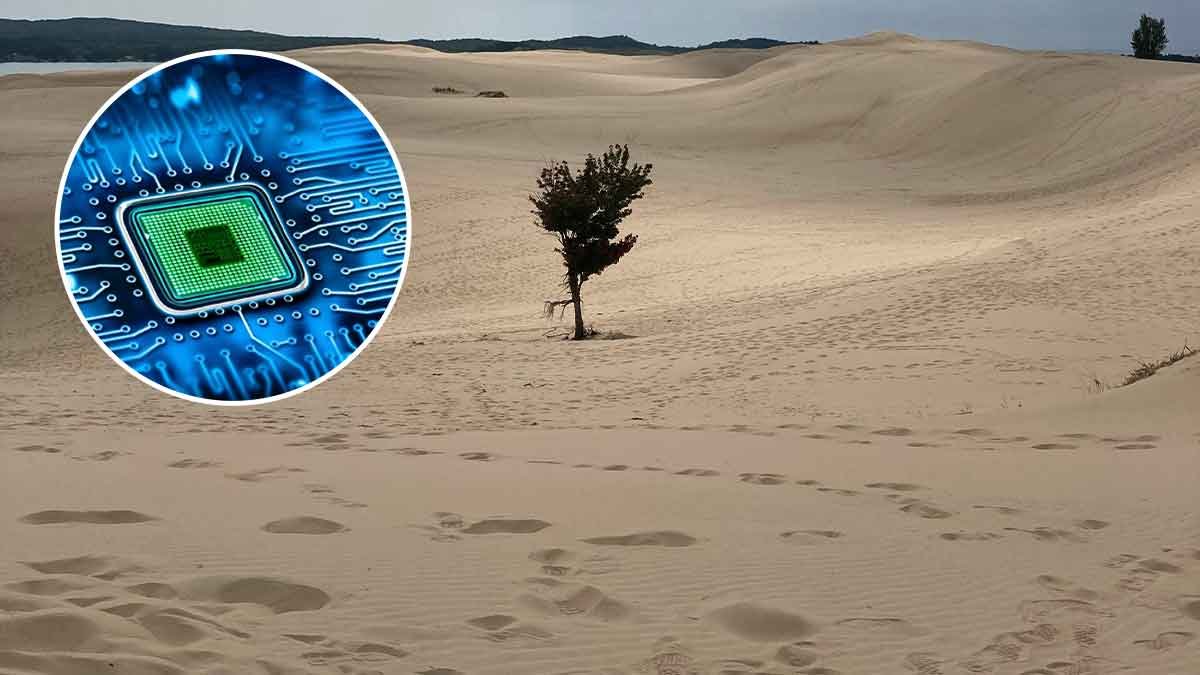
Pakistan’s vast Thar Desert could hold the key to the country’s entry into the global semiconductor industry. The Sindh Department of Information Technology and experts declared Thar sand as the most suitable for making computer chips. The ambitious proposal envisions a $450 million chip wafer foundry in the heart of the desert — a plan that could position Pakistan among nations competing for a share of the booming semiconductor market.
But turning desert sand into silicon chips demands far more than raw material. It requires billions in investment, cutting-edge technology, and a workforce Pakistan has yet to build.
Why Thar Sand Suits Chip Manufacturing
Silicon — the base material of every computer processor — comes from sand. The base ingredient of any processor, silicon, is extracted from desert sand. This material is found abundantly in the earth’s crust and consists of around 25% to 50% silicon dioxide.
Experts said that they need coal, sand, water, and electricity to make chip wafers, and the availability of such ingredients in Thar could appear beneficial. Thar’s silica-rich sand, combined with its coal reserves for power generation and available water sources, creates a rare convergence of resources in one location.
The Thar Desert holds vast reserves of silica sand, primarily used in glass manufacturing and construction. Pakistan also has significant silica deposits in Chiniot, Mianwali, Dera Ghazi Khan, and Thatta. Pakistani silica sand is a high-purity, naturally sourced sand with a silicon dioxide (SiO2) content of 95-98%.
The $450 Million Chip Wafer Foundry Proposal
The provincial IT department has submitted plans for producing silicon chip wafer foundry to the federal and Sindh governments. The estimated cost of the plan is $450 million, and it is expected that the plan will be added to the China-Pakistan Economic Corridor (CPEC) programme.
Read more: 105km Rail Link to Connect Thar Coal Mines with Port Qasim Nears Completion Ahead of July 2026
The district of Islam Kot in Tharparkar has been marked as the epicenter of this groundbreaking initiative, with 150 acres of land designated for the project’s development. Additionally, the project is set to meet its electricity demand of 250 megawatts from Thar itself.
However, as of early 2026, no federal approval or CPEC inclusion has been officially confirmed. The project remains at the preliminary paperwork stage, with documentation submitted to relevant ministries for review.
How Sand Becomes a Silicon Chip
The journey from sand to processor involves extraordinary precision. Silicon is processed to separate it from all other materials in the sand. The processing repeats several times until the manufacturer creates a 99.9999% pure sample. The purified silicon is then poured to form a cylindrical electronic-grade ingot. The cylinder’s diameter is 300mm and weighs about 100kg. The manufacturer then slices the ingot into 925-micrometer-thin wafers.
These wafers then undergo photolithography, material deposition, and etching to create billions of transistors. Processor manufacturing takes two and a half to three months of 24/7 processes. The entire production chain requires over 300 individual steps and some of the most controlled manufacturing environments on Earth.
Pakistan’s Semiconductor History
Pakistan’s semiconductor ambitions are not new. The National Institute of Silicon Technology (NIST) was established that produced Silicon Wafers from local sand. Pakistan was the first country in Asia to produce the base material for Semiconductors.
However, political instability derailed progress. In May 2021 NIST was merged with Pakistan Council for Appropriate Technology (PCAT) to create PCRET, which was finally shut down to be merged with PCSIR. The Strategic Plans Division (SPD) did manage to set up a Semiconductor Fab in Hassan Abdal which was shut down as there was no sustainable business plan.
Pakistan has the advantage of high-grade Silica Sand, Silicon Wafer Pullers, and qualified experts both home and abroad. Islamabad has an archive of plans; the challenge is in their implementation.
SIFC Strategy and IC Design-First Approach
The Special Investment Facilitation Council has revived Pakistan’s semiconductor ambitions. The proposal of a government-to-business (G2B) chip designing facility and development of the semiconductor industry was floated in the SIFC. It was suggested that Pakistan would have to start from testing and research and then develop the semiconductor industry.
Government officials have clarified that full-scale manufacturing is a long-term goal. “We want to export our IC design services to the world at the first stage to earn foreign exchange and create more job opportunities for the youth.” Pakistan was not planning IC manufacturing at this stage since this was a “resource extensive” task.
Three major companies — DreamBig, Nunami, and Xcelerium — have recently opened their design centers in Pakistan to export services. On the manufacturing side, South Asia Semiconductor Limited (SAS), a private startup, received its first silicon wafer in October 2025 and aims to build Pakistan’s first legacy chip fab targeting 90nm to 28nm nodes.
Global Market Context
Pakistan’s ambitions come at a time of unprecedented global semiconductor expansion. The semiconductor wafer market has witnessed substantial growth, expanding from $17.48 billion in 2025 to a projected $18.42 billion in 2026. The market is expected to reach $22.88 billion by 2030.
India’s Semiconductor Mission approved four additional fabs in 2025, including a wafer fab in Odisha. This makes India a direct regional competitor. Globally, nations are racing to secure semiconductor self-sufficiency, driven by AI demand and geopolitical tensions between the US and China.
Key Challenges Ahead
The road from Thar sand to silicon chips is long and uncertain. Estimates suggest that the setting up of a foundry for semiconductor manufacturing requires an investment of around $6-7 billion. Apart from capital, Pakistan has a scarcity of trained human resources as well.
“The designing and testing are cost effective processes and Pakistan can make a difference with a little initial investment of around $250 million.” IC manufacturing is a resource extensive job, so Pakistan could enter into it at a later stage.
Pakistan also faces chronic challenges in ease of doing business, energy reliability, and political continuity — all factors that have derailed previous semiconductor initiatives.
What Comes Next
The Thar Chip Wafer Foundry proposal represents a bold vision. But history shows Pakistan needs more than plans — it needs sustained execution. The SIFC’s IC design-first strategy offers a pragmatic starting point. If Pakistan can build a credible chip design export industry, it could attract the foreign investment needed to eventually build the manufacturing infrastructure that the Thar foundry plan envisions.
The sand is there. The question is whether the political will and institutional capacity can match the ambition.




Join the Conversation
Share your thoughts, questions, or feedback below.