
In 1947, a family that had run a leather business in Calcutta crossed the border into the newly created Pakistan. Four years later, they set up a textile mill in Lahore with a license the government handed them — a license pre-stamped with a name they hadn’t chosen.
That name was Nishat.
Nishat Group’s origins trace to a leather business in Calcutta established by Mian Muhammad Yahya. Following partition, Mian Muhammad Yahya and his three brothers — Mian Hameed, Mian Rafiq and Mian Ayub — founded Nishat Mills in Pakistan in 1951. The name “Nishat” was pre-assigned to the textile licence they acquired and was not chosen by the founders.
Seventy-five years later, the company that started as a single textile mill is Pakistan’s most diversified private sector conglomerate — operating across textiles, banking, cement, power generation, insurance, hospitality, dairy, automotive, paper, and aviation. At least eleven of Nishat Group’s subsidiaries are listed on the Pakistan Stock Exchange. Its chairman Mian Muhammad Mansha sits on the boards of 45 companies and is widely regarded as the most influential and wealthiest person in Pakistan. The group employs around 60,000 people — making it the largest private sector employer in the country.
This is the story of how a textile licence became a $28 billion empire — and who owns what inside it.
The Man Who Built It: Mian Muhammad Mansha
No story of Nishat Group can be told without understanding the man who transformed it from a family textile business into a national economic institution.
Mian Muhammad Mansha was born in Chiniot into a Chinioti Sheikh business family. His family had migrated to Kolkata in the 1930s from Punjab, and returned after partition. He completed early schooling at Sacred Heart Convent in Faisalabad before attending Hendon College in London, earning a degree in business administration.
Mansha moved back to Pakistan after completing his studies in 1968 and joined the family business — Nishat Mills Limited — in 1969 when his father died. In 1979, he set up Pakistan’s largest textile complex of seven factories in Nishatabad near Faisalabad, followed by another complex in Chunian near Lahore.
The defining chapter came in the 1990s, when Pakistan’s privatisation wave opened doors that would otherwise never have opened.
Mansha’s conglomerate greatly benefited from the privatisation drive of the 1990s. Through this period he made a number of acquisitions and buy-outs, including engineering at least one hostile takeover. When the dust settled, Mansha had acquired a controlling position in Adamjee Group — the country’s largest non-life insurer — and D.G. Khan Cement, previously owned by the Saigol family. But all these achievements, perhaps, play third fiddle to his master-stroke: the acquisition of MCB Bank Limited, one of Pakistan’s most profitable banks.
In March 2010, Mansha became the first Pakistani to appear on the Forbes billionaires list. He was worth $2.5 billion in 2013. Today, the Nishat Group has an asset base of $28 billion.
By 2015, Mansha had paid a total tax of Rs100 billion — the highest tax ever paid by an individual in Pakistan’s history.
Sector 1 — Textiles: The Foundation That Never Stopped Growing
Textiles is where Nishat began, and it remains the group’s identity even as the empire expanded into a dozen other directions.
Nishat Mills Limited is the flagship company of Nishat Group. It is one of the most modern and largest vertically integrated textile companies in Pakistan, with 303,048 spindles, 959 Toyota air jet looms, the most modern dyeing and processing units, two stitching units for home textile, one stitching unit for garments and power generation facilities with a capacity of 120 MW.
Nishat Mills operates across seven segments — Spinning, Weaving, Dyeing, Denim, Workwear, Home Textile and Terry, and Garments. It derives the majority of revenue from Spinning. Geographically, it operates in Europe, America, Asia, Africa and Australia, as well as Pakistan. As of December 2025, Nishat Mills had trailing 12-month revenue of $711 million.
In January 2023, Nishat acquired Wernerfelt A/S, a company based in Denmark, further extending its international textile footprint. In September 2024, Nishat sold its shareholding in Nishat Hospitality and established subsidiaries in the United Kingdom and Turkey, opening liaison offices to support its export operations.
Under the textiles umbrella sits one of Pakistan’s best-known retail brands.
Nishat Linen was founded in 1989 by Naz Mansha, the wife of Mian Muhammad Mansha. Today it is one of Pakistan’s largest home textile brands, offering fabrics, ready-made garments and home décor items. Nishat Linen operates in Pakistan and internationally, with retail stores and franchises in the UAE, USA, Bangladesh and the United Kingdom. It also operates franchises of Inglot Cosmetics and Swarovski in Pakistan.
Sector 2 — Banking: The Crown Jewel
If textiles is Nishat’s foundation, MCB Bank is its crown jewel — the single most consequential acquisition in Pakistan’s corporate history.
Muslim Commercial Bank is one of the leading banks with a deposit base of approximately Rs230 billion. With more than 1,200 branches nationwide, MCB is the largest private bank of Pakistan, also operating internationally. Since its acquisition, the management has improved its financial performance and it is now one of the most profitable banks in the country. MCB was also the first Pakistani bank to be listed on the London Stock Exchange in October 2006, after attracting $700 million worth of demand for its $150 million GDR issue.
MCB Bank started a partnership with Maybank of Malaysia, with Maybank now holding a 25% share — one of the most significant foreign investments in Pakistan’s banking sector. Mansha had aspirations of acquiring an established bank in Indonesia and possibly in the Middle East, with $700 million in cash from MCB and another $300 million raised from international markets.
MCB’s consistent profitability across economic cycles — from the 2008 financial crisis through Pakistan’s IMF programmes and the current energy shock — reflects the strength of its management and the quality of its loan book. It is the single asset that has funded Nishat Group’s expansion into every other sector it has entered.
Sector 3 — Cement: Pakistan’s Largest Producer
D.G. Khan Cement Company, part of the Nishat Group, is Pakistan’s largest cement manufacturing unit, producing 14,000 tonnes of cement per day. There are three other plants located in Balochistan, Chakwal and Khairpur, with total revenue of Rs41 billion.
DG Cement is not just a building materials company. It is a strategic asset that benefits from every infrastructure project in Pakistan — from CPEC highways to housing schemes to dam construction. As Pakistan’s building activity has expanded, DG Cement has captured the largest share of that growth.
The group also holds interests in Maple Leaf Cement, extending its footprint across Pakistan’s cement market from a second platform with different geographic coverage.
Read more: Nishat Group Acquires Rafhan Maize in Massive Rs 100 Billion Deal
Sector 4 — Power Generation: Selling Electricity to the Grid
Nishat identified power generation as a growth opportunity before most Pakistani industrialists did — and built it into one of the group’s most reliable revenue streams.
Under a power purchase agreement signed with NTDC in 2007, Nishat Power received a tariff of 12.1253 US cents per kilowatt-hour for twenty-five years. The original PPA was signed by the Government of Pakistan with sovereign guarantee, offering a 15 percent return on equity with US dollar indexation. In August 2020, the PPA was revised by the government and US dollar indexation was removed.
The group operates multiple power generation companies including Nishat Power Limited, Nishat Chunian Power Limited, Lalpir Power Limited and Pakgen Power Limited. In July 2025, Nishat Power Limited announced an investment of up to Rs2.5 billion in NexGen Auto Private Limited to support the assembly and localisation of Chery electric vehicles in Pakistan, with plans for production beginning in late 2025 under the Omoda and Jaecoo brands.
Sector 5 — Insurance: Pakistan’s Largest Non-Life Insurer
Mansha acquired a controlling position in Adamjee Group — the country’s largest non-life insurer — through a hostile takeover during the privatisation era.
Adamjee Insurance gives Nishat Group exposure to Pakistan’s growing insurance market through a dominant market-leading position across corporate, industrial, automotive and property insurance. It operates alongside MCB to offer integrated financial services — a bank and an insurer owned by the same group serving the same corporate and retail clients.
Sector 6 — Hospitality: From Lahore to London
Nishat Group owns Nishat Emporium in Lahore — a combined shopping mall and five-star hotel — as well as the St James’s Hotel and Club in London, acquired for £60 million. The hotel is located at Park Place in London and provides catering services and club membership to thousands of clients including officials and business figures.
The group’s aviation division operates through Pakistan Aviators and Aviation Private Limited, established in 1993 and based at Allama Iqbal International Airport in Lahore. The company holds a Civil Aviation Authority licence and provides private jet charters, aerial surveying and related aviation services.
The Nishat Emporium in Lahore — a landmark commercial development on Lahore’s MM Alam Road — integrates luxury retail with a five-star hotel in one of the city’s most commercially active corridors, generating rental and hospitality revenue simultaneously.
Sector 7 — Dairy and Agriculture: Five Farms, 80,000 Litres a Day
Nishat’s dairy operations are among the least-known but most operationally impressive parts of the group’s portfolio.
The dairy operations are supported by Nishat Group’s broader agricultural footprint, encompassing five farms spanning 1,500 acres across Punjab, providing integrated supply for milk production. The Sukheki farm alone maintains a herd of around 5,900 cows, with a milking capacity for 4,500 animals and a daily output of approximately 80,000 litres of premium milk. The collaboration with Turkish dairy company SÜTAŞ leverages Turkish expertise in ultra-high temperature processing to ensure product quality and shelf life suitable for local distribution.
This is not hobby farming. It is industrial-scale dairy production meeting Pakistan’s growing middle-class demand for branded, quality-verified milk products — managed with the same operational rigour Nishat applies to its cement and textile factories.
Sector 8 — Food Processing: The Rafhan Maize Acquisition
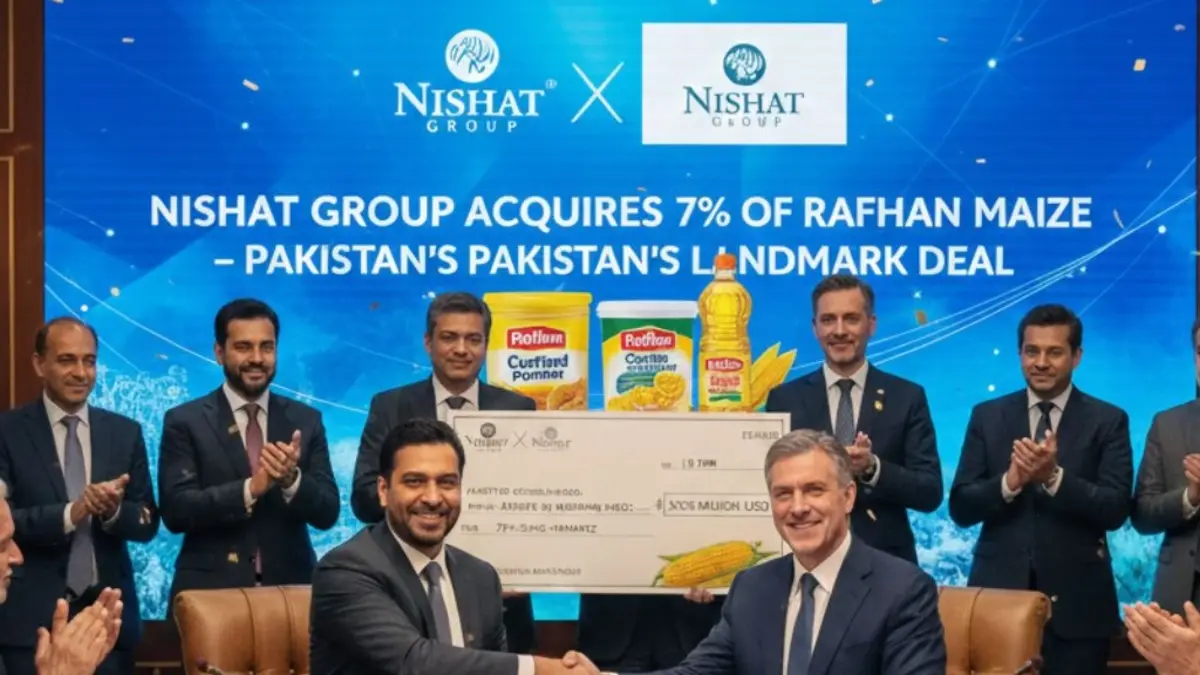
The group’s most significant recent move is its acquisition of Rafhan Maize Products — a deal that marks Nishat’s formal entry into Pakistan’s food ingredients industry.
The proposed acquirers — including Nishat Hotels and Properties Limited, D.G. Khan Cement, Nishat Mills, Nishat Power, Nishat Chunian Power, Lalpir Power, Pakgen Power and members of the Mansha family including Naz, Raza, Umer and Hassan Mansha acting in concert — intend to acquire control and up to 75.69% of Rafhan Maize Products’ voting shares.
Rafhan Maize Products started as a corn refining industry in 1953 and has grown into one of Pakistan’s largest agro-based industries, producing food ingredients and industrial products using maize as the basic raw material. The acquisition enables potential integration of corn-based ingredients such as starches and glucose into dairy formulations, while diversifying revenue streams beyond services into consumer products and leveraging the group’s distribution networks.
This deal also shows how Nishat structures its acquisitions — the buying consortium includes entities from across the group, pooling balance sheet strength across subsidiaries to finance strategic moves that no single subsidiary could execute alone.
Read more: Hyundai Nishat starts exporting locally assembled Santa Fe Hybrid to Sri Lanka
Sector 9 — Automotive: Pakistan’s Electric Vehicle Future
The group’s newest and most forward-looking sector entry is electric vehicles — and it is moving fast.
NexGen Auto, a subsidiary of Nishat Group, has partnered with China’s Chery Group to introduce iCAUR branded New Energy Vehicles in Pakistan. NexGen currently assembles the Jaecoo J7 PHEV and Jaecoo J5 HEV in Pakistan. The iCAUR brand expands this partnership into a new lineup of boxy, rugged SUV designs powered by pure electric and range-extended electric powertrains.
NexGen Auto has rapidly scaled operations, with early EV production starting ahead of schedule in late 2025. Its assembly plant is expected to produce thousands of units annually, supporting Pakistan’s shift toward electric and hybrid vehicles.
iCAUR is a Chery subsidiary established as an electric-vehicle brand in April 2023. The brand’s identity is built around new energy vehicles — boxy, rugged SUVs powered by pure electric or range-extended electric powertrains. The brand is called iCar in China but marketed as iCAUR overseas due to trademark issues.
NexGen Auto, incorporated in August 2024, has a total project cost estimated at Rs14.7 billion, to be funded through a mix of debt and equity. Nishat Power Limited committed an investment of up to Rs2.5 billion in the venture.
The entry into EVs is strategically coherent in a way that might not be obvious at first glance. A group that already generates and sells electricity, owns a bank to finance vehicle purchases, and operates an insurance company to insure those vehicles is not just assembling cars — it is building an integrated mobility ecosystem.
Sector 10 — Paper Products and Beyond
Nishat Paper Products rounds out the group’s manufacturing portfolio, providing industrial paper products for packaging and commercial use — a sector that benefits from growth in the group’s own consumer brands as well as broader economic activity.
The group also maintains an automobile leasing company in Kazakhstan — an early international financial services footprint that reflects Mansha’s stated ambitions to expand into regional markets beyond Pakistan.
The Family Structure: Interlocking Boards, Next-Generation Leadership
The family-centric model underscores a deliberate emphasis on succession planning, with the next generation actively integrated into operational and strategic roles since the early 2010s. Family involvement extends through interlocking directorships spanning more than 20 entities within the Nishat Group and its affiliates, enabling coordinated decision-making and resource allocation across sectors like power generation, insurance and aviation.
Mansha’s wife Naz Mansha — daughter of Yusuf Saigol, a union that connected two of Pakistan’s most prominent industrial families — founded and continues to supervise Nishat Linen’s operations. Sons Raza, Umer and Hassan Mansha hold positions across subsidiary boards. The structure reinforces control while facilitating diversification, as evidenced by the sons’ overlapping board positions in subsidiaries like Pakgen Power Limited and Nishat Hotels.
This interlocking structure also provides the financial firepower for acquisitions like Rafhan Maize — where multiple Nishat entities pool their balance sheets to collectively finance strategic moves.
What Nishat Means for Pakistan
At $28 billion in assets, 60,000 employees, 11 listed companies and operations in textiles, banking, cement, power, insurance, hospitality, dairy, automotive, food processing, paper and aviation — Nishat Group is not just Pakistan’s most diversified business empire. It is a lens through which Pakistan’s own economic history can be read.
The group’s total asset base is over $5 billion with strong presence in the three most important business sectors of the region — textiles, cement and financial services — and is ranked among the top five business houses of Pakistan.
Every major chapter of Pakistan’s economic story shows up in Nishat’s timeline. Partition — the family crosses the border and starts a textile mill. Nationalisation under Bhutto — Nishat’s banking assets are absorbed by the state. Privatisation under Nawaz Sharif — Nishat acquires a bank, a cement company and an insurer in five years. CPEC — Nishat enters the automotive sector through Chinese EV partnerships. The energy transition — Nishat Power and NexGen Auto position the group on Pakistan’s electric future.
The group is now 75 years old. The name it carries was assigned by a government licence. The empire built under that name was assembled by one man’s decisions across 55 years of Pakistani history.
It is, by almost any measure, the most consequential business legacy the country has produced.
Frequently Asked Questions (FAQs)
Q: Who owns Nishat Group and who runs it?
Nishat Group is owned and chaired by Mian Muhammad Mansha, one of Pakistan’s wealthiest individuals and the first Pakistani to appear on Forbes’ global billionaires list. His family — including wife Naz Mansha and sons Raza, Umer and Hassan — hold board positions across more than 20 group entities. Mansha sits on the boards of 45 companies and has paid the highest cumulative tax of any individual in Pakistan’s history.
Q: How many companies does Nishat Group own?
Nishat Group comprises over 45 entities, with at least 11 subsidiaries listed on the Pakistan Stock Exchange. Major listed companies include Nishat Mills, MCB Bank, D.G. Khan Cement, Nishat Power, Nishat Chunian Power, Lalpir Power, Pakgen Power and Adamjee Insurance. The group also holds unlisted entities in dairy, aviation, hospitality and automotive.
Q: What is Nishat Group’s total asset value?
Nishat Group’s total asset base is estimated at $28 billion, making it one of the five largest business groups in Pakistan. The group employs approximately 60,000 people across its subsidiaries, making it the largest private sector employer in the country.
Q: What is the most profitable part of Nishat Group?
MCB Bank is widely regarded as the group’s most profitable asset. It is one of Pakistan’s top four banks by market capitalisation, operates over 1,200 branches nationwide, has a Malaysian strategic partner in Maybank, and has consistently delivered among the highest returns on equity in Pakistan’s banking sector over the past two decades.
Q: How is Nishat Group entering the electric vehicle sector?
Through its subsidiary NexGen Auto, incorporated in August 2024 with a total project investment of Rs14.7 billion, Nishat has partnered with China’s Chery Group to assemble and sell Jaecoo and Omoda hybrid and electric vehicles in Pakistan. Most recently, it announced the introduction of the iCAUR brand — a range of rugged electric and range-extended SUVs — marking Nishat’s most ambitious push yet into Pakistan’s EV transition.
Q: What is the Rafhan Maize acquisition and why does it matter?
In late 2025, Nishat Group entities and family members announced a firm intention to acquire up to 75.69% of Rafhan Maize Products — one of Pakistan’s oldest and largest agro-processing companies, founded in 1953. The deal allows Nishat to integrate corn-based food ingredients into its dairy and hospitality operations, diversify revenue into consumer products, and leverage the group’s existing distribution networks. It is the most significant food sector acquisition in Pakistani corporate history.

Join the Conversation
Share your thoughts, questions, or feedback below.