
On a Monday night television programme in Islamabad, Pakistan’s Defence Minister Khawaja Asif made a statement that analysts across three continents immediately began dissecting.
“If Qatar and Turkey also join this existing agreement, it will be a welcome development,” Asif said, referring to the Strategic Mutual Defence Agreement Pakistan signed with Saudi Arabia in September 2025. He said the initiative aimed to build a broader platform of cooperation among “like-minded” states to strengthen regional stability and collective security.
Pakistan has indicated that Turkey and Qatar may join the nuclear-armed nation’s mutual defence cooperation pact with Saudi Arabia as the US-Iran war reshapes security alignment in the Middle East and South Asia. The arrangement is currently in the process of being finalised.
What began as a bilateral defence pact between two Muslim-majority states eleven months ago is now moving toward something considerably larger — and considerably more consequential for the global security order.
The Foundation: What the Saudi-Pakistan Pact Actually Says
To understand where this is going, you must first understand what has already been built.
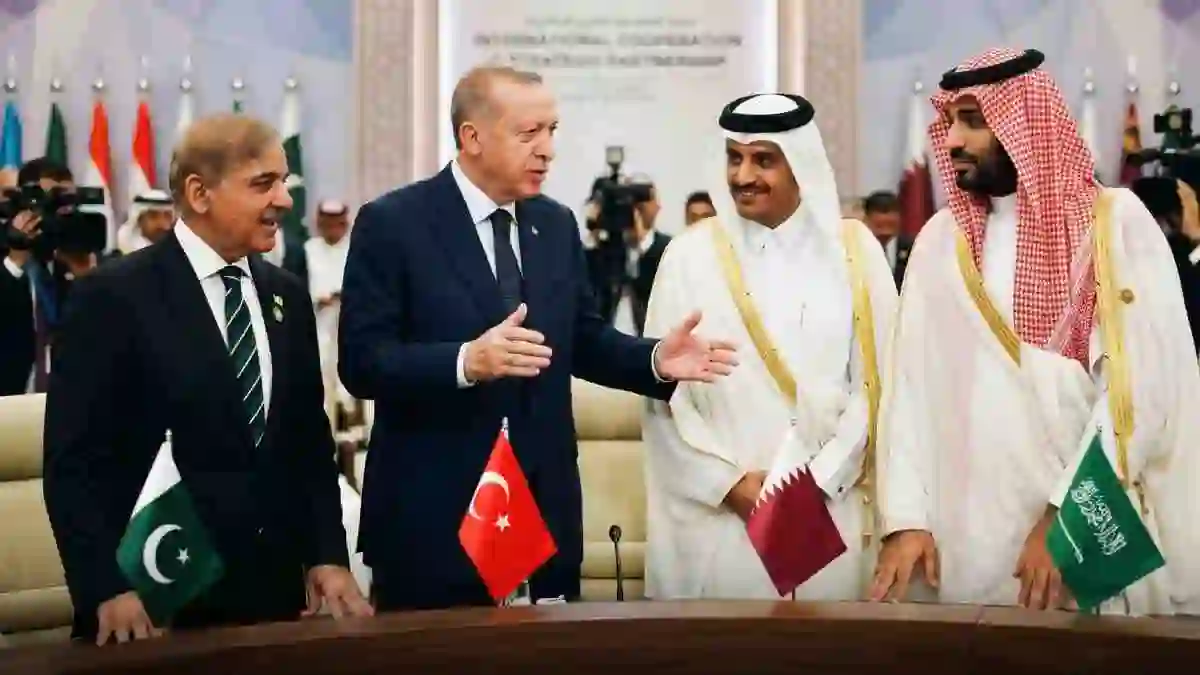
The Strategic Mutual Defence Agreement was signed on 17 September 2025 in Riyadh at Al-Yamamah Palace by Saudi Crown Prince and Prime Minister Mohammed bin Salman and Pakistani Prime Minister Shehbaz Sharif. It came against the backdrop of Israeli strikes on Qatar and followed the Arab-Islamic extraordinary summit in Doha.
The pact’s core clause mirrors NATO’s Article 5 almost exactly. The agreement states that “any aggression against either country shall be considered an aggression against both.” It is the first military pact between an Arab Gulf state and a nuclear power.
A senior Saudi security official stated: “We hope this will reinforce our deterrence — aggression against one is aggression against the other.” Pakistani Defence Minister Khawaja Asif initially hinted at the nuclear sharing aspect to the strategic agreement but later backtracked, denying such scope. This lack of clarity led to speculation, leaving the exact terms of the pact uncertain.
The ambiguity around Pakistan’s nuclear capabilities within this framework was not an oversight. It was calculated. Deterrence works precisely because adversaries cannot be certain where the line is.
The Financial Times reported that the September 9, 2025 Israeli airstrikes in Doha, Qatar deeply unsettled Gulf states’ sense of security, exacerbating long-standing concerns about United States unpredictability and commitment to their defence. The spillover of Israel’s operations in Gaza into the wider Middle East is widely seen as the defining factor in Saudi Arabia’s decision to sign a security pact with Pakistan.
The Qatar Dimension: A Separate Track Already in Motion
The prospect of Qatar joining the defence framework did not arrive with Asif’s television statement. It had been quietly advancing for months.
Pakistan’s President Asif Ali Zardari, during his November 2025 visit to Doha, explicitly offered to expand defence and defence production cooperation with Qatar. High-level discussions covered joint military exercises, training programmes, defence production collaboration, and intelligence sharing.
The momentum accelerated sharply in April. Pakistani Prime Minister Shehbaz Sharif arrived in Doha from Saudi Arabia on April 16, 2026 and met with Qatar’s Emir Sheikh Tamim bin Hamad Al-Thani. Officials described negotiations as moving rapidly toward a comprehensive strategic defence agreement.
Turkish journalist and political commentator Kemal Ozturk said in a social media post that Pakistan has signed a defence agreement with Qatar following a similar deal with Saudi Arabia, adding that military units will be stationed at bases in Qatar and that nuclear-armed Pakistan is increasing its military presence in the region. Ozturk said Türkiye, which has a military base in Qatar, played a facilitating role in the agreement.
Pakistani Defence Minister Khawaja Asif separately said Turkey and Qatar are “likely candidates” for future inclusion in or parallel agreements with the existing framework, which treats any aggression against one signatory as an attack on both.
The Pakistan-Qatar military relationship has deeper operational roots than most observers realise. Defence cooperation between Pakistan and Qatar dates back decades but has accelerated in recent years. Joint naval exercises and special forces training have built strong foundations.
Pakistan Armed Forces have consistently demonstrated excellence in international forums — in the 9th Pakistan Army Team Spirit International Competition in 2026, Qatari teams participated and secured notable medals including gold in military police events. The proposed strategic partnership is expected to include advanced tactical training, co-production of military equipment, cybersecurity collaboration, and drone technology exchanges.
The Turkey Question: NATO Ally Joining a Muslim Bloc
Turkey’s potential membership is the most geopolitically complex thread in this story — because Turkey is already inside a military alliance. It is NATO’s second-largest conventional military force, hosting American nuclear weapons at Incirlik Air Base, and bound by Article 5 commitments to the Western alliance.
In January 2026, there were multiple reports in international and regional media about advanced contacts regarding Turkey joining the Strategic Mutual Defence Agreement between Saudi Arabia and Pakistan. It was later confirmed that Turkey would not be joining the SMDA, and the SMDA would remain a bilateral alliance. The SMDA was described as similar to the NATO Treaty, which includes an article stating that any attack on one of the parties is to be considered an attack on the other.
Those January 2026 discussions stalled. Asif’s May 11 statement suggests they may be reviving — but in a different form.
The statement by Pakistan’s Defence Minister indicates that Islamabad is no longer treating the 2025 Saudi-Pakistan security pact as a narrowly bilateral arrangement but increasingly views it as the foundation of a broader Sunni strategic-security architecture. Asif’s declaration that the arrangement “has been partially finalized” and remains “in the process” has amplified speculation that a multi-domain military bloc combining nuclear deterrence, Gulf financial leverage, Turkish defence-industrial capabilities, and Qatari strategic basing access may now be entering an advanced political coordination phase.
Türkiye’s participation would nevertheless create complex diplomatic balancing pressures because Ankara remains a NATO member possessing obligations and operational relationships embedded deeply within Western alliance architecture. Washington may therefore interpret deeper Turkish involvement in a nuclear-linked regional defence framework as evidence of increasing strategic autonomy emerging among key American security partners.
Turkey’s path to inclusion is likely not through formal SMDA membership but through a parallel bilateral pact with Pakistan — mirroring the Qatar model — that achieves practical defence integration without triggering NATO treaty obligations. Turkey already has a military base in Qatar. A network of bilateral pacts rather than a single multilateral treaty is the legally cleaner structure for any NATO member seeking regional flexibility.
The Antalya Forum: Where the Leaders Met
The leaders of Pakistan, Turkey, and Qatar met at the Antalya Diplomacy Forum from April 17 to 19, 2026. Turkish officials at Antalya discussed the trilateral framework with Pakistani and Qatari counterparts. The issue of Pakistan’s expanding Gulf military presence, its nuclear capabilities, and the framework for a broader defence architecture were all reportedly on the agenda.
The Antalya forum meeting — coming one day after Shehbaz Sharif’s Doha visit and within days of the Qatar defence discussions reaching their “advanced phase” — was not coincidental scheduling. It was the strategic setting for the same conversation to continue at the highest level.
What Each Country Brings to the Alliance
The emerging bloc’s combined strategic profile is striking.
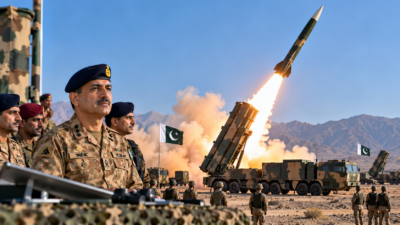
Pakistan contributes the only nuclear arsenal in the Muslim world, a battle-tested military that has just demonstrated in Marka-e-Haq its capacity for multi-domain operations across air, land and cyber simultaneously, a diplomatic credibility built through the US-Iran ceasefire mediation, and approximately 13,000 troops already deployed to Saudi Arabia.
Saudi Arabia brings the world’s second-largest proven oil reserves, the financial capacity to fund alliance operations and economic backstops for partner states, sovereign wealth exceeding $700 billion, and the political legitimacy of being custodian of Islam’s two holiest sites.
Turkey contributes NATO membership and its associated intelligence architecture, the region’s most capable indigenous defence industrial base — producing Bayraktar drones that have reshaped battlefields from Ukraine to Syria — a 1,000-kilometre coastline at the Mediterranean’s strategic nexus, and a military tradition that combines Western interoperability with regional operational experience.
Qatar provides Al Udeid Air Base — the largest American air base outside the continental United States — giving the bloc a unique capacity to host both US operations and an expanding Pakistani military presence simultaneously. Qatar’s sovereign wealth fund exceeds $500 billion. Its traditionally flexible foreign policy gives the bloc a diplomatic channel to actors otherwise isolated, including Iran, with whom Qatar maintained ties even during the 2017–2021 Gulf blockade.
Pakistan, Turkey, Egypt and Saudi Arabia have emerged as a potential new regional power bloc — Trump’s Board of Peace — bringing distinct strategic assets: Pakistan has nuclear weapons, Saudi Arabia holds the world’s second-largest oil reserves, Egypt controls the Suez Canal, and Turkey is a NATO member. With a combined population of 500 million, they represent the most politically and militarily influential Muslim-majority grouping in the world. Pakistan’s Minister for Defence Production confirmed to Reuters that a Pakistan-Saudi Arabia-Turkey trilateral defence agreement is already in the pipeline.
The “Islamic NATO” Question
The comparison has been raised repeatedly — and Pakistan’s own minister introduced it first.
After the signing of the SMDA, Pakistani Defence Minister Khawaja Muhammad Asif said that other Arab countries could also join the agreement, adding that there should be an Islamic pact similar to NATO. There has been scant coverage in Arab media of these developments. Qatar even called for the agreement’s expansion to include Egypt, and likewise expressed the need for an Islamic NATO.
The comparison flatters and misleads simultaneously. NATO has a 75-year institutional history, an integrated military command, standardised equipment and procedures, and the largest collective defence spending pool in human history. The Saudi-Pakistan pact and its potential expansions have none of those features yet.
What the emerging framework does share with NATO’s founding logic is the insight that drove the 1949 Washington Treaty: security is more credible when states aggregate it. The mutual defence clause that makes any attack on one an attack on all is not just rhetoric. It changes adversarial calculations about the cost of aggression in ways that no individual state’s deterrence posture can achieve alone.
Whether that insight translates into an institutionalised alliance with command structures, joint exercises, interoperability standards and political coordination mechanisms depends entirely on the political will that follows this current crisis moment.
The Iran Calculation
Pakistan remains Iran’s sole trusted intermediary in the US-Iran ceasefire process. Tehran accepted Pakistan’s mediation precisely because Islamabad was not perceived as an adversary. Does Pakistan’s deepening defence integration with Saudi Arabia — Iran’s regional rival — undermine that trust?
Iran is likely to perceive any expansion of the Strategic Mutual Defence Agreement as part of a broader encirclement dynamic emerging after the 2026 US-Iran war. A four-state bloc spanning South Asia, the Gulf, and the Eastern Mediterranean would geographically compress Iran’s strategic operating environment while increasing coordinated military pressure across multiple fronts. The alliance’s combination of missile capabilities, naval access, airpower, intelligence sharing, and drone warfare expertise would significantly complicate Iranian deterrence calculations during future regional crises.
The maritime dimension is especially significant because Hormuz-related disruptions during the 2026 conflict demonstrated how rapidly Gulf instability can threaten global energy flows and international shipping routes. Joint maritime security coordination among Pakistan, Saudi Arabia, Türkiye, and Qatar could therefore evolve into one of the alliance’s most strategically consequential operational dimensions.
Yet paradoxically, Iran’s foreign minister publicly welcomed the original Saudi-Pakistan pact. Iranian President Masoud Pezeshkian, speaking at the United Nations General Assembly session, welcomed the pact between Pakistan and Saudi Arabia as the beginning of a “comprehensive regional security system” in opposing Israeli military strikes expansion in the Middle East.
Iran’s calculation at the time was that a Pakistan-anchored regional security arrangement provided a counterweight to Israeli military unilateralism — a threat Tehran considered more immediate than Saudi-Pakistani cooperation. Whether that calculation survives the expansion of the pact to include Turkey and Qatar, and the explicit Muslim-world security framework language from Pakistani officials, is one of the most significant open questions in regional geopolitics.
Qatar’s Internal Contradiction
Of all the potential additions to the defence framework, Qatar presents the most structurally complex case. Al Udeid Air Base in Qatar hosts approximately 10,000 US military personnel and serves as the forward headquarters of US Central Command. Qatar is simultaneously a partner of the US military and, through this potential defence pact, aligning with a nuclear-armed Pakistani military that is actively deploying troops to Saudi Arabia to protect against Iranian attack.
Qatar’s participation could simultaneously create internal contradictions if alliance obligations clash with American operational priorities linked to Al Udeid’s regional military mission.
The resolution to this contradiction is the same one Turkey employs: parallel rather than exclusive commitments. Qatar does not need to choose between the US and Pakistan. It can host both. The question is whether, in a direct conflict scenario, those commitments remain compatible — and that question has no theoretical answer. It can only be answered by events.
Pakistan’s Role: Architect, Not Just Member
What is most striking about the current moment is not that Turkey and Qatar might join a defence pact. It is that Pakistan is the country that built the pact, recruited Saudi Arabia into it, is negotiating Qatar’s accession, facilitated Turkey’s interest through Antalya, and is simultaneously the mediator trying to end the war that created the geopolitical conditions for the alliance in the first place.
Pakistani Prime Minister Shehbaz Sharif’s April 2026 visits to Saudi Arabia, Türkiye, and Qatar reinforced perceptions that Islamabad has been quietly coordinating a wider strategic realignment across multiple regional capitals.
This is not reactive diplomacy. It is architecture. Pakistan is not being invited into a framework built by others. It is building the framework and inviting others in — using the credibility earned through US-Iran mediation, the trust built through the Saudi deployment, and the relationships cultivated over years of military cooperation with Gulf states and Turkey.
The country that spent the first decade of this century being described as a problem is now being described, by Bloomberg, Reuters, the Financial Times and Arab News, as the architect of the Muslim world’s most consequential security realignment in a generation.
Frequently Asked Questions (FAQs)
Q: What is the Strategic Mutual Defence Agreement and when was it signed?
The SMDA is a mutual defence pact between Pakistan and Saudi Arabia signed on September 17, 2025 in Riyadh. Its core clause states that any aggression against either country shall be considered an aggression against both — a formulation directly modelled on NATO’s Article 5 collective defence provision. It is the first military pact between an Arab Gulf state and a nuclear power. Pakistan’s Defence Minister Khawaja Asif initially suggested it extends Pakistan’s nuclear umbrella to Saudi Arabia, though he later walked back that specific claim.
Q: Has Turkey officially joined the Saudi-Pakistan defence pact?
No. In January 2026, it was confirmed that Turkey would not formally join the SMDA as a third member. The most likely path for Turkey’s inclusion is through a separate bilateral defence agreement with Pakistan — similar to the Qatar framework — that achieves practical military integration without triggering Turkey’s NATO treaty obligations. Defence Minister Asif’s May 2026 statement suggests the framework is still being designed.
Q: What stage are Pakistan-Qatar defence talks at?
Advanced. Pakistani President Zardari raised the framework during his November 2025 Doha visit. PM Shehbaz met Qatar’s Emir on April 16, 2026. Turkish journalist Kemal Ozturk reported that Pakistan has already signed a defence agreement with Qatar and that Pakistani military units will be stationed at Qatar’s bases. Pakistani and Qatari officials described negotiations as moving rapidly, though no formal public signing ceremony has occurred.
Q: What does Qatar’s inclusion mean for the US, which has its largest overseas air base there?
It creates a structural complexity. Al Udeid Air Base in Qatar hosts 10,000 US military personnel and serves as CENTCOM’s forward headquarters. Qatar joining a Pakistan-anchored mutual defence framework means it would have simultaneous defence commitments to Washington and to Islamabad. Analysts expect Qatar to manage this through the same parallel-commitment model Turkey uses in NATO — staying in both frameworks and managing any conflicts case by case rather than through formal priority rules.
Q: Why is this arrangement being compared to an “Islamic NATO”?
Pakistan’s own Defence Minister Khawaja Asif first raised the comparison after the SMDA was signed, suggesting other Muslim countries could join and that there should be an Islamic security pact similar to NATO. Qatar subsequently called for the framework’s expansion to include Egypt. The comparison reflects the mutual defence clause structure, the cross-regional membership and the ambition to create collective deterrence. It overstates the current institutional reality — the framework lacks NATO’s command structures, standardised procedures and decades of operational integration — but accurately captures the political direction being signalled.
Q: How does this affect Pakistan’s role as US-Iran ceasefire mediator?
This is the central tension. Pakistan brokered the ceasefire partly because Iran trusted it as non-adversarial. Pakistan’s deepening military integration with Saudi Arabia — Iran’s primary regional rival — risks undermining that trust. Iranian President Pezeshkian had welcomed the original Saudi-Pakistan pact as a counterweight to Israeli military expansion. Whether Tehran maintains that interpretation as the framework expands to include Turkey and Qatar — states with more clearly anti-Iranian strategic orientations — is the most consequential open question in the region’s immediate future.
Join the Conversation
Share your thoughts, questions, or feedback below.