
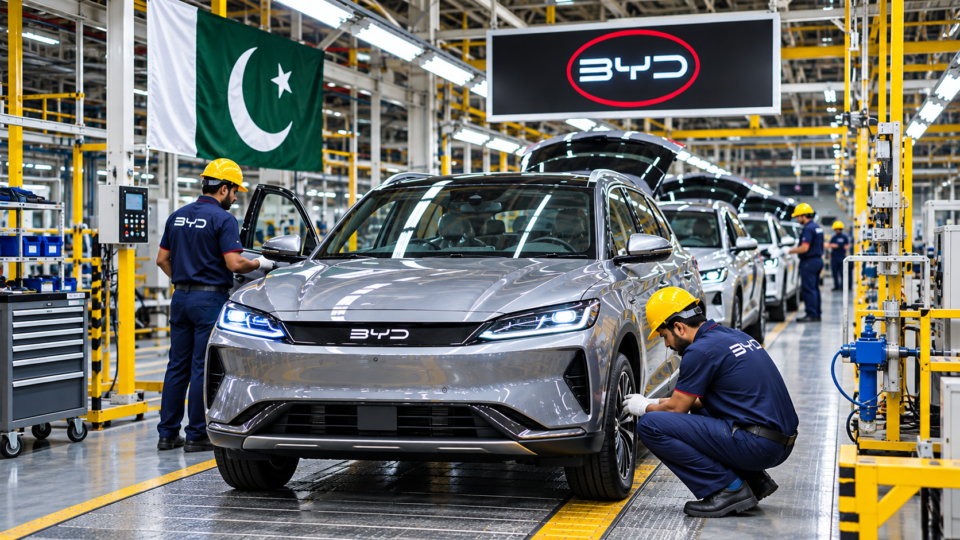
Pakistan’s automotive industry is preparing for a major development as Chinese electric vehicle manufacturer BYD moves closer to starting local vehicle assembly in the country. Hub Power Company Limited (HUBCO), through its associated company Mega Motor Company (MMC), is targeting December 2026 for the start of completely knocked-down (CKD) production at its upcoming manufacturing facility near Karachi.
The BYD Sealion 6 plug-in hybrid electric vehicle (PHEV) is expected to become the first model assembled locally. The development marks an important step in BYD’s long-term plans for Pakistan, where the company has been expanding its passenger vehicle business and building its presence in the growing electric and hybrid vehicle market.
BYD Sealion 6 Expected to Be the First Locally Assembled Car
The BYD Sealion 6 is expected to lead the company’s local assembly operations. It is a plug-in hybrid SUV that combines an electric motor and battery system with a petrol-powered engine, offering drivers the flexibility of electric driving alongside conventional fuel-powered operation.
Its expected introduction through local assembly could help BYD strengthen its position in Pakistan’s SUV market. The vehicle is aimed at customers interested in modern technology, electrified driving and the convenience of a hybrid powertrain.
HUBCO management shared the December production target during an analyst briefing. The timeline was also reported in an investment research update following the meeting.
The start of CKD production means vehicles will initially be assembled in Pakistan using imported components and parts. It should not be confused with complete domestic manufacturing or the immediate production of all vehicle components within the country.
BYD Manufacturing Plant Being Developed Near Karachi
The upcoming manufacturing facility is located near Karachi and is being developed through the BYD and Mega Motor Company partnership. The project is intended to establish local vehicle assembly operations and support the company’s future expansion in Pakistan.
The plant is expected to have an initial annual production capacity of approximately 25,000 vehicles when operating on a double-shift basis. According to the reported plans, capacity could eventually be increased to 50,000 vehicles annually as operations expand and market demand grows.
The facility represents an important investment in Pakistan’s automotive sector. It could also create opportunities for local suppliers, technical workers, engineers and businesses involved in vehicle manufacturing and related services.
BYD Sales in Pakistan Cross 10,000 Vehicles
BYD’s business in Pakistan has reportedly gained significant momentum. HUBCO management disclosed that cumulative sales of BYD vehicles in the country have crossed 10,000 units.
The company’s electric mobility business also reported a profit of approximately Rs1.5 billion during the first quarter of fiscal year 2026–27. HUBCO’s share of that profit was reported at around Rs780 million.
These figures indicate that BYD has established a growing customer base in Pakistan despite operating in a market where electric and plug-in hybrid vehicles are still developing.
Management expects local assembly to support further business growth by strengthening the company’s supply and production capabilities. The move could also help BYD serve customers more efficiently as its dealership and after-sales network expands.
More BYD Models Being Considered for Pakistan
The Sealion 6 is not necessarily the only vehicle planned for the company’s future lineup. HUBCO management has indicated that additional BYD models are being evaluated, particularly vehicles in the higher-volume B and C segments.
The Sealion 6, Denza B8 and Denza B5 have been mentioned among models expected around the end of 2026. However, this does not mean that all three vehicles have been confirmed for local assembly in December.
BYD’s broader strategy appears focused on expanding its presence across different vehicle categories and reaching more customers. Additional models could help the company compete in Pakistan’s SUV and crossover markets while offering buyers more choices in electrified vehicles.
Will Locally Assembled BYD Cars Become Cheaper?
One of the biggest questions for Pakistani car buyers is whether local assembly will reduce BYD vehicle prices.
Local assembly may provide cost advantages compared with importing completely built-up vehicles. It could also improve supply availability and reduce some expenses associated with importing fully assembled cars.
However, lower prices are not guaranteed immediately. Initial CKD production is expected to depend significantly on imported components, while duties, taxes, exchange rates, shipping expenses and manufacturing costs will continue to influence final vehicle prices.
HUBCO has previously discussed a long-term localisation ambition of up to 80%. Achieving that level would require gradual investment in domestic suppliers, component manufacturing and the wider automotive supply chain. It should be viewed as a long-term target rather than the localisation level expected at the beginning of production.
What Local BYD Assembly Means for Pakistan’s Auto Industry
The start of BYD assembly could increase competition in Pakistan’s automotive market, particularly in the electric and plug-in hybrid vehicle segments. Local production may encourage other manufacturers to expand their own investment in new-energy vehicles and improve their product offerings.
The project could also support employment opportunities in manufacturing, quality control, engineering, logistics and vehicle maintenance. As production expands, local businesses may gain opportunities to supply selected components and services.
Another important part of BYD’s strategy is the development of charging infrastructure. HUBCO and its associated businesses have been working to expand charging facilities along major routes, supporting the wider adoption of electric vehicles in Pakistan.
Nevertheless, the long-term success of the sector will depend on affordable vehicle prices, reliable charging facilities, stable government policies, consumer confidence and the development of local manufacturing capabilities.
December 2026 Production Target Marks a New Phase for BYD
BYD’s planned December 2026 production start represents a significant transition from relying primarily on imported vehicles towards establishing local assembly operations in Pakistan.
With the Sealion 6 expected to become the first locally assembled model, an initial capacity of 25,000 vehicles annually and the possibility of expanding to 50,000 units, the project could become an important part of Pakistan’s developing electric vehicle industry.
For Pakistani customers, the biggest developments to watch will be the official start of production, the first locally assembled vehicle deliveries, future model announcements and any changes in prices.
If the company achieves its production target, BYD will take another major step towards building a long-term manufacturing presence in Pakistan.


Join the Conversation
Share your thoughts, questions, or feedback below.