
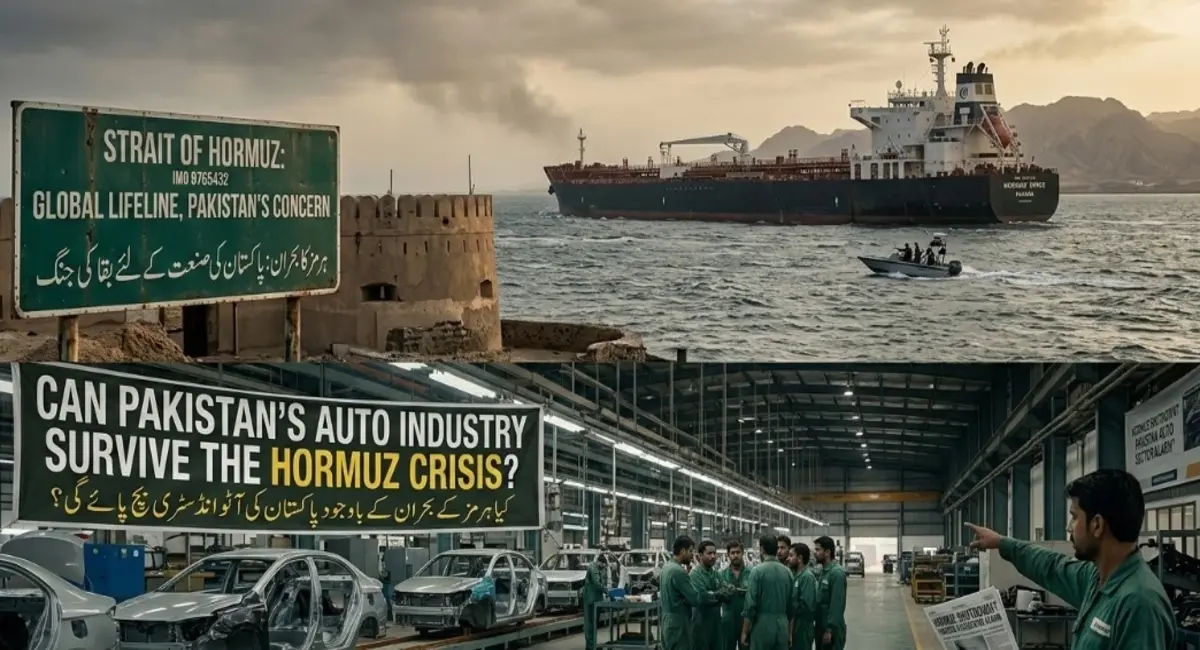
Learn how the Strait of Hormuz closure could impact Pakistan’s auto sector, fuel supply, and local industries, and what solutions are available to solve the issue.
The Strait of Hormuz is one of the most important sea routes in the world. Nearly one-fifth of the world’s oil supply passes through this narrow waterway every day. When conflict or tension disrupts this route, the entire global economy feels the shock.
Right now, the situation is getting more serious. The ongoing conflict involving Iran, Israel, and the United States has made shipping through the Strait of Hormuz extremely risky. Many cargo ships have slowed down, changed routes, or stopped operations entirely.
For Pakistan, this crisis creates a major challenge. The country imports around 85 percent of its oil from the Gulf region, which means most of its fuel passes through this same chokepoint.
As a result, the Hormuz crisis not only threatens petrol prices. It also creates serious risks for
- Pakistan’s auto sector
- manufacturing industries
- overall economic stability
However, despite the challenges, Pakistan’s industries still have several ways to adapt and survive.
Strait of Hormuz Closure Impacts Pakistan’s Auto Sector: Rising Costs and Delayed Parts
Pakistan’s auto sector has already encountered multiple economic pressures over the last few years. Inflation, currency depreciation, Budget deficit, and import restrictions have slowed production. Now, the Hormuz crisis has created another major hurdle that can further destabilize the economy of the country.
Shipping Delays Are Disrupting Car Production
Most vehicles assembled in Pakistan depend on imported parts called CKD kits (Completely Knocked Down kits). These kits include essential components such as engines, electronics, and body parts.
Normally, these shipments arrive within two weeks through Gulf shipping routes. However, due to security concerns in the Strait of Hormuz, many ships now avoid the area and take longer routes around Africa.
Because of this change, delivery time has increased to five or six weeks.
Serious problems are emerging for car manufacturers due to these challenges as assembly plants has to rely heavily on continuous supply chains. When parts arrive late, factories must slow down production or temporarily stop operations.
Freight Costs Are Increasing Car Prices
Shipping costs have also skyrocketed. Reports are claiming that the cost of chartering cargo ships has jumped from around $900,000 to more than $4 million in just a few days.
Naturally, companies cannot absorb these costs alone. As a result, car prices in Pakistan may increase again in the near future.
This situation is directly affecting consumers because higher production costs translate into higher vehicle prices.
Localization Is Becoming the Only Real Solution
Because imports are becoming expensive and unpredictable, auto companies are now highly focusing on localization. Localization means producing more vehicle parts inside Pakistan rather than importing them.
Cities like
- Sialkot
- Gujranwala
Karachi already have strong manufacturing industries capable of producing components such as:
- Door handles
- Seat covers
- Plastic components
- Metal fittings
If Pakistan increases local production, the auto industry can reduce its dependence on foreign supply chains. In the long run, this shift could strengthen Pakistan’s industrial base.
Read more: Global Cargo Diversions During Middle East Conflict Can Turn Pakistan Into Transhipment Hub
Energy Crisis Threat: How Fuel Shortages Can Hurt Local Industries
While the auto sector faces supply problems, Pakistan’s broader industries face an even bigger challenge: energy shortages due to massive fuel shortage.
Factories cannot operate without fuel, electricity, or gas.
Textile and Fertilizer Industries Need Constant Energy
Pakistan’s economy heavily depends on its manufacturing sector. Key industries include:
- Textile mills in Faisalabad
- Fertilizer plants across Punjab
- Cement factories
- Steel manufacturers
All these industries consume large amounts of energy every day.
If fuel imports slow down because of the Hormuz crisis, production costs will increase. In extreme situations, factories may even shut down temporarily.
This scenario could harm exports and reduce economic growth.
Pakistan Is Searching for Alternative Oil Routes
To reduce the risk of supply disruption, Pakistan has started exploring alternative routes for oil shipments.
One important option involves Saudi Arabia’s Yanbu Port, which lies on the Red Sea rather than the Persian Gulf.
Oil shipped from this port can travel through different maritime routes, avoiding the Strait of Hormuz entirely.
Although this route is longer and slightly more expensive, it provides a critical backup supply line for Pakistan’s fuel needs.
This strategy helps ensure that factories continue running and industries remain operational.
Pakistan’s 30-Day Fuel Buffer: A Short-Term Safety Net
Another important factor is Pakistan’s fuel reserve capacity.
Currently, Pakistan holds approximately 25 to 28 days of petroleum reserves. These reserves are acting as a temporary buffer during global supply disruptions.
However, this safety margin is still limited.
If the crisis continues for several months, Pakistan will need consistent imports via alternative routes to maintain stable fuel supplies.
To manage the situation, authorities are also considering weekly fuel price adjustments. These alterations are allowing the government to balance supply costs and maintain imports.
Although frequent price changes may frustrate consumers, they assist in ensuring that Pakistan can continue purchasing fuel from international markets.
How Pakistan Can Reduce Fuel Consumption
Policymakers of Pakistan are searching for a way forward; the country must also look forward and take a multipronged approach to solve the issue.
Several practical steps are available that can help achieve this goal.
Work From Home Can Save Millions of Liters of Fuel
One simple solution involves increasing remote work.
Organizations must permit employees to work from home; daily commuting will definitely be reduced after following this step. As a result, chances are that the fuel consumption also drops.
During the pandemic, Pakistan already had encountered how remote work can help in reducing traffic and energy use.
If organizations reintroduce flexible work policies, the country would be capable of saving millions of liters of petrol every month.
Turning Crisis Into Opportunity: Building a Stronger Industrial Future
Every major economic crisis also creates an opportunity for reform.
The Hormuz crisis is clearly illustrating that Pakistan must create ways to reduce its over-reliance on imported fuel and foreign supply chains. Several long-term solutions can help strengthen the economy:
- Expand local manufacturing and auto parts production
- Increase renewable energy adoption
- Diversify fuel import routes
- Improve energy efficiency in industries
If policymakers and businesses act quickly, Pakistan can transform this crisis into a turning point for industrial development.
Solar Energy Can Protect Industries From Future Crises
The Hormuz crisis also highlights Pakistan’s urgent need to expand renewable energy.
Solar power offers a powerful solution for industries.
Many factories already have large rooftops that can support solar panels. Once installed, solar systems can supply a significant portion of a factory’s electricity needs.
Although installation requires initial investment, solar power reduces long-term energy costs and protects industries from global oil shocks.
As a result, companies that switch to solar today will likely become more competitive and resilient in the future.
Final Thoughts: Pakistan’s Industries Can Survive despite strait of Hormuz closure
The closure or disruption of the Strait of Hormuz has become the reason of serious economic uncertainty all over the world. For Pakistan, the risks are escalating rapidly because the country relies heavily on Gulf oil imports.
However, Pakistan’s industries still have strong survival tools.
Localization in the auto sector, alternative oil routes via the Red Sea, renewable energy investments, and smarter fuel consumption strategies can actually prove to be helpful for stabilizing the economy.
Most importantly, Pakistan’s greatest strength lies in its resilience and how it continues to be resilient in the future.
If industries adapt quickly and policymakers support long-term reforms, Pakistan will not only survive the Hormuz crisis—it can emerge
- Stronger
- More independent
- Well prepared for upcoming global challenges.
Frequently asked questions FAQs
What is the current geopolitical significance of the Strait of Hormuz for Pakistan?
The Strait of Hormuz is one of the most important shipping routes for Pakistan. It connects the oil-rich Gulf countries with international markets. Pakistan imports most of its oil from countries like Saudi Arabia, Kuwait, and the United Arab Emirates, and these shipments usually pass through this route. Because of this heavy dependence, any instability in the Strait can create serious concerns for Pakistan’s energy supply and economic stability.
What options does Pakistan have to reduce its reliance on the Strait of Hormuz?
Pakistan is exploring several strategies to reduce dependence on this important shipping route. One possible solution is importing oil through alternative ports, such as Saudi Arabia’s Red Sea terminals. Another option involves increasing local energy production, including coal, renewable energy, and domestic gas reserves. In the long term, Pakistan may also build larger fuel storage facilities to create stronger emergency reserves during global supply disruptions.
How does instability in the Strait of Hormuz affect Pakistan’s oil import costs?
When the Strait of Hormuz becomes unstable, oil prices in international markets often rise quickly. At the same time, shipping companies charge more to transport cargo through risky areas. Insurance providers also increase premiums to cover potential damage from conflict or attacks. These extra costs eventually increase the overall price of oil imports for Pakistan, which can lead to higher fuel prices for consumers.
How does the Strait of Hormuz affect Pakistan’s oil import companies?
For Pakistan’s energy supply, the Strait of Hormuz plays an immense role that cannot be denied A large portion of the country’s oil imports travels through this narrow sea route. When tensions or conflicts occur in the area, oil tankers may slow down, delay their journeys, or avoid the route completely. This situation makes it harder for Pakistani oil companies to maintain their fuel reserves and keep supplies stable. As a result, companies may face higher costs and supply pressure when shipments are delayed.
What logistics firms in Pakistan handle shipments through the Strait of Hormuz?
Several shipping and logistics companies play a role in transporting goods connected to the Strait of Hormuz. The most important state-owned shipping company is Pakistan National Shipping Corporation, which operates vessels that carry oil and other cargo for Pakistan. Major terminals like Karachi Gateway Terminal Limited also manage container operations at Karachi Port. International shipping companies such as Maersk and MSC Mediterranean Shipping Company are also involved in transporting cargo that eventually arrives in Pakistan.
How does instability in the Strait of Hormuz affect Pakistan’s oil import costs?
When the Strait of Hormuz becomes unstable, oil prices in international markets often rise quickly. At the same time, shipping companies charge more to transport cargo through risky areas. Insurance providers also increase premiums to cover potential damage from conflict or attacks. These extra costs eventually increase the overall price of oil imports for Pakistan, which can lead to higher fuel prices for consumers.
Which Pakistani energy companies are most impacted by disruptions in the Strait of Hormuz?
Large oil companies and refineries in Pakistan feel the biggest impact when shipments are delayed. Pakistan State Oil imports a large share of the country’s fuel, especially diesel from Gulf countries. Refineries such as Pakistan Refinery Limited and Cnergyico also depend on steady crude oil supplies. When tanker deliveries slow down, these companies may reduce production because they do not receive enough crude oil.
How do marine insurance companies handle Pakistani cargo passing through the Strait of Hormuz?
Marine insurance protects cargo while it travels through international waters. When ships move through areas with security risks, insurers usually add special coverage known as war-risk insurance. This extra protection raises the cost of transporting goods through the Strait of Hormuz. Pakistani importers often rely on large international insurers to protect their cargo because these companies can handle high-risk shipping routes.
Can oil shipments passing through the Strait of Hormuz be tracked from Pakistan?
Yes, oil shipments can be tracked using international maritime tracking platforms. Services such as MarineTraffic and Kpler allow companies to monitor ship locations using satellite and AIS tracking data. Pakistani logistics companies often use these tools to follow tanker movements and delivery timelines. However, during security threats, some ships temporarily turn off their tracking signals for safety reasons.
Which consulting firms help Pakistani businesses understand geopolitical risks?
Many companies seek expert advice to manage risks related to global conflicts and trade disruptions. Consulting firms like EY-Parthenon provide strategic analysis and risk assessments for businesses. Some banks also have research departments that offer economic insights, including Habib Bank Limited. These experts help companies prepare for supply chain disruptions and global economic changes.



Join the Conversation
Share your thoughts, questions, or feedback below.