
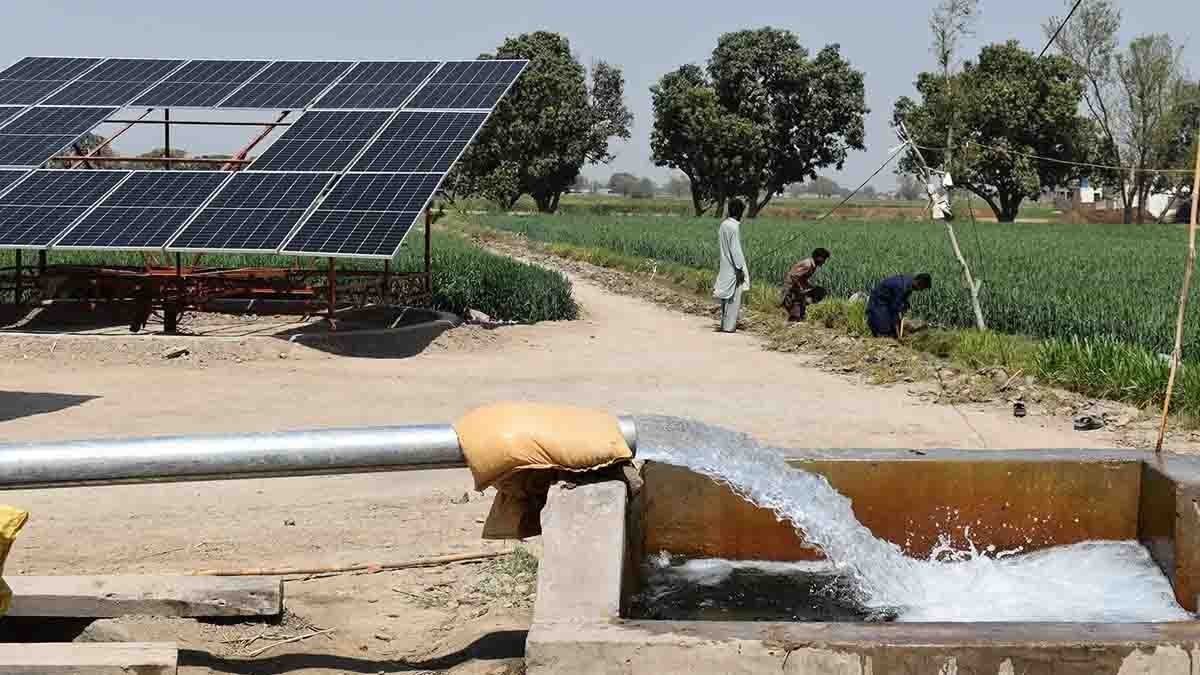
Pakistan has launched a large program to shift Balochistan’s subsidised agricultural tubewells from grid electricity to solar power. The aim is to cut a major fiscal burden, reduce pressure on the power system, and give farmers a more predictable energy source for pumping.
The program targets about 27,000 legally subsidised agricultural tubewells. It works through a simple trade: the government pays cash compensation to eligible tubewell owners, and QESCO disconnects the electricity connection and retrieves equipment to prevent reconnection.
What the tubewell solarisation program is
The federal government and the Government of Balochistan agreed to convert subsidised agricultural tubewells to solar power under a cost-sharing approach. Officials and media reporting commonly cite a total program size of roughly Rs 55 billion, financed 70% by the federal government and 30% by Balochistan.
The project is implemented on the ground by the Quetta Electric Supply Company (QESCO), which handles disconnections and recovery of grid assets such as transformers and poles.
Funding and approvals: from Rs 14bn to a larger envelope
The March 2025 steering committee meeting chaired by Deputy Prime Minister Ishaq Dar reported that the federal government issued a sanction of Rs 14 billion to Balochistan on February 4, 2025. By March 1, 2025, the provincial government had disbursed Rs 12.4 billion, based on QESCO’s Daily Situation Report.
In the next major funding step, the federal cabinet’s Economic Coordination Committee (ECC) approved the release/transfer of an additional Rs 24.5 billion on May 6, 2025 to support timely completion of the solarisation of about 27,000 tubewells. That ECC decision explicitly anchored the program inside the larger Rs 55 billion plan.
Read more: 500,000 applications received under Punjab’s tube well solarization program
How the scheme works: compensation plus disconnection
The heart of the program is a compensation mechanism. Under the framework described in official statements, the government provides about Rs 2 million per tubewell for each legal agricultural connection that is disconnected from the grid.
The steering committee update also gave a clearer picture of the tubewell landscape in the province:
- 27,437 agricultural tubewells were described as subsidised (legal)
- 10,263 were described as illegal connections
That distinction matters. The compensation is tied to legal, subsidised connections and is linked to disconnection from the grid.
Why QESCO retrieves transformers and poles
Disconnection alone is not enough if equipment remains on site. QESCO has therefore removed transformers, high-tension poles, and related hardware to reduce the risk of unauthorised reconnection.
Dawn’s reporting on Phase I highlighted how hard this can be in practice. QESCO reported resistance from some landowners and difficulties retrieving equipment, including cases where components were removed before handover.
Progress so far: disconnections and load reduction
As of March 1, 2025, the steering committee was told that QESCO had achieved:
- 4,539 disconnections
- Retrieval of 2,626 transformers and 2,378 poles
- A measured 67.4 MW load reduction
Separately, QESCO reported completing a first phase of solarisation work in Quetta and Pishin that transitioned 2,699 agricultural users to solar, backed by Rs 5.398 billion funding for that phase.
Key challenges and what happens next
By mid‑2025, credible reporting described two major friction points.
First, security and field logistics slowed progress. The Express Tribune reported that security conditions hampered retrieval of equipment and broader implementation timelines.
Second, verification and process design became a live issue. Business Recorder later reported a dispute involving QESCO and the Power Division over funds and responsibility for third‑party verification, which is meant to confirm solarisation and disconnection steps.
Despite these constraints, the program clearly moved beyond a single announcement. It secured fresh ECC funding, continued steering committee oversight, and produced measurable disconnections and load reduction.
The next meaningful public update should answer two questions: how many legal tubewells have been fully solarised and verified, and how the government will handle the large stock of illegal agricultural connections that sit outside the compensation model.


Join the Conversation
Share your thoughts, questions, or feedback below.