
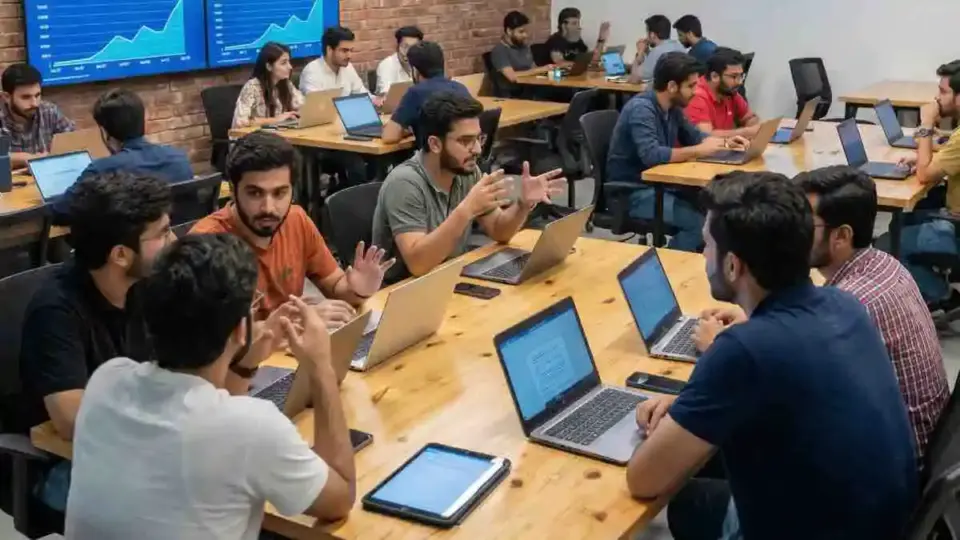
Pakistani tech founders are no longer waiting for local capital to catch up.
A growing number of ambitious Pakistani startups are building products in Pakistan but incorporating abroad — especially in the United States, UAE, Singapore, and the UK — to access global venture capital, banking, payments, customers, and acquisition markets.
This trend accelerated sharply in 2025–2026 as founders realized one hard truth: Pakistani talent can build world-class products, but Pakistani company structures often struggle to attract top-tier international investors.
Why Pakistani Founders Are Looking Abroad
Pakistan’s startup funding recovered in 2025, but only modestly. Startups raised $36.6 million in disclosed funding in 2025, up from $22.5 million in 2024. Yet that is still far below the boom years, when Pakistani startups raised $347 million in 2021 and $331 million in 2022.
At the same time, Pakistan’s technology talent is selling globally. IT and IT-enabled services exports crossed $4.18 billion in the first 11 months of FY2025-26, the highest level on record, with freelancers contributing more than $1 billion.
That gap explains the offshore push. The talent is here. The customers are global. The capital is mostly outside Pakistan.
The Delaware C-Corp Advantage
For startups targeting American venture capital, the most common route is a Delaware C-Corp.
US investors prefer this structure because it supports preferred stock, stock options, cleaner cap tables, familiar legal documentation, and predictable corporate law. Delaware corporations are also easier for venture funds to process because the legal templates, investor protections, and exit mechanics are already well understood.
For a Pakistani founder pitching a Silicon Valley fund, this matters. A Delaware parent company can remove friction before it appears. Instead of spending investor meetings explaining Pakistani corporate law, foreign exchange limits, banking hurdles, or share transfer procedures, the founder can focus on product, revenue, and growth.
UAE and Singapore Are Also Rising
Not every Pakistani startup needs a US company on day one.
Founders targeting the Gulf often prefer the UAE, especially Dubai or Abu Dhabi, because of proximity, investor networks, banking access, and easier regional hiring. Those targeting Southeast Asia may choose Singapore. SaaS and AI companies selling into the US usually lean toward Delaware.
The structure often looks like this:
- Foreign parent company in Delaware, UAE, Singapore, or UK
- Pakistani subsidiary or service company
- Engineering, product, support, and operations based in Pakistan
- Global customers and investors contracted through the foreign entity
This allows founders to keep Pakistan’s cost advantage while accessing international capital markets.
Read more: Ten Pakistanis Are Among the Founders of America’s Billion-Dollar Companies
2025–2026 Made the Shift Obvious
The strongest signal came from Pakistani founders building globally.
In 2025, Pakistani-founded AI startup Jams, co-founded by Asad Awan and Hamza Aftab, joined OpenAI after previously raising from Andreessen Horowitz and Indus Valley Capital. Indus Valley Capital called the exit proof that Pakistani talent can go global and said Jams was its first investment under a model backing Pakistani founders building globally, especially those based in the United States.
That one line captures the new playbook: Pakistani founder, global market, foreign capital, international exit.
Other examples show the same direction. US-based healthtech startup Allia Health, co-founded by Saroosh Khan, raised $2 million from a Tim Draper-backed round while planning expansion into Pakistan. UAE-based venture builder Disrupt.com, founded by Pakistani entrepreneurs, announced a $100 million commitment to back global startups after the founders previously built Cloudways, which was acquired by DigitalOcean for $350 million.
This Is Not a Brain Drain — If Pakistan Plays It Right
The danger is obvious: if all valuable Pakistani startups incorporate abroad, Pakistan may lose the cap tables, tax upside, and headquarters value.
But the opportunity is bigger.
If founders keep engineering, product development, AI teams, sales support, and operations in Pakistan, offshore incorporation can become a bridge — not an exit. It can bring foreign exchange, high-paying jobs, global training, and investor confidence back into the local ecosystem.
Pakistan already benefits when local talent earns foreign revenue. The SBP has also eased some rules for IT exporters and freelancers, allowing export proceeds up to $25,000 to be exempt from declaration and allowing firms to retain $5,000 per month or 50% of export proceeds, whichever is higher, in Exporters’ Special Foreign Currency Accounts.
But founders still want more: easier outbound payments, Stripe and PayPal access, smoother ESOP rules, faster company registration, clearer tax treatment, and startup-friendly foreign investment processes.
What Pakistani Founders Should Do Before Incorporating Abroad
Founders should not blindly open a foreign company because everyone else is doing it.
The right structure depends on the business model.
If your startup is a local marketplace, logistics company, lending platform, or regulated fintech serving only Pakistan, a local company may still make sense. But if you are building SaaS, AI tools, developer products, fintech infrastructure, cybersecurity, healthtech, or B2B software for international customers, a foreign parent can be strategically useful.
Before setting up abroad, founders should clarify:
- Where the customers are
- Where investors will come from
- Where IP should legally sit
- Whether Pakistan will remain an operating subsidiary
- How founder shares and ESOPs will be structured
- Tax impact in Pakistan and abroad
- Banking, payments, and compliance costs
Bad structuring early can become expensive later.
The Bottom Line
Pakistani founders are not incorporating abroad because they lack confidence in Pakistan. They are doing it because global venture capital has rules — and founders who want global money must speak the legal and financial language investors understand.
The best outcome is not to stop this trend. It is to make sure Pakistan benefits from it.
If Pakistan can keep the talent, jobs, R&D, and operations at home while founders raise global capital abroad, the country can turn offshore incorporation into a launchpad for the next generation of Pakistani-built global tech companies.
FAQs
Why are Pakistani startups incorporating abroad?
They want easier access to US VC funding, global banking, payment gateways, international customers, stock options, and acquisition markets.
What is the most common structure for US VC?
A Delaware C-Corp is usually preferred by US venture investors because it supports standard VC terms, preferred shares, and employee stock options.
Does this mean founders are leaving Pakistan?
Not always. Many keep engineering and operations in Pakistan while using a foreign parent company for fundraising and global contracts.
Which sectors benefit most from offshore incorporation?
SaaS, AI, cybersecurity, fintech infrastructure, developer tools, healthtech, and B2B software benefit the most.
Is offshore incorporation always the right choice?
No. Startups focused only on Pakistan’s domestic market may not need it. Founders should consult legal and tax experts before restructuring.




Join the Conversation
Share your thoughts, questions, or feedback below.