
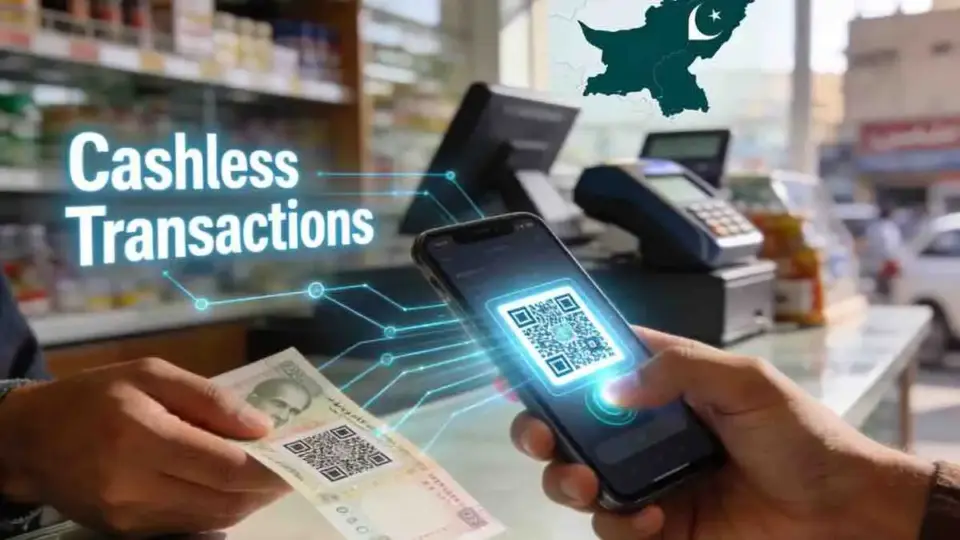
Pakistan’s move toward a cashless economy has reached a major milestone.
During January–March 2026, digital channels handled 92% of all retail transactions processed through formal banking and payment systems, according to the State Bank of Pakistan’s latest Payment Systems Quarterly Review for Q3 FY26. The banking and payments ecosystem processed 3.7 billion retail transactions worth Rs168.8 trillion during the quarter.
This is one of the clearest signs yet that Pakistanis are moving away from branch-based and paper-based payments toward mobile apps, wallets, Raast, internet banking, QR payments, POS machines and e-commerce platforms.
But there is one important caveat: this data covers transactions processed through formal banking and payment channels. It does not include cash transactions happening outside the banking system.
The Big Number: 3.4 Billion Digital Transactions
Out of the 3.7 billion formal retail transactions recorded in the quarter, 3.4 billion were conducted through digital payment channels. These included mobile banking apps, digital wallets, internet banking, USSD, ATMs, POS machines, e-commerce platforms and call/IVR banking services. The value of digital transactions reached Rs 68.3 trillion, up from Rs 64.4 trillion in the previous quarter.
That means Pakistan’s digital adoption is not just growing in volume. It is also growing in value.
However, the value share tells a more balanced story. Digital payments made up 92% by volume, but around 40% by value of total formal retail payments. This shows that smaller everyday transactions are rapidly going digital, while many high-value payments still move through branches, cheques and over-the-counter channels.
Mobile Apps Are Leading the Revolution
The biggest driver of Pakistan’s digital payments boom is the mobile phone.
Mobile banking apps and e-money wallets handled 2.89 billion transactions worth Rs 41.67 trillion during January–March 2026. These app-based transactions included fund transfers, bill payments, merchant payments and account or wallet-based payments across online and physical retail channels.
By March 2026, Pakistan had:
- 95.8 million branchless banking mobile app users
- 28.9 million banking mobile app users
- 7.3 million EMI wallet app users
- 16.2 million internet banking users
These numbers show that digital finance is no longer limited to urban professionals. Wallets and mobile apps are becoming mainstream financial tools across Pakistan.
Read more: Pakistan’s digital transformation to generate $20 billion by 2029
Raast Is Becoming Pakistan’s Digital Payment Backbone
Raast, Pakistan’s instant payment system, is also gaining serious momentum.
During the January–March 2026 quarter, Raast processed 742 million transactions worth Rs 23.27 trillion. Person-to-person Raast transfers increased to 664 million transactions worth Rs 18.88 trillion, while person-to-merchant adoption also expanded. By the end of the quarter, more than 2.6 million merchants had onboarded or registered their alias for Raast P2M services.
This matters because Raast can become Pakistan’s version of a low-cost national payment rail. If merchant acceptance keeps growing, it can reduce dependence on cash, lower payment friction and make small business transactions easier to document.
QR Payments Are Growing Fast
QR-based merchant payments are another major signal of change.
SBP reported that QR merchant transactions reached 87.3 million during the quarter, showing 41% quarter-on-quarter growth. Their value rose 63% to Rs 0.5 trillion.
This is especially important for small retailers, street vendors, service providers and home-based businesses. QR payments are cheaper and easier to deploy than traditional card machines, making them better suited for Pakistan’s large informal retail economy.
If QR acceptance spreads at scale, it could help bring millions of small merchants into the formal digital economy.
E-Commerce Is Also Moving Through Wallets and Accounts
Pakistan’s online shopping ecosystem is also benefiting from digital payments.
Consumers made 434.5 million online purchases worth Rs 0.47 trillion through account and wallet-based payment channels during the quarter.
That number is important because e-commerce cannot grow properly if payments remain cash-heavy. Digital payments reduce failed deliveries, improve seller trust, create transaction records and make refunds easier.
For online marketplaces, fintechs, delivery companies and digital retailers, the rise of account and wallet-based payments is a major growth signal.
Cash Is Not Dead Yet
Despite the rapid digital shift, Pakistan is not fully cashless.
Bank branches processed 127.9 million transactions worth Rs 99.5 trillion, while branchless banking agents handled 154.7 million transactions worth Rs 1.1 trillion during the same quarter. Pakistan also had 20,232 bank branches and 819,397 banking agents by the end of March 2026.
This shows two things at once.
First, digital channels dominate everyday transaction volume. Second, physical banking remains critical for high-value payments, cash deposits, withdrawals and customers who still depend on in-person financial services.
Pakistan is becoming more cash-lite, but it is not cash-free.
Read more: Cashless system implemented at every stall of Islamabad’s H-9 weekly bazaar
Why This Matters for Pakistan’s Economy
A stronger digital payments ecosystem can reshape Pakistan’s economy in several ways.
For consumers, it means faster payments, easier bill settlement, instant transfers and less dependence on cash. For merchants, it means better sales records, faster settlement and access to formal financial products. For banks and fintechs, it creates new opportunities in wallets, merchant acquiring, credit scoring, digital lending and embedded finance.
For the government, digital payments can help improve documentation, reduce leakages and widen the tax net — but only if policy is designed carefully. Over-taxing digital payments could push users back to cash.
The next challenge is trust. Users need strong fraud protection, simple complaint handling, cybersecurity, low transaction costs and reliable app performance. Without that, digital growth can slow.
The Bottom Line
Pakistan’s cashless shift is real.
With 92% of formal retail transactions now happening through digital channels, mobile apps, wallets and Raast are becoming the country’s main payment infrastructure.
The opportunity is huge: lower cash dependence, stronger e-commerce, better merchant documentation and greater financial inclusion.
But the real test is whether Pakistan can bring cash-heavy informal transactions into the same system. If QR payments, Raast P2M and mobile wallets continue growing, Pakistan’s digital economy may finally move from promise to daily reality.
FAQs
What percentage of Pakistan’s retail payments are now digital?
Digital channels handled 92% of formal retail transactions by volume during January–March 2026, according to SBP.
Does this mean 92% of all payments in Pakistan are cashless?
No. SBP’s report covers transactions processed through formal banking and payment channels. It does not include cash transactions outside the banking system.
How many digital transactions were processed in the quarter?
Digital payment channels processed 3.4 billion transactions worth Rs 68.3 trillion during January–March 2026.
Which digital channel is most popular in Pakistan?
Mobile banking apps and e-money wallets are the biggest drivers, handling 2.89 billion transactions worth Rs 41.67 trillion in the quarter.
How much did Raast process?
Raast processed 742 million transactions worth Rs 23.27 trillion during the quarter.
Are QR payments growing in Pakistan?
Yes. QR merchant payments reached 87.3 million transactions, growing 41% quarter-on-quarter.
Is Pakistan becoming fully cashless?
Not yet. Pakistan is becoming more cash-lite, but cash and branch-based payments still play a major role, especially in high-value and informal transactions.




Join the Conversation
Share your thoughts, questions, or feedback below.