
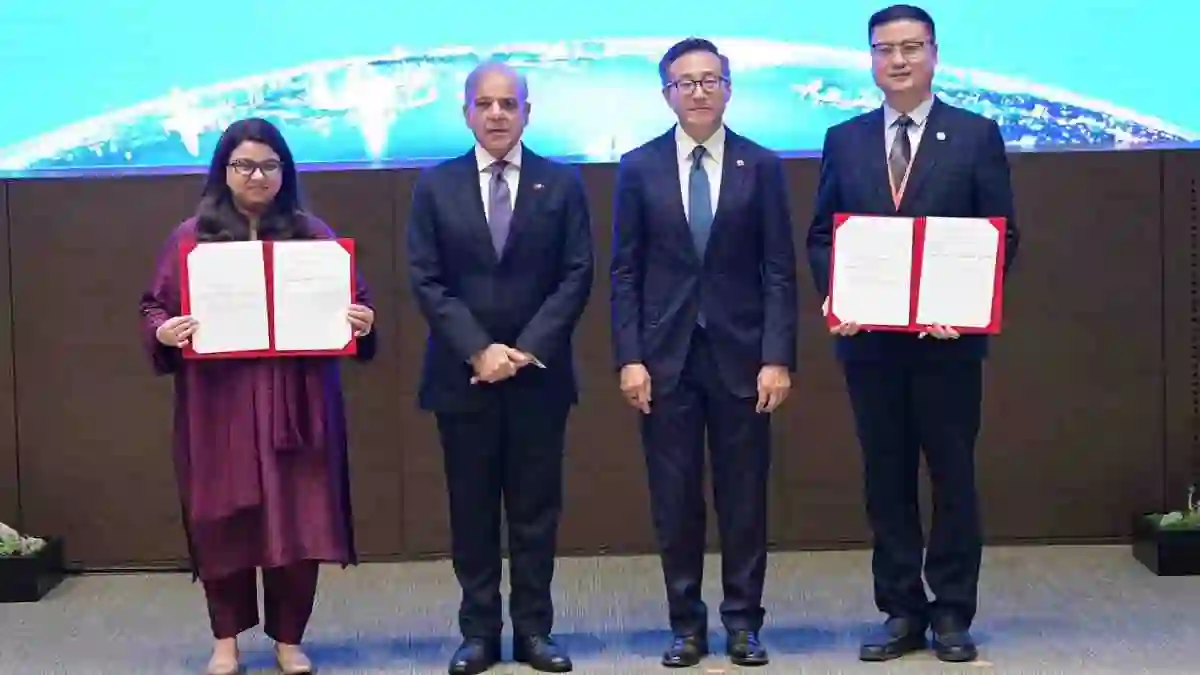
On Sunday, May 24, 2026, Prime Minister Shehbaz Sharif walked into Alibaba Group’s headquarters in Hangzhou, China’s technology capital, and came out with something Pakistan has been trying to arrange for years.
The prime minister and Alibaba Group Chairman Joe Tsai attended the signing ceremony of multiple MoUs, aimed at strengthening cooperation in artificial intelligence, cloud solutions, digital trade, fintech, SME development and healthcare innovation.
In a televised ceremony, PM Shehbaz met Alibaba chairman Joe Tsai, who outlined five areas the group aimed to work on with Pakistan: export, AI, fintech, healthcare, and human capital. The chairman outlined plans to leverage Alibaba’s know-how and technology to help other countries such as Pakistan, inviting small businesses and exporters to the platform.
This was not a courtesy visit. Multiple binding agreements were signed, specific deliverables were committed to, and Pakistan’s IT Minister personally shook hands with Joe Tsai over a set of documents that will shape the country’s digital economy for years.
The question is: what was actually agreed, who benefits, and what needs to happen for any of it to matter?
The $7 Billion Context: Alibaba Inside a Larger Story
The Alibaba signing was one centrepiece of a larger economic offensive.
Pakistani and Chinese companies signed agreements and MoUs worth more than $7 billion during high-level engagements led by Prime Minister Shehbaz Sharif in Hangzhou on Sunday. The agreements focused on information technology, telecom, battery energy storage systems, renewable energy and agriculture.
Alibaba chief Joe Tsai praised PM’s vision for Pakistan’s digital transformation. Deputy PM and Foreign Minister Ishaq Dar told investors Pakistan is open for business. Pakistan signed over 300 MoUs and joint ventures worth $13 billion with China across the broader state visit.
PM Shehbaz also engaged with leading Chinese enterprises including StarCharge, CATL and Xiuzheng Pharmaceutical to explore practical investment and industrial cooperation, and met with renewable energy CEO Agnes Siu of Sheng Hou Neng Yuan Ke Ji Company to discuss Pakistan’s increasing appetite for renewable energy.
The Alibaba deal sits inside a $13 billion, 300-MoU visit that also covered CPEC Phase II, Xi Jinping-level talks, and the 75th anniversary of Pakistan-China diplomatic relations. In that context, the digital economy agreements are not a side show. They are the most immediately implementable part of the entire programme.
Agreement 1 — The Long-Term Strategic Framework
The centrepiece is a government-to-company commitment that provides the legal architecture for everything else.
A long-term strategic framework agreement was signed between the Government of Pakistan and Alibaba Group aimed at accelerating Pakistan’s digital transformation in areas including artificial intelligence, cloud computing, digital trade, financial technology, healthcare innovation and SME development.
Alibaba Chairman Joe Tsai gave details of the areas in which his company intended to collaborate with Pakistan. He said Pakistan and China had strategic partnership through the Belt and Road Initiative and his company would work to improve digital infrastructure, industrial capabilities and cross-border trade between the two countries. The cooperation would enhance in areas of cloud computing, data centres, artificial intelligence, trade facilitation, global market access, financial technology, financial literacy, healthcare, smart hospitals, telemedicine, pharmaceuticals and agriculture.
Alibaba chairman Joe Tsai pledged to help Pakistan digitise customs clearance, payment gateways and SME export platforms specifically.
This is not a single deliverable. It is a platform — a legal and institutional relationship that allows project-level agreements to be signed and executed over time. Its value depends entirely on what gets built under it.
Read more: Letin Auto joins a growing list of Chinese EV makers entering Pakistan
Agreement 2 — SMEDA and Alibaba: 2,000 Pakistani Businesses on a Global Platform
The most immediately tangible agreement for ordinary Pakistani businesses is the one signed between SMEDA and Alibaba Group.
Small and Medium Enterprises Development Authority signed a memorandum of understanding with Alibaba Group, aiming at enhancing digital trade and expanding global market access for Pakistan’s small and medium-sized enterprises. Collaboration with Alibaba Group will create new opportunities for youth, entrepreneurs and startups, while also contributing to the promotion of exports and digital commerce in Pakistan.
The specific deliverable is a dedicated Pakistani digital storefront on Alibaba’s global B2B platform.
For small and medium enterprises, Alibaba and SMEDA will onboard at least 2,000 Pakistani businesses into a dedicated Pakistan Pavilion, enabling access to AI-powered business tools and global markets.
A Pakistan Pavilion on Alibaba.com means Pakistani manufacturers, exporters, and product companies — textiles, leather goods, surgical instruments, sports equipment, food products, ceramics — will have verified, SEO-optimised storefronts visible to Alibaba’s 40 million global buyers. Alibaba.com is not a consumer shopping site. It is a B2B procurement platform where international buyers place bulk orders worth thousands to millions of dollars per transaction.
For the tens of thousands of Pakistani SMEs currently trying to sell internationally through informal networks, trade shows, and underdeveloped websites, this is infrastructure that previously required years and significant capital to build independently.
Agreement 3 — Alibaba.com and Ignite: AI Tools and E-Commerce Training
A companion agreement to the SMEDA MoU covers the training and technology side of the export equation.
Alibaba.com has signed a memorandum of understanding with Ignite, Pakistan’s National Technology Fund under the Ministry of Information Technology and Telecommunication, to expand digital trade and help the country’s SMEs and startups reach global markets. The agreement commits both sides to joint promotional activities, targeted e-commerce training and the deployment of AI-driven tools to boost export competitiveness and digital trade participation.
Under the agreement, Alibaba.com will organise online and offline promotional activities including Pakistan trade shows and a national online pavilion, deliver targeted B2B e-commerce training, and provide AI-powered tools to selected exporters. Ignite will support implementation by identifying potential exporters, coordinating seminars in key cities, and promoting Alibaba.com-led initiatives across Pakistan.
This is the operational layer behind the Pakistan Pavilion. SMEDA brings the businesses. Ignite handles identification, training and implementation logistics. Alibaba provides the platform, the AI tools and the global buyer access. The three-entity structure — government, national technology fund, global platform — is a well-designed institutional model for this kind of export development programme.
Agreement 4 — Alibaba Cloud and Ignite: Urdu AI Models and 500,000 People
This is the agreement with the most far-reaching long-term implications for Pakistan’s tech sector.
Under a strategic framework agreement, Alibaba Cloud and Pakistan’s Ignite will collaborate on developing AI models in Urdu and regional languages. The initiative also includes a nationwide skills development programme targeting up to 500,000 individuals. The agreement further provides for joint AI hackathons and innovation-driven activities to promote technological entrepreneurship in Pakistan.
Urdu AI model development is not a vanity project. It is the foundational infrastructure that Pakistan’s entire AI industry depends on. Pakistani developers, startups, and entrepreneurs cannot build competitive AI products for the 240 million Urdu-speaking market without high-quality large language models trained on Urdu data. English-language AI models from OpenAI, Anthropic and Google are trained on data sets that have minimal Urdu representation — making them structurally limited for Pakistani use cases in education, healthcare, legal services, government and commerce.
Alibaba Cloud’s collaboration on Urdu models through Ignite brings one of the world’s most capable cloud AI platforms — the same infrastructure that powers Alibaba’s own internal AI research — to bear on a gap that Pakistan’s startup ecosystem has been trying to fill with limited resources for years.
The 500,000 skills development target is the most ambitious number in the entire Hangzhou package. At current IT export workforce levels, 500,000 newly trained individuals would represent a near-doubling of Pakistan’s commercially active digital talent pool.
Agreement 5 — Healthcare: DAMO Academy and AI Diagnostics
In the health sector, DAMO Academy and Sky 47 will introduce AI-based diagnostic systems in Pakistani cities, while another programme will enhance embedded intelligence capabilities in universities through collaboration with Pakistani institutions.
DAMO Academy is Alibaba’s global research institute — the group’s in-house version of Google DeepMind. Its collaboration with Sky 47 on AI diagnostics brings Alibaba’s most advanced medical AI tools into the Pakistani healthcare system, targeting the urban diagnostic gap where qualified radiologists, pathologists and specialists are significantly outnumbered by patient demand.
This is not the central story for the SME or startup audience, but it is the agreement with the most direct impact on Pakistan’s population — a healthcare AI system that can identify diseases earlier and more accurately than human diagnosis alone, deployed in a country where specialist doctor density is among the lowest in the region.
Read more: China announces $1.5 billion investment for 300-acre industrial park in Punjab
What This Means for Pakistani Startups
The 2026 Alibaba agreements create three direct opportunities for Pakistani startups:
Cloud infrastructure at competitive rates. Alibaba Cloud’s entry into the Pakistan market under a government framework agreement typically comes with preferential pricing for domestic startups. Every rupee saved on cloud infrastructure is a rupee that can be deployed into product development, hiring, or marketing.
Alibaba AI tools access. The Ignite-Alibaba Cloud collaboration gives Pakistan’s startup ecosystem structured access to Alibaba’s AI product suite — including model development tools, enterprise AI applications and data infrastructure — that would otherwise require individual commercial negotiations with one of the world’s largest cloud platforms.
Global market credibility. A Pakistani startup that can demonstrate its product runs on Alibaba Cloud, integrates with Alibaba’s AI tools, or exports through the Alibaba.com Pakistan Pavilion gains instant credibility with Gulf and Southeast Asian investors who are familiar with Alibaba’s ecosystem. The reputational effect of the Alibaba association is a form of market access in itself.
What This Means for the Pakistan IT Export Target
Pakistan’s IT exports crossed $3 billion annually and the government has set a target of $10 billion within five years. The Alibaba agreements do not directly generate IT exports — but they remove some of the most significant structural barriers that have prevented Pakistani digital companies from scaling internationally.
The deal envisages streamlined entry processes for accredited tech and logistics staff, aligning with China’s broader efforts to simplify short-term business travel for Belt and Road partners. These measures dovetail with Beijing’s recently expanded 30-day visa-free policy for business visitors from Belt and Road partner countries, potentially accelerating project mobilisation.
Pakistani IT companies bidding for Chinese enterprise contracts — data centre management, software development, BPO services — previously faced significant friction in sending engineers to China for project implementation. Green-lane immigration arrangements change that calculus materially.
The Pakistan Amazon-Style Platform: Coming in Parallel
The Alibaba partnership lands alongside a separately announced domestic initiative that addresses the same problem from a different angle.
The government is developing an Amazon-style digital marketplace modelled on global platforms such as Amazon, Alibaba and AliExpress, allowing Pakistani SMEs to showcase and sell products directly to international customers. The initiative, being developed by the Ministry of Industries and Production, is part of the broader push to digitise the SME sector and increase its contribution to exports.
The combination of a domestic marketplace and Alibaba’s Pakistan Pavilion creates complementary infrastructure — one targeting domestic market integration, the other targeting international B2B buyers. Pakistani SMEs can simultaneously build their presence on the government’s platform for regional and domestic discovery and on Alibaba.com for global bulk procurement.
The Hard Questions: What Must Actually Happen
The optimism around Alibaba partnerships in Pakistan has historical precedent — and historical disappointment. A 2025 MoU between Alibaba.com and Ignite signed at the 2nd Pakistan-China B2B Investment Conference produced a similar set of commitments. The Hangzhou agreements of May 2026 represent a significant escalation in scope and seniority, but the implementation gap between a signed document and a working programme is where Pakistan’s institutional machinery has repeatedly stalled.
For the 2,000 SME Pakistan Pavilion target to be reached, SMEDA needs to identify export-ready businesses, help them create compliant product listings in English, verify their export documentation, and ensure they can receive international payments. Each of those steps requires institutional capacity that SMEDA is still developing.
For the 500,000 skills development target, Ignite needs delivery partners, city-level training infrastructure, curriculum vetted by Alibaba, and a tracking mechanism for completion. At Pakistan’s previous digital skills training throughput rates, 500,000 individuals is a multi-year programme.
For the Urdu AI model collaboration, Ignite and Alibaba Cloud need to agree on data collection methodology, model architecture, evaluation benchmarks, and open-source versus commercial licensing terms. These are technically complex decisions that will determine whether the resulting models are genuinely useful or diplomatically symbolic.
None of these are impossible. But each requires exactly the kind of sustained, unglamorous institutional execution that makes the difference between an MoU and a transformation.
Frequently Asked Questions (FAQs)
Q: What was actually signed at Alibaba’s Hangzhou headquarters on May 24, 2026?
Four major agreements were signed: a long-term strategic framework agreement between the Government of Pakistan and Alibaba Group covering AI, cloud, fintech, SME development and healthcare; an MoU between SMEDA and Alibaba Group to onboard at least 2,000 Pakistani businesses into a dedicated Pakistan Pavilion on Alibaba.com; an MoU between Alibaba.com and Ignite covering AI tools, B2B e-commerce training and trade promotion; and a framework agreement between Alibaba Cloud and Ignite for Urdu AI model development and a 500,000-person skills development programme.
Q: What is the Pakistan Pavilion on Alibaba.com and how can businesses join?
The Pakistan Pavilion is a dedicated branded storefront on Alibaba.com — a global B2B platform with 40 million international buyers — that aggregates verified Pakistani exporters and manufacturers into a single discoverable destination. SMEDA is responsible for identifying and onboarding eligible businesses. SMEs interested in joining should register with SMEDA directly and monitor SMEDA’s official communications for the rollout timeline and application process.
Q: Who is Ignite and what role does it play in the Alibaba agreements?
Ignite is Pakistan’s National Technology Fund operating under the Ministry of IT and Telecommunication. It functions as Pakistan’s primary implementation partner for digital economy development programmes. Under the Alibaba agreements, Ignite is responsible for identifying export-ready SMEs, coordinating city-level training seminars, administering the 500,000-person skills development programme, and managing the Alibaba Cloud collaboration on Urdu AI models.
Q: What is an Urdu AI model and why does it matter for Pakistani startups?
An Urdu AI model is a large language model trained specifically on Urdu text data, enabling AI-powered applications — chatbots, content generation, search, translation, voice assistants, document processing — to perform accurately in Urdu. Currently, English-language AI models from major global providers have limited Urdu training data, making them unreliable for Pakistani use cases. A high-quality Urdu model developed in collaboration with Alibaba Cloud would provide Pakistani startups with the foundational AI infrastructure needed to build products for the 240 million Urdu-speaking market domestically and globally.
Q: Does this deal affect Daraz, the Pakistani e-commerce platform Alibaba already owns?
The agreements signed in Hangzhou are focused on B2B exports through Alibaba.com rather than Daraz, which operates as a consumer B2C marketplace. Daraz remains a separate operational entity within Alibaba’s ecosystem. However, the strengthened government-to-Alibaba relationship and the fintech and logistics provisions in the strategic framework are likely to benefit Daraz’s payment infrastructure and logistics partnerships in Pakistan over time.
Q: What would success look like 12 months from now?
Clear success indicators would include: SMEDA publishing an open application process for the Pakistan Pavilion and confirming the first 500 businesses onboarded by end of 2026; Ignite and Alibaba Cloud announcing the first cohort of Urdu AI model development with a published dataset and evaluation benchmark; city-level B2B e-commerce training delivered in at least five cities; and at least one Pakistani SME completing its first international order through the Pakistan Pavilion. Without these specific milestones being met, the Hangzhou agreements remain an expression of intent rather than a programme in motion.



Join the Conversation
Share your thoughts, questions, or feedback below.