
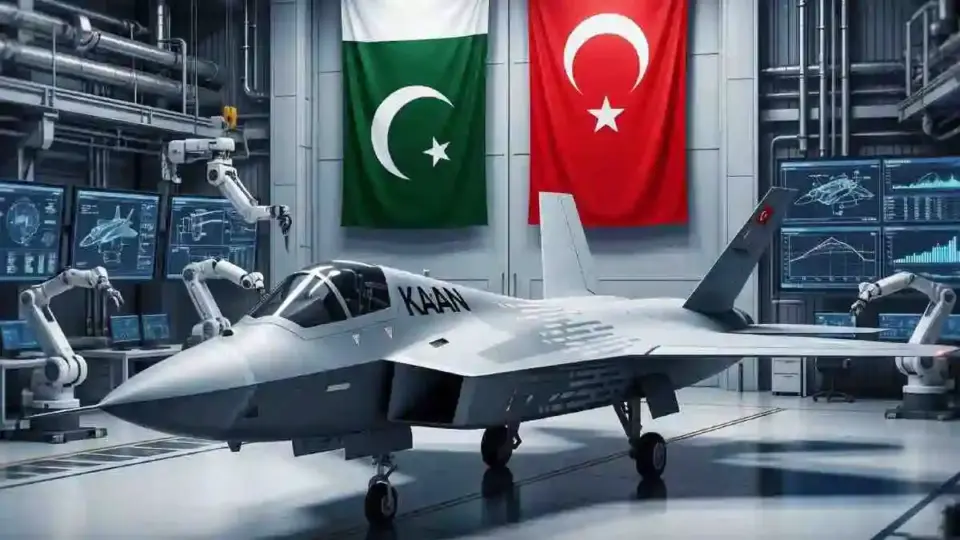
Pakistan’s next major leap in air power may not come from simply buying another foreign aircraft. It may come from helping build one.
Pakistan is actively engaged with Türkiye on the KAAN fifth-generation stealth fighter jet, a project that has become one of the most ambitious aerospace programs in the Muslim world. For Islamabad, the collaboration is not just about replacing older aircraft. It is about gaining access to advanced fighter design, software integration, production experience, and long-term aerospace self-reliance.
KAAN is Türkiye’s indigenous fifth-generation combat aircraft, led by Turkish Aerospace Industries. The aircraft is being developed to replace Türkiye’s F-16 fleet from the 2030s and is designed around next-generation features such as low observability, internal weapons carriage, sensor fusion, enhanced situational awareness, and advanced air-to-air and air-to-ground capability.
Why KAAN Matters for Pakistan
Pakistan has long relied on a mix of Chinese, American, and jointly developed platforms. The JF-17 program proved that Pakistan can participate in fighter production when given industrial responsibility. KAAN could take that model to a much higher level.
The real value for Pakistan lies in technology absorption. If Islamabad secures a meaningful workshare, Pakistani engineers could gain experience in avionics, mission software, electronic systems, simulation, testing, maintenance planning, and eventually localized production.
That is why this collaboration matters far beyond the aircraft itself. It could help Pakistan build the ecosystem needed for future indigenous fighter and unmanned combat aircraft programs.
The Collaboration Is Already Moving
The Pakistan-Türkiye aerospace track is not a new discussion. Turkish Aerospace opened an office in Pakistan’s National Science and Technology Park in 2019, creating an early base for aviation technology cooperation. NSTP also lists Turkish Aerospace among the major companies housed in Pakistan’s innovation ecosystem.
In January 2025, the eighth Pak-Turk Industrial Expo Joint Working Group meeting was held in Pakistan. Reports from Turkish defense media said the meeting included representatives from 32 institutions, with Türkiye’s delegation led by Turkish Aerospace CEO Mehmet Demiroğlu and supported by companies such as ASELSAN, HAVELSAN, Milsoft, Crypttech, and SDT. Pakistan’s side included representatives from 23 companies.
The two major agenda items were the potential export of KAAN to Pakistan and the design and co-production of a new helicopter. Türkiye Today reported that the talks reflected both countries’ shared aim to deepen defense technology and industrial cooperation.
Read more: Why Did Pakistan Station 13,000 Soldiers and Fighter Jets at Saudi Air Base?
Pakistani Engineers Are Already Part of the Story
The most important detail is that Pakistani engineering participation has already been discussed publicly. Turkish officials and defense reporting have previously stated that around 200 Pakistani engineers and technical personnel were supporting the KAAN program, while Turkish Aerospace’s former CEO Temel Kotil described the project as a “Turkish-Pakistani fighter programme.”
That does not mean Pakistan fully owns or co-produces KAAN today. But it does mean Pakistan is not merely watching from the sidelines. It is already part of the technical conversation around one of the world’s newest fifth-generation fighter projects.
KAAN Has Crossed Major Milestones
KAAN completed its maiden flight on February 21, 2024, flying for 13 minutes, reaching 8,000 feet and 230 knots. Its second test flight took place on May 6, 2024, lasting 14 minutes and reaching 10,000 feet.
Türkiye has since signed a procurement contract for KAAN with Turkish Aerospace, marking a major step toward induction into the Turkish Air Force. Anadolu reported that KAAN is expected to enter operational service around 2028, while Türkiye’s defense minister has said both the aircraft and its indigenous engine program are moving according to schedule.
The Big Caveat: No Public Pakistan Contract Yet
Pakistan’s involvement is real, but it is important not to overstate it.
As of May 2026, no formal public contract has been announced for Pakistan’s procurement or co-production of KAAN. Quwa noted that while the institutional framework is dense — including working groups, embedded engineers, and repeated high-level engagement — the missing piece remains a signed, financed, and scheduled agreement.
That matters because defense projects can stall without export permissions, engine approvals, financing, timelines, and production guarantees. Türkiye’s earlier T-129 helicopter deal with Pakistan faced problems because of U.S. engine export restrictions, showing why engine sourcing will also be watched closely in the KAAN case.
KAAN’s first blocks are linked to the F110 engine family, while Türkiye is developing its own TF35000 engine with a possible integration target around 2032.
Read more: Top 10 advanced fighter jets in 2026: The world’s most powerful combat aircraft
Why Pakistan Must Move Fast
Indonesia has already signed an agreement for 48 KAAN aircraft, including production, engineering, and technology-sharing elements. That deal shows Türkiye is willing to internationalize the KAAN program — but it also means Pakistan cannot assume it will automatically receive priority status without a clear commitment.
For Pakistan, the smartest path is not just to buy aircraft. It should negotiate for local assembly, component manufacturing, software workshare, training pipelines, maintenance rights, and export-linked industrial participation.
The Bottom Line
Pakistan’s collaboration with Türkiye on KAAN could become a turning point for the country’s aerospace industry.
If handled properly, KAAN can give Pakistani engineers a bridge into fifth-generation aircraft development and help Pakistan move from aircraft assembly toward real design participation.
But the opportunity will only become historic if Islamabad converts cooperation into a formal industrial agreement — with clear timelines, local workshare, and technology transfer.
FAQs
Is Pakistan officially part of the KAAN fighter jet program?
Pakistan is actively engaged through engineering and defense-industrial cooperation, but no final public procurement or co-production contract has been announced yet.
What is KAAN?
KAAN is Türkiye’s indigenous fifth-generation stealth fighter jet developed by Turkish Aerospace Industries.
Why does KAAN matter for Pakistan?
It could give Pakistan access to advanced aerospace design, avionics, software integration, testing, and production experience.
Could Pakistan produce KAAN locally?
That depends on a formal agreement. Discussions have included export and possible industrial cooperation, but local production terms have not been publicly finalized.




Join the Conversation
Share your thoughts, questions, or feedback below.