
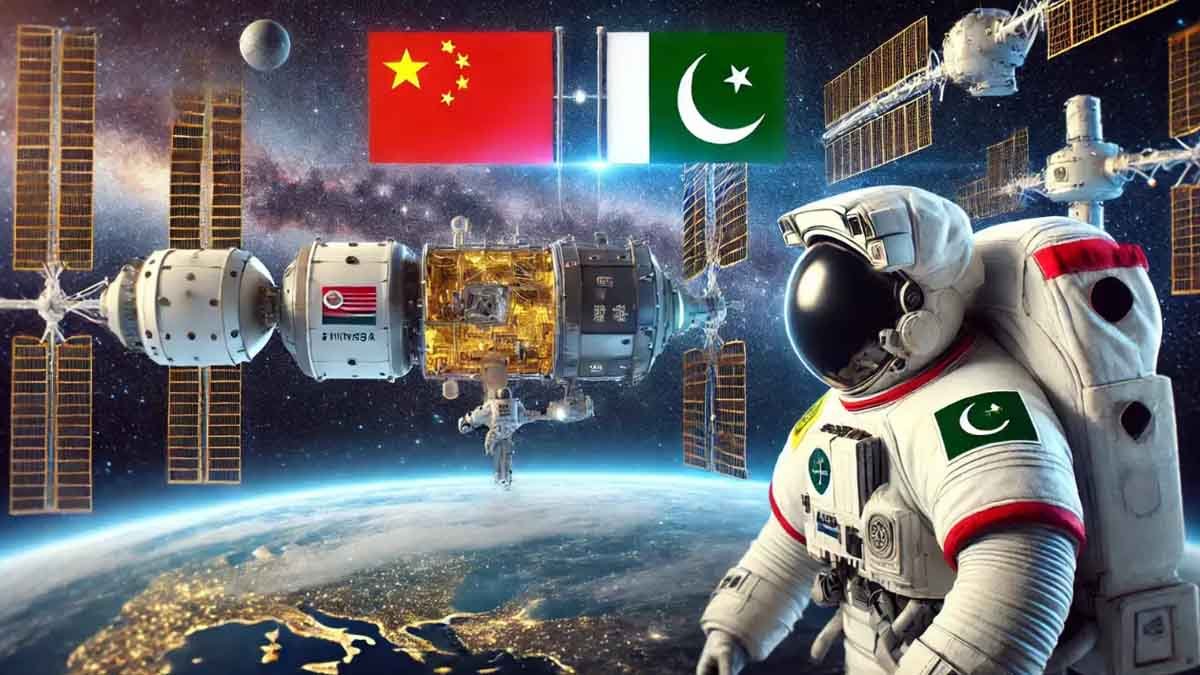
Pakistan will send its first astronaut to China’s Tiangong Space Station in October or November 2026, marking a historic milestone in bilateral space cooperation.
Two Pakistani candidates have completed advanced selection and are now undergoing intensive training at the Astronauts Centre of China. One will be chosen for the mission, making Pakistan the first foreign nation to send an astronaut to China’s space station.
Historic Space Partnership
The China Manned Space Engineering Office (CMSEO) and Pakistan Space and Upper Atmosphere Research Commission (SUPARCO) signed a landmark cooperation agreement on February 28, 2025, in Islamabad.
The agreement marks the first time China will select and train international astronauts, with a Pakistani astronaut to later fly to the Chinese space station.
Pakistani Prime Minister Shehbaz Sharif witnessed the signing ceremony, calling it a wonderful gesture that deepens cooperation between the two nations.
First Foreign Astronaut Program
China Manned Space Agency announced that two Pakistani astronauts will undergo training alongside Chinese astronauts, and one will be selected to participate in a short-duration spaceflight mission as a payload specialist.
The initiative represents China’s first astronaut training program for a foreign country. It demonstrates growing international cooperation in space exploration and strengthens strategic ties between Pakistan and China.
Selection and Training Process
Pakistan selected five astronaut candidates from military and civilian backgrounds, with the best two selected through physical fitness, mental tolerance, and adaptability tests.
Three-Phase Selection
The selection process is carried out in three phases, with preliminary selection in Pakistan, while shortlisting and final selection take place in China.
In February 2026, two candidates successfully completed the secondary phase of selection after undergoing comprehensive medical, psychological, and aptitude evaluations at the Astronauts Centre of China.
Both candidates met international human spaceflight standards and advanced to the final training phase.
Six-Month Training Program
The shortlisted candidates will undertake advanced astronaut training for six months at the Astronauts Centre of China.
The Chinese team is working on preparation for the training, including the training plan, teaching materials, and living support during training.
The intensive program prepares candidates for the physical, technical, and psychological demands of human spaceflight.
Read more: Astronaut from Pakistan will be first international visitor to China’s Tiangong space station
Mission Timeline and Details
One candidate will be chosen for a spaceflight mission aboard the Chinese Space Station, planned for October or November 2026.
October 2026 Launch Window
A Pakistani astronaut will embark on a Shenzhou flight as a payload specialist for a short-duration mission, strongly suggested to be aboard Shenzhou-24 in late 2026.
The astronaut will join the Chinese space station during a crew rotation period. Tiangong hosts six astronauts for around five days during crew handovers, giving the Pakistani astronaut a handful of days to conduct experiments and activities while in orbit.
Payload Specialist Role
The selected astronaut will carry out a short-duration flight mission as a payload expert and, in addition to performing routine duties, will conduct scientific experiments for Pakistan.
The astronaut will undertake a short-duration mission during a crew rotation period, serving as a payload specialist responsible for conducting scientific research and microgravity experiments covering materials science, biological studies, and space technology applications.
Scientific Objectives
Over 300 scientific proposals have been shortlisted in fields like medicine, ecology, aerospace, and astronomy to be conducted in microgravity.
The research will support Pakistan’s growing interest in space science and innovation. Pakistani scientists will design and oversee experiments conducted aboard Tiangong, contributing valuable data to national research programs.
The mission enables direct exposure to advanced space operations, enhancing Pakistan’s technical capacity in space research and satellite technology.
Strategic Significance
Pakistan becomes the first foreign partner in China’s astronaut program, joining an elite group of nations with human spaceflight capability.
A space industry expert noted that Pakistan is one of Beijing’s earliest and most important partners in its Belt and Road Initiative, and the announcement signals to other participants that they too could benefit from China’s space programme.
The cooperation extends beyond astronaut training. The agreement is the latest sign of close cooperation between the two countries, which will also see a Pakistani rover going to the moon10.
China has helped launch key Pakistani satellites and trained over 200 Pakistani space professionals. The countries have signed over a dozen space-related agreements covering satellite development, launch services, and ground station construction.
This mission positions Pakistan firmly on the global space map. It opens new avenues for technological sovereignty, inspires future generations in STEM fields, and demonstrates Pakistan’s transition from space observer to active participant.
The knowledge and experience gained will contribute to Pakistan’s long-term goals in space exploration, supporting national priorities in climate resilience, precision agriculture, and advanced scientific innovation.


Join the Conversation
Share your thoughts, questions, or feedback below.