
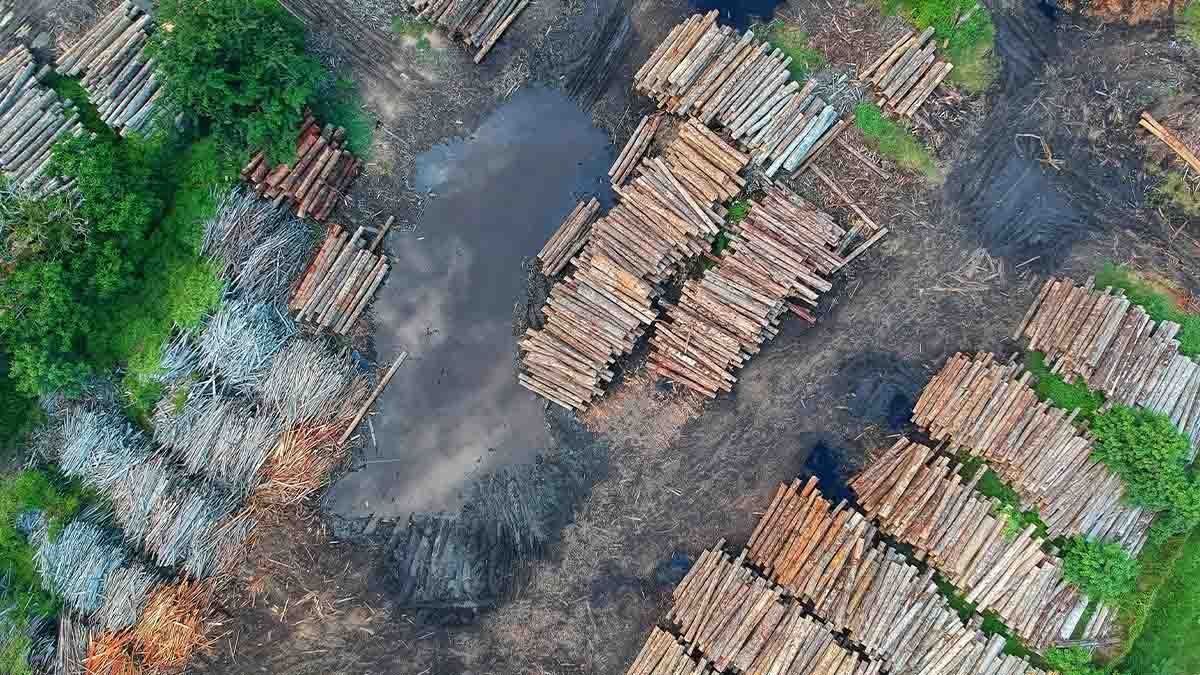
Pakistan ranks among the most forest-depleted countries in the world. With forests covering barely 4.67% of its total land area as of 2023, the country falls far short of the 25% global benchmark for a healthy environment. Decades of deforestation, unchecked logging, and urbanization have left Pakistan dangerously exposed to floods, droughts, and biodiversity collapse.
The consequences are no longer abstract. The devastating 2025 monsoon floods across northern Pakistan killed over 700 people — and experts directly blame deforested mountains for amplifying the disaster.
How Much Forest Does Pakistan Have?
Forest area as a percentage of land area in Pakistan stood at 4.67% in 2023, according to World Bank data. The exact percentage remains disputed. The UN’s Food and Agriculture Organisation estimates just 2.2%, while the Pakistan Forest Institute puts it at 5.1%.
In absolute terms, forest cover has dropped from 3.78 million hectares in 1992 to 3.09 million hectares in 2025. Ideally, a country should have 25% forest cover for a healthy environment. However, Pakistan has one of the lowest forestation rates in the world.
According to the REDD+ programme survey, Azad Jammu and Kashmir has the highest forest cover at 36.9%, followed by Islamabad at 22.6%, Khyber Pakhtunkhwa at 20.3%, and the former Federally Administered Tribal Areas at 19.5%.
18 Percent Decline in 33 Years
Pakistan faces a critical environmental tipping point with a drastic 18% decline in forest cover since 1992. The degradation of forests, rangelands, and worsening climate change effects directly contribute to catastrophic floods, landslides, and cloudbursts. Khyber Pakhtunkhwa has seen the largest share of this decline.
Annual deforestation peaked at about 40,000 hectares in 1992 but has declined to 11,000 hectares in 2025 due to government intervention. Despite these efforts, Pakistan continues to lose around 11,000 hectares of forest every year.
Rangeland area has also fallen from 60% to 58%, with biomass production plummeting from full potential to just 20%. This collapse reduces grazing capacity, degrades soil, and intensifies erosion across Pakistan’s mountainous north.
Read more: Punjab launches massive afforestation, eco-tourism drive
Why Pakistan Keeps Losing Forests
Logging and Fuelwood Dependency
Thousands of hectares of forest are destroyed yearly. The rising population, coupled with poverty and lack of awareness, has led to illegal and unsustainable logging, overharvesting of wood for fuel and charcoal, and increased small-scale farming. The country’s economic and energy crisis has pushed households and businesses toward wood as fuel. Half the population has no access to clean fuel for cooking, and an estimated 68% uses firewood.
Urbanization and Agriculture
The main reasons for deforestation include urbanization, farming, overgrazing, and tourism development. Large tracts of riverine and temperate forests have been converted to farmland or cleared for infrastructure, particularly in Punjab and Sindh.
Climate Change and Forest Fires
Forest fires pose a severe threat to forest ecosystems, wildlife, and communities. They contribute to deforestation, loss of biodiversity, and economic damage. Rising temperatures, prolonged droughts, and shifting rainfall patterns have made northern forests increasingly vulnerable to fire and windstorm damage.
2025 Floods Expose the Cost of Deforestation
The 2025 monsoon floods devastated northern KP — including Buner, Swat, Bajaur, Battagram, Mansehra, and Shangla — as well as Gilgit-Baltistan. Over 700 people died, thousands were displaced, and critical infrastructure suffered extensive damage.
Dr. Adil Zareef of Sarhad Conservation Net warned that without forests, bare mountains heat 5 to 8 degrees more than forested areas, causing monsoon winds to rise rapidly and trigger sudden cloudbursts instead of steady rain.
Experts argue that the catastrophic floods of 1992, 2010, and 2025 prove the destruction of forests and rangelands has transformed upper watershed regions into “flood factories.”
Types of Forests in Pakistan
Pakistan’s forests fall into several distinct categories:
- Coniferous forests grow between 1,000 and 4,000 meters altitude across KP, AJK, and northern Balochistan. Common species include Pindrow Fir, deodar, blue pine, and chir pine.
- Sub-tropical dry forests occur up to 1,000 meters in Punjab and KP districts.
- Riverine forests line the banks of the Indus and its tributaries, mainly in Sindh and Punjab.
- Mangrove forests are concentrated in the Indus River Delta along the Arabian Sea coast.
- Tropical thorn forests dominated by xerophytic shrubs spread across Punjab’s plains and parts of Sindh and Balochistan.
Reforestation Efforts and Results
Ten Billion Tree Tsunami Programme
The Billion Tree Tsunami was a tree plantation drive launched in 2014 by the government of Khyber Pakhtunkhwa in response to the challenge of global warming. It scaled up nationally in 2018 as the Ten Billion Tree Tsunami Programme (TBTTP). The programme, now called the “Upscaling Green Pakistan Programme,” has a total cost of Rs 125.18 billion.
A peer-reviewed study published in 2026 confirmed a significant 3.36% increase in forest area in KP, demonstrating the effectiveness of coordinated reforestation projects. Post-TBTTP, average land surface temperature fell by 0.09°C, precipitation increased by 15.33%, and evapotranspiration rose by 5.52%.
The earlier KP-specific phase increased provincial forest cover from 20% to 26% and created more than 500,000 green jobs.
Mangrove Restoration Success
Globally, mangroves have undergone a decades-long decline. But in Pakistan, mangroves expanded nearly threefold between 1986 and 2020. Experts attribute this success to massive planting and community engagement.
Under the TBTTP, 43.5 million mangrove plants are planned for the Indus Delta — one of the world’s largest mangrove restoration efforts.
REDD+ and International Cooperation
Pakistan is implementing its National REDD+ Strategy, which specifies policies and measures for forest ecosystem restoration aimed at reducing emissions and enhancing carbon uptake. The REDD+ Indus Delta project aims to restore 350,000 hectares of wetlands in Sindh province through a 60-year public-private partnership.
What Must Change Going Forward
Protecting Pakistan’s forests requires a multi-faceted approach that brings together government institutions, conservation organizations, and local communities.
Experts recommend implementing environmental monitoring systems using satellite and local data, promoting alternative fuel sources, and establishing dedicated units to fight forest fires in vulnerable mountain districts.
Pakistan’s forest cover crisis demands more than tree planting campaigns. It requires enforcement of logging bans, community-driven forest management, transition away from fuelwood dependency, and sustained international financing. Without decisive action, the next flood season could prove even more catastrophic.




Join the Conversation
Share your thoughts, questions, or feedback below.