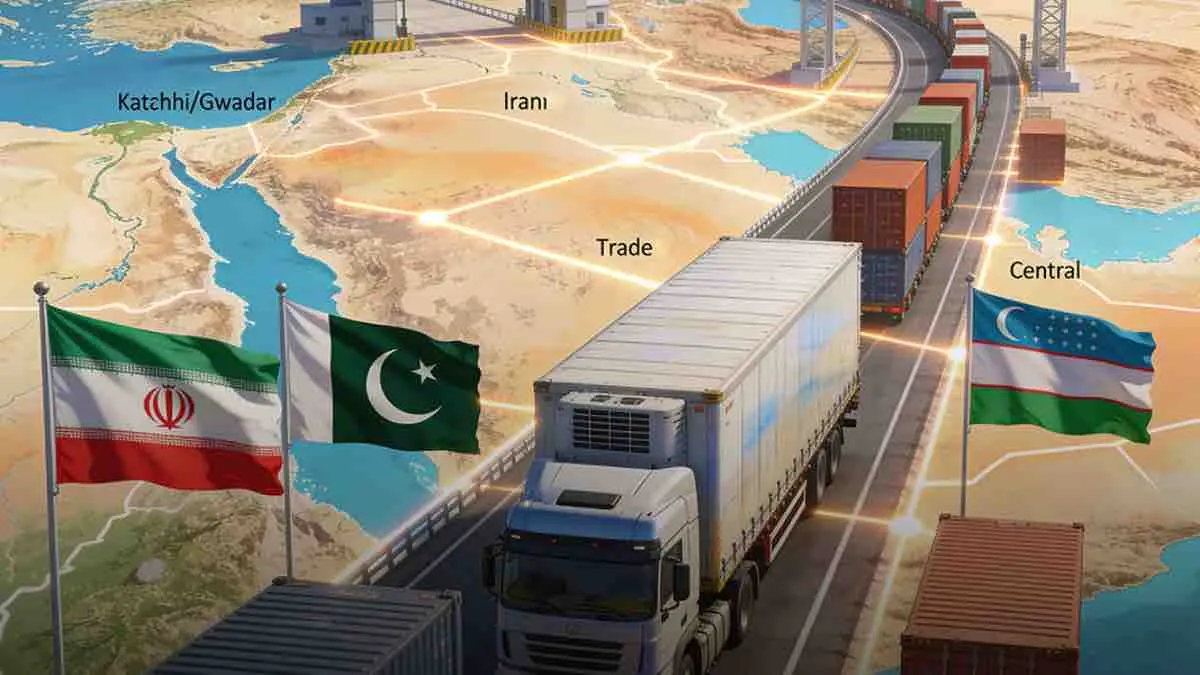
A refrigerated truck loaded with frozen meat pulled away from Karachi’s BOML Container Freight Station on April 10, 2026, destined for Tashkent, Uzbekistan. It crossed the Gabd border post near Gwadar, entered Iran through the Rimdan crossing, and began a journey that no Pakistani commercial cargo had taken before through this route.
With that inaugural shipment, Pakistan formally activated the Pak-Iran Transit Corridor — a new overland trade route linking South Asia to Central Asia through Iranian territory.
The timing was not coincidental.
A Corridor Born From Diplomacy
The launch of the corridor comes as Pakistan seeks to strengthen overland trade access to Central Asia. Experts directly linked the development to improving bilateral ties between Islamabad and Tehran, built during Pakistan’s mediation of the US-Iran ceasefire.
Munawar Hussain Panhwar, associate professor at Quaid-i-Azam University in Islamabad, said: “This corridor seems to be interlinked with growing bilateral relations between Islamabad and Tehran. Pakistan’s mediatory efforts to end the Middle East conflict have further brought the two sides closer.”
Nuclear-armed Pakistan, alongside Türkiye, China, Saudi Arabia and Egypt, helped secure a two-week ceasefire between Washington and Iran, 39 days after US-Israeli strikes on Iran in February. Islamabad also hosted rare US-Iran talks on Saturday, which ended without agreement but saw progress on several points.
The corridor is both a product of that goodwill and a signal of where Pakistan’s strategic priorities now lie.
How the Corridor Works
Director Transit Trade Customs Sanaullah Abro told The Express Tribune that the inaugural shipment, comprising frozen meat, was transported via refrigerated trucks to Tashkent, Uzbekistan. Under the corridor, consignments from Pakistan are routed through Gwadar and Iran onwards to the Central Asian states.
The Pakistan-Iran transit corridor has been launched under the TIR (Transports Internationaux Routiers) system. The Directorate of Transit Trade Customs has streamlined TIR procedures and activated key border crossing points including Taftan, Rimdan, Sost and Gwadar for TIR transit.
The TIR system — a United Nations-backed international customs transit scheme — allows sealed cargo to cross multiple borders with minimal customs checks at each stop. This dramatically reduces delays and the administrative burden on exporters moving goods through transit countries.
The inaugural shipment was jointly facilitated by Pakistan Customs, with Director General Transit Sanaullah Abro and Director Transit Rashid formally inaugurating the first two refrigerated TIR transport units at BOML CFS. Representatives from logistics operator Broadpeak were also present, alongside BOML CFS management and PNC-ICC chair.
Officials described the development as a significant step forward for Pakistan’s transit trade framework, highlighting the potential of the Gabd–Rimdan corridor to strengthen Gwadar’s strategic connectivity and expand access to emerging export markets in Central Asia.
What This Means for Gwadar and CPEC
The corridor does not stand alone. It is deeply embedded in Pakistan’s broader connectivity vision anchored around the China-Pakistan Economic Corridor (CPEC) and Gwadar Port.
The $64-billion CPEC project links northwest China to Pakistan’s Gwadar port via roads, railways and pipelines, providing a route for cargo to the Middle East, Central Asia and Africa. China wants the CPEC’s connectivity extended to Central Asia, and this corridor will play a significant role in achieving that.
Panhwar noted: “China, which also pushed Iran, wants the CPEC’s connectivity with Central Asia, and this corridor will play a significant role. The US is also onboard in this regard.”
Officials said the corridor would provide Pakistan with an alternative, cost-effective trade route, reducing reliance on sea routes. It is also expected to shorten transit time and significantly lower logistics costs.
Increased international container traffic has already been observed at Karachi Port in recent weeks, with officials noting growing coordination between customs authorities, TIR operators, and logistics companies as Pakistan works to strengthen transshipment activity through both Karachi and Gwadar.
Pakistan’s Trade With Central Asia Is Already Climbing
The corridor arrives as Pakistan’s economic ties with Central Asian markets are showing real momentum.
Pakistan’s trade with Central Asia, including Afghanistan, rose to $2.41 billion in 2025, up from $1.92 billion in 2024, with exports at $1.77 billion and imports at $641 million.
The new corridor is designed to accelerate that trajectory. Direct overland access through Iran reduces the distances and costs that have historically made Pakistani goods less competitive in Uzbekistan, Kazakhstan, Turkmenistan and beyond compared to suppliers closer to those markets.
The move also opens Pakistan’s export sectors — particularly food, pharmaceuticals and manufactured goods — to a combined Central Asian consumer base of nearly 75 million people.
Read more: Pakistan Tajikistan Land Corridor via Gilgit Proposed to Boost Trade
India’s Chabahar Retreat and Pakistan’s Strategic Window
The corridor’s launch lands at a geopolitically significant moment for India, which for a decade built its own Iran-based access route to Central Asia through Chabahar Port.
In 2016, Iran, India and Afghanistan signed a deal to develop Chabahar Port, a deep-water port on Iran’s southeastern coast, developed with significant Indian investment to bypass Pakistan and connect to Afghanistan and Central Asia. But India has since scaled back its involvement following US sanctions and an approaching April 2026 deadline. India transferred $120 million, liquidating its financial commitment, and saw officials resign from India Ports Global Ltd (IPGL) to avoid US penalties.
Pakistan has gained from the trade gap left by India. With New Delhi’s Chabahar ambitions constrained by US sanctions pressure and the collapse of its Iranian diplomatic calculus following the war, Pakistan’s Gwadar-to-Iran route is stepping into precisely the space India sought to occupy.
The contrast is stark. India invested years and hundreds of millions of dollars building its Iran access corridor — only to be forced to retreat. Pakistan, by deepening ties with Tehran through the ceasefire mediation and activating the TIR corridor simultaneously, has captured the same strategic prize at a fraction of the cost.
The Pipeline Question Returns
The corridor’s launch has also rekindled a long-delayed bilateral energy dream: the Iran-Pakistan gas pipeline.
Hopes were running high that Pakistan and Iran may revive their gas and oil pipeline projects following the peace talks between Iran and the United States. Pakistan and Iran had signed a commercial agreement in 2009, and in 2013 then-Iranian President Mahmoud Ahmadinejad and former President Asif Ali Zardari inaugurated the gas pipeline project. Iran has completed its portion of the pipeline, while Pakistan has yet to kick off construction on its side.
Officials say Iran is willing to extend the gas sale agreement for another decade, but Pakistan has wanted to shelve the project due to US sanctions on Tehran and weak domestic demand. Over the years, Pakistan explored alternative options including laying an LNG pipeline to Gwadar with an 80km extension to the Iranian border. A Chinese company expressed interest in building the pipeline, but sanctions remained a hurdle.
With US-Iran ceasefire talks now under way in Islamabad and sanctions relief on Iran’s 10-point demand list, the geopolitical window for revisiting the pipeline is wider than it has been in over a decade.
A New Regional Logistics Hub Takes Shape
Taken together, the Pak-Iran Transit Corridor, CPEC’s expansion, the ceasefire diplomacy, and Pakistan’s growing Central Asian trade volumes point to a single strategic direction: Islamabad positioning itself as the linchpin of South-to-Central Asian trade connectivity.
Iran and Pakistan have set a target to increase bilateral trade from $3 billion to $10 billion as part of the new partnership framework. Both sides framed this goal as a step toward strengthened economic cooperation and long-term regional integration.
The new corridor is expected to provide faster and more efficient transit options for exporters while positioning Pakistan as a key logistics hub connecting South Asia, the Middle East, and Central Asia.
The first truck that left Karachi for Tashkent was carrying frozen meat. But the route it opened is carrying something far heavier: Pakistan’s ambition to be at the centre of a new Asian trade geography — one built on proximity, diplomacy, and infrastructure, not just aspiration.
Frequently Asked Questions (FAQs)
Q: What is the Pak-Iran Transit Corridor and when did it launch? It is a new overland trade route allowing Pakistani exports to move through Iran to Central Asian countries using the international TIR customs transit system. It was formally activated on April 10, 2026, with its first shipment — frozen meat — dispatched from Karachi to Tashkent, Uzbekistan.
Q: What is the TIR system and why does it matter? TIR (Transports Internationaux Routiers) is a UN-backed international customs transit framework that allows sealed cargo to cross multiple national borders with minimal customs inspections at each stop. It reduces delays, lowers logistics costs, and makes multi-country overland trade commercially viable for exporters.
Q: Which border crossings are active under this corridor? The Directorate of Transit Trade Customs has activated Taftan, Rimdan (Gabd), Sost, and Gwadar as the primary TIR transit crossing points under the new corridor.
Q: How does this corridor connect to CPEC? The corridor routes cargo through Gwadar Port — a flagship CPEC node — before entering Iran and continuing to Central Asia. China sees this as a direct extension of CPEC’s connectivity ambitions, giving its goods and Pakistan’s exports combined overland access to Central Asian markets without sea routes.
Q: Why did India lose its position in Iran’s trade corridor? India invested over a decade and hundreds of millions of dollars developing Chabahar Port in Iran as its gateway to Central Asia. However, US sanctions pressure in early 2026, including the rescinding of sanctions waivers, forced India to liquidate its financial commitments and withdraw key personnel. Pakistan’s improved Iran ties and corridor activation have stepped into that vacuum.
Q: Could the Iran-Pakistan gas pipeline be revived? It is possible. Iran completed its side of the pipeline years ago and is willing to extend the gas agreement for another decade. With US-Iran peace talks under way in Islamabad and sanctions relief on the negotiating table, the geopolitical conditions for revisiting the long-stalled pipeline project are more favourable now than at any point since 2013.