
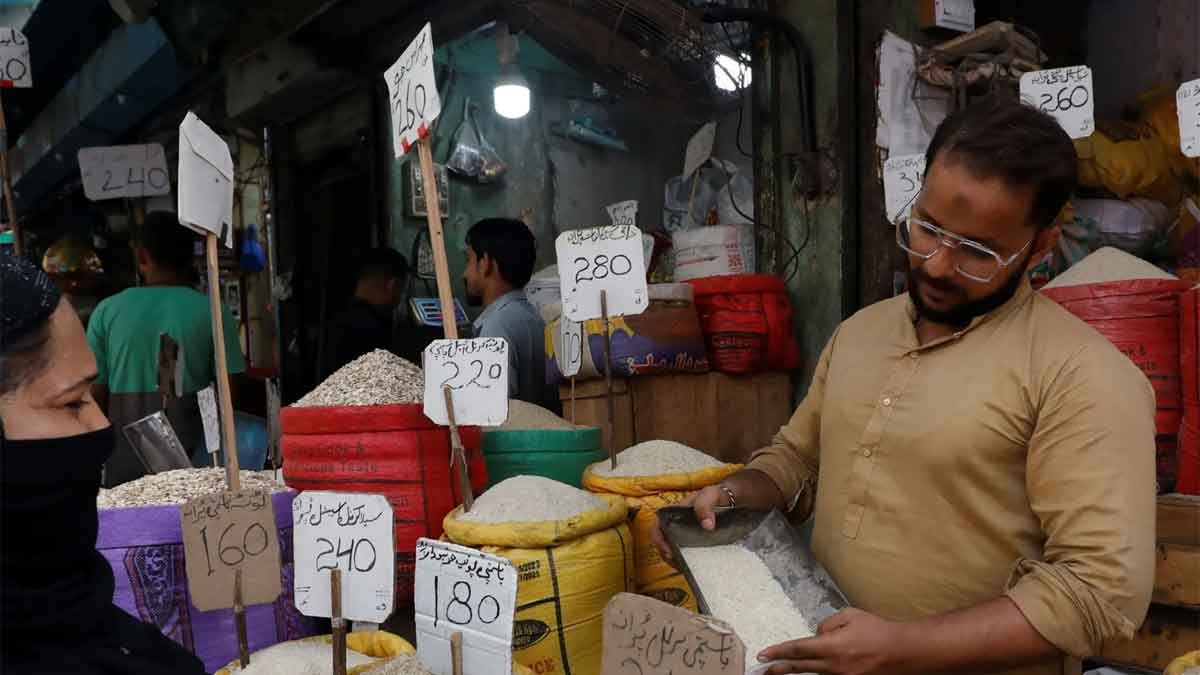
Pakistan’s rice exports came under strong pressure in FY2026 after earlier signs of stability. In February alone, exports dropped 35.38%, even though the government had introduced subsidies to support the sector. This sharp fall has raised concerns among exporters about whether the support measures are working.
The slowdown is not limited to one month. During the first eight months (July–February) of FY2025–26, rice exports declined by 40% compared to the same period last year. This shows a clear loss of momentum in one of Pakistan’s key export sectors.
Official data from the Pakistan Bureau of Statistics shows exports falling to $1.49 billion, down from $2.48 billion a year earlier. The drop highlights the scale of the downturn despite policy support.
Looking ahead, risks remain high. Analysts warn that rising tensions in the Middle East, particularly due to the ongoing Iran conflict, could further disrupt trade. Any impact on shipping routes in the Gulf region — a major market for Pakistani rice — may lead to even more pressure on exports.
Pakistan Rice Exports 2026: Latest Official Update
Pakistan’s rice exports began FY2025 with strong momentum. In the first five months of the fiscal year, exports rose 35.40% to $1.515 billion, with shipments crossing 2.377 million metric tons. That early surge made rice one of Pakistan’s strongest export stories in late 2024.
But the trend did not hold at the same pace. Later official data shows that the sector lost momentum during the rest of FY2025 and entered FY2026 under much heavier pressure. The result is a more mixed picture than the original article suggested.
FY2025 Started Strong
The original numbers were genuine. Between July and November 2024, Pakistan exported 2.377 million metric tons of rice worth $1.515 billion. Basmati exports reached 370,282 metric tons valued at $386.116 million, while other rice varieties brought in about $1.129 billion.
That performance reflected strong overseas demand and a favorable start to the year. It also helped lift Pakistan’s broader food exports during that period.
The Export Trend Weakened Later
The strong opening did not continue through the full year. Pakistan’s Annual Plan 2025-26 says rice export receipts fell 9.71% in July-April FY2024-25, dropping from $3.282 billion to $2.963 billion.
The State Bank later confirmed the broader slowdown. In its Annual Report 2024-25, SBP said rice exports declined 14.7% in FY2025, mainly because India re-entered the global rice market in September 2024 and international rice prices softened. The report added that non-basmati rice was hit hardest, while basmati stayed relatively more resilient.
That means the original article now captures only the best part of the cycle, not the overall outcome.
Read more: Major win for Pakistan as Kenya lowers rice export valuation by $155 per ton
New Trade and Policy Changes
The post-publication period also brought important policy changes. On January 14, 2025, Pakistan and Bangladesh signed an MoU for rice exports through TCP and Bangladesh’s Directorate General of Food. Later official records said the framework covered 200,000 MT annually for five years, and that 52,500 MT of white rice had already been exported to Bangladesh in March 2025.
On March 10, 2025, the Ministry of National Food Security and Research announced that methyl bromide fumigation would no longer be done in Pakistan for these exports. Instead, fumigation would take place in importing countries. The ministry said this would lower exporter costs and help Pakistan compete better in international markets, especially in Europe.
Then, on January 23, 2026, the Ministry of Commerce issued the Drawback of Local Taxes and Levies for Rice Order, 2026. The order allowed a 9% drawback on qualifying basmati and brown rice exports and 3% on specified lower-value rice categories. On February 9, 2026, the ministry revised the FOB clause and capped the higher-rate category at US$1,275 per metric ton.
Latest Official FY2026 Picture
The latest official data is much weaker than the late-2024 headline suggested. The Ministry of Commerce’s July-January FY2025-26 commodity statement shows total rice exports at $1.305 billion, down 40.51% from $2.194 billion a year earlier. Export volume also fell 32.94%.
Within that, basmati exports were down 6.62% in value to $477.71 million, while other rice varieties fell 50.81% to $827.78 million. That confirms the market has become much tougher, especially for non-basmati shipments.
Outlook for Exporters
The supply outlook is not entirely negative. In October 2025, the Federal Committee on Agriculture estimated Pakistan’s rice production for 2025-26 at 9.417 million tons from 3.039 million hectares. That gives exporters a stronger production base than before.
Still, the most accurate 2026 conclusion is this: Pakistan’s rice export story is no longer about uninterrupted growth. It is now about adjustment. The sector has stronger government backing, fresh trade channels, and a good crop outlook, but it is also facing price pressure, tougher competition, and weaker recent export earnings.




Join the Conversation
Share your thoughts, questions, or feedback below.