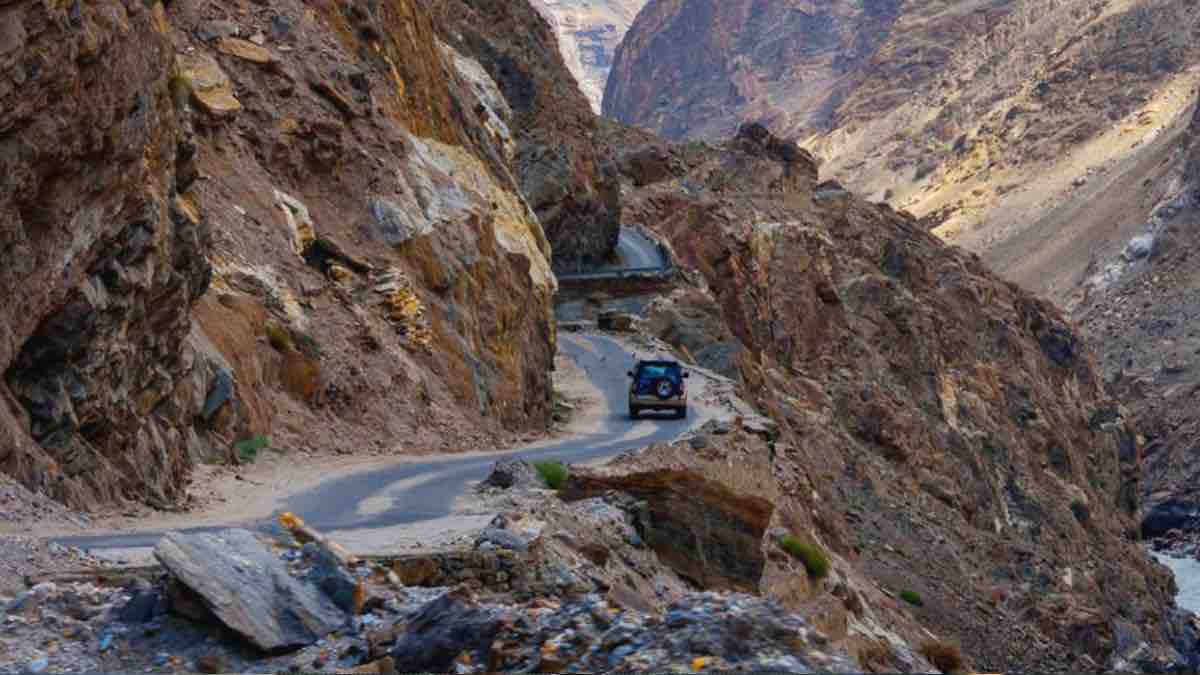
Pakistan’s northern regions are highly famous for their marvelous and soul-satisfying beauty—towering peaks, deep valleys, roaring rivers, and ancient glaciers. But there are various things hidden within this beauty, are some of the most dangerous roads in the world. These routes are carved into the sides of massive mountains and often have no guardrails, no room for error, and no second chances.
Travelers from around the world come to encounter these roads not only for adventure, but also for the sheer amazement of how humans managed to build paths in such impossible terrain.
Below are the Top 5 Most Dangerous Roads of Pakistan that you must know and be aware of when you make plans to travel through these roads.
1. Fairy Meadows Road (Nanga Parbat’s “Killer Mountain” Road)
Key Hazard: Extreme Narrowness & Deadly Drop-offs
Location: Gilgit-Baltistan, starting from Raikot Bridge on the Karakoram Highway
Fairy Meadows Road is often called one of the scariest roads on Earth, and for good reason. It is a narrow, unpaved mountain track about 16.2 km long, built right into the cliffs of Nanga Parbat—the world’s ninth-highest mountain, also known as “Killer Mountain.”
The road is so tight that only one jeep can be able to pass at a time. On one side, there is a huge rocky wall, and on the other, a massive drop of thousands of feet straight down to the Indus River. There are
- No safety barriers installed
- No fences along the road
- Absolutely no room for mistakes.
One wrong move, one slip, and the vehicle can lead the vehicle to fall into the deep valley.
Drivers who take this road must be experienced, focused, and extremely calm. The path gets worse as you go higher, and finally, vehicles cannot go any further. The last component of the journey must be completed on foot, by bike, or on horseback, which adds to the adventure and danger.
Even though it is dangerous, the road leads to Fairy Meadows which is a beautiful green meadow with mind-blowing views of Nanga Parbat, so many tourists still dare to take the risk.
2. Karakoram Highway (KKH – N-35)
Key Hazard: Landslides & Unstable Terrain
Location: From Havelian (KPK) to the Khunjerab Pass (China Border)
The Karakoram Highway, often called the “8th Wonder of the World,” is the highest paved international road. It stretches for about 1,300 km and connects Pakistan with China at the Khunjerab Pass, one of the highest border crossings on Earth.
Even though it’s an engineering marvel, it is also extremely dangerous. This is because the KKH passes through some of the most unstable mountain ranges in the world. The mountains are young, which means they are always shifting. As a result, the KKH constantly encounters:
• Landslides
• Rockfalls
• Flash floods
• Glacier meltwater
• Snow blockages and avalanches
Certain sections, especially near Besham, Dasu, and Chilas, are known for sudden rock falls that can block the road for hours or even days. Sometimes, masses get stuck between roadblocks with no access to food or shelter.
At high altitudes, like near Khunjerab, the air gets thinner, temperatures drop sharply, and visibility can disappear in seconds due to snowfall or smog or sometimes fog. Drivers must be well prepared for rapid weather changes and extremely long travel times.
Despite all this, the KKH is still one of the most famous tourist roads in the world and it is attracting thousands of travelers each year.
Read more: Top 10 must-visit beautiful places in Pakistan for 2026 travelers]
3. Gilgit–Skardu Road (S-1 Strategic Highway)
Key Hazard: Sharp Hairpin Turns & Narrow Road Along the Indus River
Location: Gilgit to Skardu (along the mighty Indus River)
The Gilgit–Skardu Road, known as S-1, is about 167 km long and is one of the most nerve-racking drives in Pakistan. It was carved directly into the cliffs of the Indus River, creating a narrow path where two vehicles can barely cross each other.
What makes this road dangerous?
• It bends sharply with tight, blind hairpin turns
• The river below is extremely fast and powerful
• The road has many parts where even a small mistake can lead to a fall straight into the Indus
This route is essential because it connects Skardu—a major tourist and military region—to the rest of Pakistan. For years, the road was unpaved and in terrible condition. Although improvements have been made recently, the danger is still very real, especially during:
• Rainy seasons
• Snowfall
• Spring snowmelt
These conditions are meant to cause landslides that can result in the blocking of the road for days. People traveling on this road must be patient, prepared, and mentally ready for long delays.
4. Shimshal Valley Road
Key Hazard: Extreme Exposure, Deep Gorges & Complete Isolation
Location: The road tarts near Passu on the KKH and leads to Shimshal Valley
Shimshal Valley is one of the most remote places in Pakistan, and its road is clearly depicting that isolation. The road to Shimshal was completed only recently, and before that, people had to walk for several days to reach the valley.
Today, the road exists, but it is still one of the most dangerous and fear-provoking mountain roads:
• It is unpaved and narrow, with loose gravel
• There are huge cliffs and steep drops everywhere
• The road passes through deep gorges, hanging cliffs, and avalanche-prone areas
• There are old, shaky wooden bridges that can terrify even the bravest driver
What makes it worse is that help is far away. If a vehicle breaks down or an accident happens, it may take hours or even days for rescue teams to reach. The people of Shimshal are brave and skilled at driving in these tough conditions, but for visitors, the road is a huge challenge.
5. Khaltaro Valley Road
Key Hazard: Steep Gradients & Loose Gravel Surface
Location: Gilgit District
Khaltaro Valley Road is not as famous internationally as the others, but many local drivers consider it one of the scariest roads in northern Pakistan. The road is steep—some slopes reach up to 15% gradient, which feels almost like climbing a wall.
The surface is made of loose gravel, so tires can slip easily. Add to that the narrow width and no protective barriers, and you get a road where full concentration is required at every second. One wrong move can send a vehicle rolling down the cliff.
Locals use strong 4×4 vehicles, but even they drive carefully because the danger is always present. The views are beautiful, but the road demands respect.
Reasons: Why are These Roads So Dangerous?
Pakistan’s northern terrain is naturally rough and wild. These dangers come from:
• Extreme heights and steep cliffs
• Unstable mountain rocks
• Heavy snow and unpredictable weather
• Poor road maintenance
• Very limited rescue services
Despite all this, the masses are still preferring these dangerous roads to travel for adventure, tourism, or to reach their homes. They show the resilience of the people living in the mountains and the incredible beauty hidden within Pakistan’s rugged landscape.