
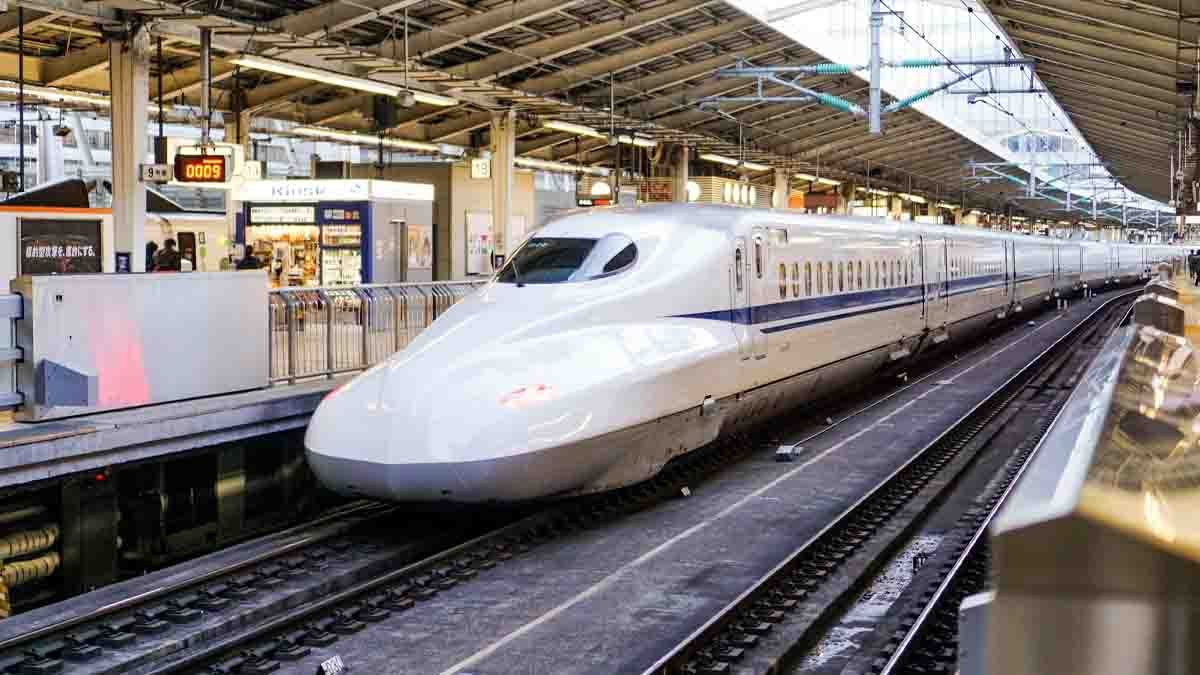
Pakistan’s most talked-about rail project just cleared a major milestone. On April 16, 2026, Pakistan Railways and the Punjab government signed a formal agreement to launch a high-speed train service between Lahore and Rawalpindi — the country’s busiest inter-city rail corridor.
The deal, signed by Federal Railways Minister Hanif Abbasi and Punjab Chief Minister Maryam Nawaz, moves the project from political announcement into structured implementation.
From Announcement to Agreement: The April 2026 MoU
The agreement was signed by Railways Minister Hanif Abbasi and Punjab Chief Minister Maryam Nawaz in Lahore. The proposed service is expected to complete the journey between the two cities in about two hours and 15 minutes, significantly reducing travel time on one of the country’s busiest rail corridors.
Federal Minister for Railways Hanif Abbasi said that with Punjab’s support, around 90 million people will benefit from nine routes, providing travel facilities at European standards.
The signing brings to a close more than a year of political endorsements, working group meetings, and feasibility discussions — and formally commits both the federal and provincial governments to a shared execution framework.
Route Details: How the Train Will Reach Rawalpindi
The project will see trains from Lahore travel via Lalamusa, Dina, Gujar Khan and Rawalpindi before reaching Islamabad. The existing line between Kalowal and Pindora will be rebuilt and doubled as part of the plan, that also involves reconstruction of bridges and marshalling yards along the route.
The existing railway line between Rawalpindi and Lahore is 280 kilometers long, and trains currently in service travel at an average of 65 kilometers per hour.
The route passes through hilly terrain near Margalla and includes three major river bridges — over the Chenab, Ravi, and Jhelum — plus at least eight canal culverts, all of which will need reconstruction.
Travel Time, Frequency, and Station Upgrades
The most immediate change commuters will notice is travel time. The premier train, Green Line, currently reaches from Lahore to Rawalpindi in four and a half hours. CM Maryam wants to reduce this time to two hours.
Under the MoU, the target is now 2 hours and 15 minutes.
The number of trains operating between Lahore and Rawalpindi is set to increase to 120, enhancing travel convenience and transportation quality.
Approval has been granted to construct all stations from Lahore to Rawalpindi to meet international standards.
More than 400,000 trees will be planted along railway tracks, while green parks will be developed from Shahdara to Raiwind.
Read more: Here’s why bullet train between Lahore and Rawalpindi is just a dream for the time being
The Cost Question: What Will It Actually Take?
Financing remains the project’s largest unresolved challenge.
The Rs 400 Billion Starter Plan
A modernised high-speed service (at up to 160 km/h) using upgraded track, locomotives, and safety systems has been priced at around Rs 400 billion ($1.4 billion).
A conversation had been held with Prime Minister Shehbaz Sharif, “who had asked us to submit the Rs 400 billion plan in this regard.”
Funding for the project, estimated at up to $US 10bn, has yet to be agreed and Aurangzeb is liaising with Pakistan Railways (PR) over a number of potential options, including a public-private partnership (PPP) model.
Full Bullet Speed Could Cost Up to $15 Billion
According to experts, the project’s cost will run into multi-billion dollars. “The per-kilometer cost of laying railway track for a fast train is between $40 and $50 million, meaning the total cost can reach up to $10 billion,” they added.
Independent engineer Riaz Rashid, a former senior consultant on Saudi Arabia’s North-South Rail Project, estimates a true high-speed system built to international standards could cost up to $15 billion.
Expert Reality Check: Is This Actually a Bullet Train?
Not everyone is convinced the “bullet train” label fits the current plan.
The Punjab government’s plan to introduce Pakistan’s first bullet train between Lahore and Rawalpindi is being met with skepticism from senior railway officials, who have termed the idea a “dream” given the country’s outdated infrastructure and steep financial requirements. While Punjab’s political leadership remains keen on launching a fast rail service, experts say a bullet train would require a complete overhaul of existing rail assets — including tracks, stations, signals, coaches, engines, and support systems.
Experts say Punjab CM’s hopes for a high-speed line between Lahore and Rawalpindi are “unrealistic.” “We don’t even have the rolling stock (coaches and locomotives, etc) that are compatible with bullet trains,” a senior PR official explained.
Globally, the benchmark speed for high-speed trains is between 200 and 250 kilometres per hour, while more advanced bullet trains can travel over 300kmph.
Estimated ticket prices for a bullet train could exceed Rs 15,000 to Rs 20,000 per passenger, making the service unaffordable for the vast majority. Officials drew comparisons with Saudi Arabia’s Haramain High Speed Railway, which is only viable due to heavy government subsidies.
Supporters counter that the same skepticism greeted the Lahore–Islamabad Motorway (M-2) in 1997 — and that it is now indispensable.
Phased Approach: 160 km/h First, Then True High Speed
The government appears to have quietly adjusted its ambitions.
The Bullet Train project itself is being envisioned in phases. Initially, the goal is to modernise the existing rail track to support speeds of up to 160 km/h — not yet “bullet” speed, but a substantial leap from the current average of 60–70 km/h. Full high-speed rail could be introduced in the long term, based on performance, ridership demand, and financial sustainability.
Independent experts believe that running a high-speed train between Lahore and Rawalpindi is a herculean task, something that would take years to complete. It may take up to seven years if the government starts work today on war-footings with thousands of labourers and engineers.
The phased model — start fast, scale to bullet — is the same path India, France, and Japan followed when building their own high-speed rail networks.
Beyond Rawalpindi: Punjab’s 1,415 km Rail Network
The April 2026 MoU covers far more than the Lahore–Rawalpindi route.
The initiative also includes the development of multiple local rail routes spanning around 1,415 kilometers across 20 districts of Punjab. According to officials, the expanded network will include routes such as Shahdara to Narowal via Sialkot, as well as services covering Raiwind, Kasur, Pakpattan, and Lodhran. Additional lines are planned between Sheikhupura, Jaranwala, and Shorkot, along with connectivity from Lala Musa to Malakwal and Sargodha. Another proposed route will link Faisalabad with Chak Jhumra and Shahinabad, while an interprovincial corridor from Kot Addu to Kashmore via Dera Ghazi Khan is also part of the project.
A modern railway network spanning 1,415 kilometers will also be established across 20 regions of Punjab on eight local routes, along with the introduction of advanced trains. The Punjab government will provide modern DMU trains on regional routes.
This signals that the Lahore–Rawalpindi line is not a standalone vanity project but the flagship of a broader provincial rail modernization strategy.
The Bigger Picture: ML-1 and National Rail Reform
The Lahore–Rawalpindi project sits alongside an even larger federal initiative.
Pakistan Railways has unveiled an ambitious bullet train project between Lahore and Karachi, aiming to slash travel time from nearly 20 hours to just five by 2030. The project forms a pivotal part of the $6.8 billion ML-1 upgrade under the China-Pakistan Economic Corridor (CPEC).
The project is expected to raise Pakistan’s rail freight share from 4% to 20% by 2030, significantly reducing reliance on costly road transport and cutting billions in fuel imports.
Together, the Punjab provincial initiative and the federal ML-1 program represent the most ambitious overhaul of Pakistan’s rail network in decades.
Whether the Lahore–Rawalpindi corridor ultimately delivers 160 km/h or full bullet-train speed depends on funding, terrain engineering, and political follow-through. But for the first time in the country’s rail history, a formal agreement is in place — and the clock is now running.


Join the Conversation
Share your thoughts, questions, or feedback below.