The countdown clock read less than 90 minutes.
US President Donald Trump had set a deadline. If Iran did not reopen the Strait of Hormuz by 8pm Washington time on April 7, he would destroy its bridges, power plants, and what he described — in a post that shook the world — as its entire “civilisation.”
Then a phone rang in Islamabad.
Just under 90 minutes before Trump’s deadline expired, he took to Truth Social and announced he had agreed to a two-week ceasefire with Iran after almost six weeks of bombing. Soon after, Iranian Foreign Minister Abbas Araghchi confirmed the ceasefire on X, giving a world on edge a chance to breathe again.
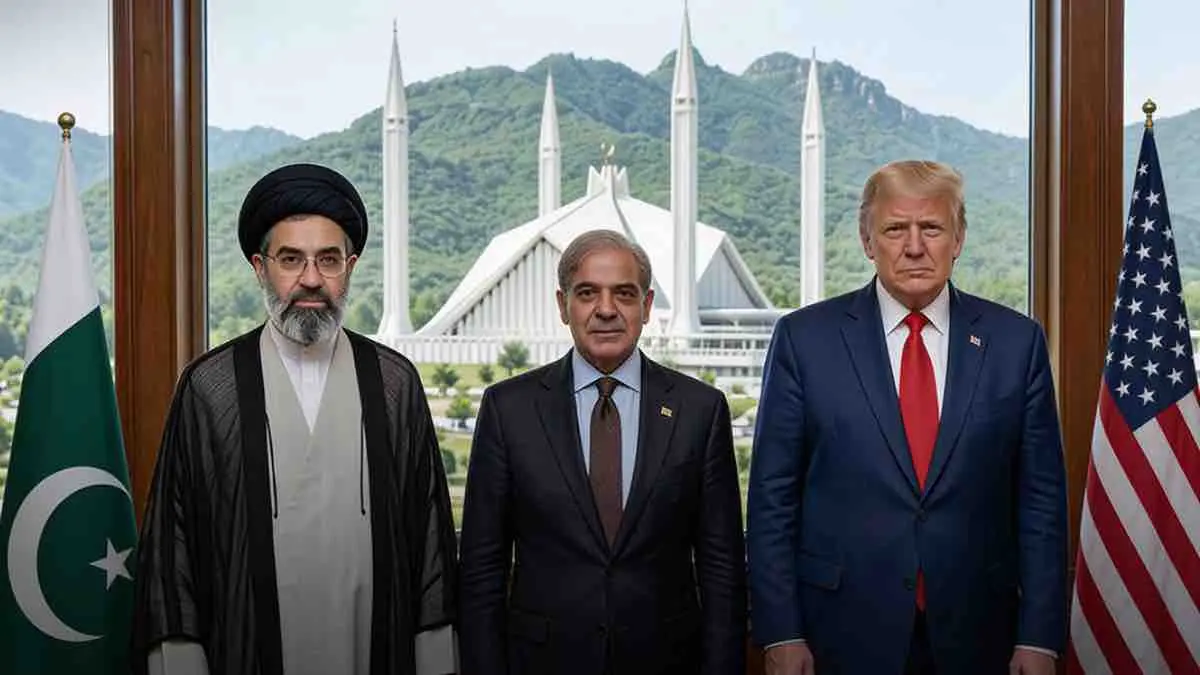
Both Washington and Tehran named the same reason for the breakthrough: Pakistan.
The Words That Made History
Trump wrote: “Based on conversations with Prime Minister Shehbaz Sharif and Field Marshal Asim Munir, of Pakistan, and wherein they requested that I hold off the destructive force being sent tonight to Iran… I agree to suspend the bombing and attack of Iran for a period of two weeks.”
Iran’s response was equally direct. Araghchi said: “On behalf of the Islamic Republic of Iran, I express gratitude and appreciation for my dear brothers HE Prime Minister of Pakistan Sharif and HE Field Marshal Munir for their tireless efforts to end the war in the region,” adding that Iran had accepted the ceasefire “in response to the brotherly request of PM Sharif.”
PM Shehbaz announced that Washington and Tehran, along with their allies, had agreed to an immediate ceasefire “everywhere, including Lebanon,” and invited both delegations to Islamabad on April 10, 2026, to negotiate a conclusive agreement to settle all outstanding disputes.
The move prompted US stocks to reverse declines and set the stage for Trump’s announcement just hours later. Oil prices dropped 16 percent. The Strait of Hormuz — closed for five weeks — was set to reopen.
How the War Began
To understand how Pakistan ended up at the centre of a global crisis, you have to understand how the crisis began.
The war started on February 28 when the US and Israel launched coordinated strikes that killed Supreme Leader Ali Khamenei and struck Iran’s military and nuclear infrastructure. In five weeks, it killed more than 2,000 people in Iran, disrupted roughly a fifth of the world’s oil supplies, and threatened to draw in regional powers.
The closure of the Strait of Hormuz in late February 2026 disrupted global energy markets, with oil prices surging. The ceasefire aimed to stabilize energy prices and prevent further escalation.
The US-Iran conflict, now in its sixth week, caused over 5,000 casualties, including more than 1,600 civilians in Iran and 1,000 in Lebanon.
For Pakistan, the war was not a distant crisis. It hit home.
Pakistan’s Balancing Act from Day One
Pakistan’s diplomatic engagement began within hours of the first strikes — and it was anything but simple.
When the first strikes hit Tehran, Foreign Minister Ishaq Dar was in Saudi Arabia attending a meeting of the Organisation of Islamic Cooperation. Within hours, Pakistan’s Ministry of Foreign Affairs issued a statement, and Dar called Araghchi to convey solidarity.
By March 3, Dar was addressing Pakistan’s Senate: “Pakistan is ready to facilitate dialogue between Washington and Tehran in Islamabad,” he told lawmakers.
At home, the situation was volatile. In Karachi, demonstrators tried to storm the US consulate on March 1, leaving at least 10 people dead. Pakistan’s Shia Muslim population, estimated at 15 to 20 percent of the country’s roughly 250 million people, was watching closely.
Munir summoned Shia clerics to Rawalpindi and warned that violence inside Pakistan would not be tolerated. The message was clear: Pakistan would maintain order and pursue diplomacy simultaneously.
On March 12, Shehbaz travelled to Jeddah with Munir to meet Saudi Crown Prince Mohammed bin Salman, expressing “full solidarity” while urging restraint. It was a delicate balancing act — Pakistan had to maintain its mutual defence pact with Riyadh without being drawn into direct confrontation with Iran, its neighbour with which it shares a nearly 1,000km border.
Qamar Cheema, executive director of the Sanober Institute, explained Pakistan’s early credibility advantage. “When Pakistan condemned American strikes, that was where Pakistan won over the Iranians as well. This role as a global peacemaker is the result of personal diplomatic investment in Iran and the protection of international law,” he said.
The Proposals, the Rejections, and the Backchannel
As the war escalated through March, Pakistan became the primary channel for every major proposal exchanged between Washington and Tehran.
On March 16–17, Israeli strikes killed Ali Larijani, secretary of Iran’s Supreme National Security Council, and one of the most powerful figures in Tehran. On March 18, Israeli jets struck South Pars — the world’s largest natural gasfield — which accounts for roughly 70 percent of Iran’s domestic gas production. The attack triggered a new wave of Iranian retaliation on Gulf energy infrastructure, sending oil and gas prices soaring.
From March 22 to 23, Munir spoke directly to Trump. The US president had already announced a five-day pause on strikes targeting Iranian energy infrastructure, signalling he was open to a diplomatic exit.
On March 23, Pakistan formally offered to host talks. Sharif echoed the offer publicly on X, tagging Trump, Araghchi and Witkoff.
On March 26, Dar confirmed that the US had shared a 15-point proposal with Iran via Pakistan, demanding commitments on Iran’s nuclear programme, limits on its ballistic missiles, and the reopening of the Strait of Hormuz. Tehran rejected it and responded with a 10-point counteroffer — demanding an end to hostilities, sanctions relief, reparations, recognition of its sovereignty over the strait, and the withdrawal of US forces from the region.
The positions were far apart. But the fact that both proposals passed through Islamabad confirmed Pakistan’s indispensable role.
Read more: Pakistan’s Islamabad Accord Wins as US-Iran Ceasefire Takes Effect Immediately
The Quadrilateral Mechanism and China’s Entry
Pakistan did not work alone. It built a coalition.
In Riyadh, a quadrilateral mechanism took shape, bringing together Pakistan, Saudi Arabia, Turkiye and Egypt. On March 29, the foreign ministers of all four countries reconvened in Islamabad — their second such meeting in ten days.
After the talks, Dar travelled to Beijing and met Chinese Foreign Minister Wang Yi. The two sides outlined a five-point initiative that included a ceasefire, early dialogue, civilian protection, restoration of shipping through the Strait of Hormuz, and a larger UN role. On Tuesday, Trump confirmed that China appeared to have played a role in pushing Iran towards talks.
Pakistan’s Ambassador to the United States Rizwan Saeed Sheikh, speaking on CNN, said: “We are thankful to Saudi Arabia, Türkiye, Egypt, Qatar, China and others whose joint efforts made the ceasefire possible and paved the way for dialogue.” He added: “China, from day one, urged all sides to exercise restraint and pursue diplomacy.”
The Munir Factor: A Direct Line to Trump
No analysis of Pakistan’s mediation is complete without understanding Field Marshal Asim Munir.
His relationship with Trump dates to early last year when Pakistan arrested the alleged perpetrator of the Abbey Gate bombing in Kabul in 2021, which killed 13 American service members. Their relationship truly took root after the brief conflict between Pakistan and India in May, when Trump publicly claimed credit for brokering a ceasefire — a claim acknowledged by Pakistan but rejected by India.
That episode opened a direct channel between Munir and the White House. He has since visited Washington twice, and Trump publicly praised him on several occasions, telling reporters that Pakistanis “know Iran very well, better than most.”
Pakistan’s powerful army chief visited Washington with Sharif last year after the India flare-up. Sharif praised Trump’s “bold and visionary” intervention, while Munir said the US leader deserved the Nobel Peace Prize for stopping the escalation between the nuclear-armed neighbours.
Analysts, however, cautioned against reducing Pakistan’s role to personal relationships alone.
Professor Ishtiaq Ahmad of Quaid-i-Azam University said: “The personal equation helped accelerate decision-making at a critical moment, but the mediation was not built on personalities alone. It rested on institutional alignment between Pakistan’s civil and military leadership and on sustained engagement with Washington over the past year.”
The Final Hours: A Civilization Nearly Died
The climax came on Easter Sunday, April 6.
As Pope Leo XIV called for peace from the Vatican, Trump issued a stark warning on Truth Social: “Tuesday will be Power Plant Day, and Bridge Day, all wrapped up in one, in Iran.” He threatened to blow up all of Iran’s bridges and power facilities if it did not reopen the Strait of Hormuz.
By Monday, Pakistan had put forward a two-phase ceasefire proposal with Munir in contact with Vance, Witkoff, and Araghchi. Trump initially rejected the plan. Hours before the 8pm deadline expired, he posted: “A whole civilization will die tonight, never to be brought back again.”
The framework was reportedly negotiated after overnight talks between Field Marshal Asim Munir, US Vice President JD Vance, US special envoy Steve Witkoff, and Iranian Foreign Minister Abbas Araghchi.
According to officials, Munir continued engaging both sides in the final hours, even as much of the diplomacy remained out of public view, until Sharif’s public appeal came with about five hours remaining.
The breakthrough followed shortly after.
Islamabad Becomes the World’s Diplomatic Capital
With the ceasefire in effect, Pakistan moved immediately to host the next phase.
White House Press Secretary Karoline Leavitt confirmed that Vice President JD Vance, special envoy Steve Witkoff, and Jared Kushner would travel to Islamabad for talks beginning Saturday morning local time.
Iran is expected to be represented by Parliament Speaker and former Revolutionary Guards commander Mohammad Baqer Qalibaf, alongside Foreign Minister Abbas Araghchi.
Axios described the talks as the highest-level meeting between the US and Iran since the 1979 Islamic Revolution, representing a crucial tipping point that could lead to the resumption of war if the high-stakes discussions fail.
Pakistan’s federal cabinet declared a “Day of Gratitude,” with PM Shehbaz chairing a cabinet meeting where members celebrated the diplomatic gains, applauded his leadership, and served sweets during the session. Members also paid tribute to Field Marshal Munir and Deputy PM Ishaq Dar for their roles.
The World Responds
The international reaction was swift and sweeping.
Kazakhstan’s President Kassym-Jomart Tokayev welcomed the “achievement of an agreement on a full ceasefire and truce in the Middle East, reached with the mediation of Prime Minister of Pakistan Shehbaz Sharif and Field Marshal Munir.” Malaysian Prime Minister Anwar Ibrahim extended “sincere congratulations and deep appreciation to Pakistan and Prime Minister Shehbaz Sharif for the tireless and courageous diplomacy that helped bring this moment about.”
The President of the EU Commission Ursula von der Leyen thanked Pakistan for playing the role of mediator. The President of the European Council Antonio Costa thanked Pakistan and all parties involved. Sweden’s Foreign Minister also lauded Pakistan for mediating peace between the US and Iran.
Kamran Bokhari, senior resident fellow with the Middle East Policy Council in Washington, told Reuters: “Pakistan hosting US-Iran talks represents a major upgrade in Islamabad’s strategic standing. After decades of being a troubled state, Pakistan appears to be re-emerging as a major American ally in West Asia.”
What Comes Next — and What Remains Unresolved
The ceasefire is fragile. Multiple fault lines remain.
Key differences exist over whether Lebanon is included in the ceasefire. Israeli Prime Minister Netanyahu’s office said the arrangement does not cover Lebanon, and Israeli attacks there killed dozens on the very day the ceasefire was announced — contradicting Sharif’s claim that the truce covered “everywhere including Lebanon.”
Iranian Foreign Minister Araghchi warned: “The Iran–US ceasefire terms are clear and explicit: the US must choose — ceasefire or continued war via Israel. It cannot have both.”
Iran’s 10-point proposal framework includes not only its nuclear programme and regional security, but also primary and secondary sanctions dating back 45 years.
Yet even analysts who called for caution acknowledged Pakistan’s historic achievement.
Former Pakistan Ambassador to the UN Masood Khan said: “This is the first time Pakistan has simultaneously managed active conflict mediation between two adversaries under ongoing military escalation without direct contact between them. While ultimate success will depend on the outcome of the process, even at this preliminary stage, Pakistan has already carved a niche for itself in diplomatic chronicles.”
When Pakistan quietly facilitated US Secretary of State Henry Kissinger’s secret trip to Beijing in 1971, its role remained unacknowledged for years. This time, recognition came almost immediately — from both Washington and Tehran.
Frequently Asked Questions (FAQs)
Q: How did Pakistan broker the US-Iran ceasefire in April 2026? Pakistan acted as the primary backchannel mediator for weeks, carrying proposals between Washington and Tehran, hosting quadrilateral talks with Saudi Arabia, Turkey and Egypt, and engaging China. In the final hours, Field Marshal Asim Munir held direct talks with Vice President Vance, Steve Witkoff, and Iranian FM Araghchi, while PM Shehbaz made a public appeal that prompted Trump to agree to a two-week ceasefire.
Q: Why did both the US and Iran trust Pakistan as a mediator? Pakistan maintains a mutual defence pact with Saudi Arabia and a direct line to Trump through Field Marshal Munir, while simultaneously sharing a nearly 1,000km border with Iran and condemning the initial US-Israeli strikes — giving it credibility with Tehran. It had no prior involvement in the Abraham Accords or the 2015 Iran nuclear deal, making it a neutral actor both sides could accept.
Q: What is the ‘Islamabad Accord’ proposal? Pakistan introduced a draft 45-day, two-phased ceasefire framework on April 5, 2026. Phase 1 called for an immediate halt to hostilities and reopening of the Strait of Hormuz. Phase 2 would involve 45 days of final negotiations in Islamabad. Iran rejected the proposal but it formed the basis for the eventual two-week ceasefire agreed on April 7.
Q: Who is leading the US and Iran delegations in the Islamabad talks? The US delegation is led by Vice President JD Vance, accompanied by special envoy Steve Witkoff and Jared Kushner. Iran’s delegation is expected to be led by Parliament Speaker Mohammad Baqer Qalibaf alongside Foreign Minister Abbas Araghchi.
Q: What are the key unresolved issues going into the Islamabad talks? The main disputes include whether Lebanon is covered by the ceasefire, Iran’s 10-point demands for sanctions relief and nuclear programme recognition, the future of US forces in the region, and the permanent status of the Strait of Hormuz. Israel’s continued strikes on Lebanon remain the most immediate threat to the ceasefire holding.
Q: How significant is this diplomatically for Pakistan? Analysts describe it as Pakistan’s most significant diplomatic achievement in decades. It is the first time Pakistan has simultaneously mediated active conflict between two adversaries under ongoing military escalation — without direct contact between them. Recognition came immediately from both Washington and Tehran, a sharp contrast to Pakistan’s 1971 role facilitating Kissinger’s Beijing visit, which remained secret for years.