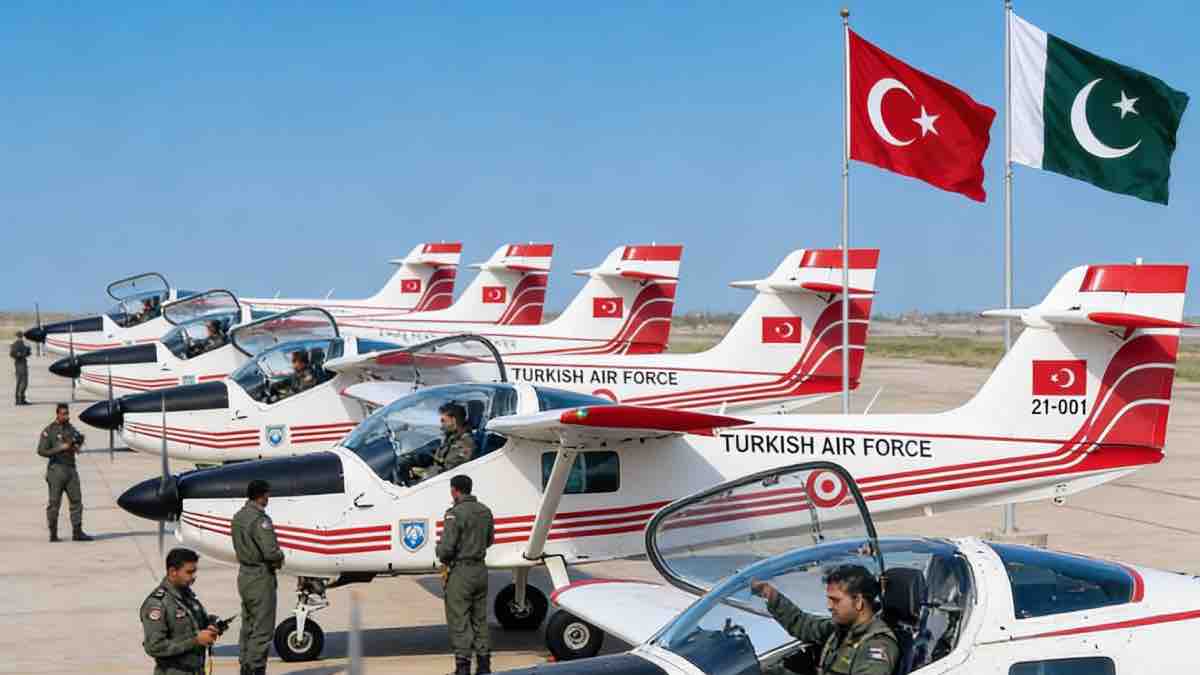
Pakistan has completed the delivery of 52 MFI-395 Super Mushshak basic trainer aircraft to Turkey, marking a major milestone for the country’s defence aviation industry. All aircraft, manufactured by the Pakistan Aeronautical Complex (PAC), have now entered service with the Turkish Air Force, replacing ageing trainer fleets and strengthening bilateral defence cooperation.
Deal Finalised After Years of Collaboration
The Super Mushshak programme dates back to 2016, when Turkey placed an order for the aircraft during the IDEAS Defence Exhibition in Karachi. Following negotiations led by Turkey’s Presidency of Defense Industries, preliminary agreements were signed in November 2016, and the final contract was concluded at the IDEF 2017 defence exhibition in Istanbul.
The COVID-19 pandemic had impacted the delivery schedule, but PAC remained committed to the programme. The first three aircraft arrived in Yalova in October 2022, with subsequent deliveries carried out in various phases. As per reports, the final aircraft was delivered by December 2025, completing the entire fleet.
Read more: New Army Rocket Force Command to bolster Pakistan’s strike capability
Induction into the Turkish Air Force
Prior to entering the actual service, the early batches underwent acceptance checks and flight-line testing at facilities operated by Turkish Aerospace Industries (TAI). The aircraft have now been inducted primarily into the 123rd Squadron at Izmir Cigli Air Base, while additional units are operating from Istanbul Ataturk Airport and Yalova.
With the induction of the Super Mushshak, the Turkish Air Force is set to retire its older Cessna T-41D Mescalero and SF-260D trainer aircraft, modernising its basic flight training system.
About the Super Mushshak
The MFI-395 Super Mushshak is based on the Swedish Saab MFI-15 design, for which Pakistan acquired production rights before further developing the aircraft locally. It is powered by a 260-horsepower Textron Lycoming piston engine, features a glass cockpit, fixed tricycle landing gear, and the ability to operate from short or semi-prepared runways.
With a top speed of around 365 km/h, the aircraft is widely used for initial pilot training and has been exported to several countries.
Read more: Air India to face $600 million loss from Pakistan airspace ban
What are the major Impacts of the Delivery?
This successful delivery carries significant implications for Pakistan. It is reinforcing PAC’s reputation as a reliable defence exporter, and it has the potential to execute large international contracts despite global disruptions. The deal also strengthens Pakistan–Turkey strategic ties, particularly in defence technology and aerospace cooperation.
For Turkey, the Super Mushshak is providing a modern training platform, improving pilot training efficiency while reducing maintenance costs. More broadly, the project is depicting the growing role of PK in the global defence aviation market, especially among countries that are looking for affordable and dependable solutions to Western suppliers.