
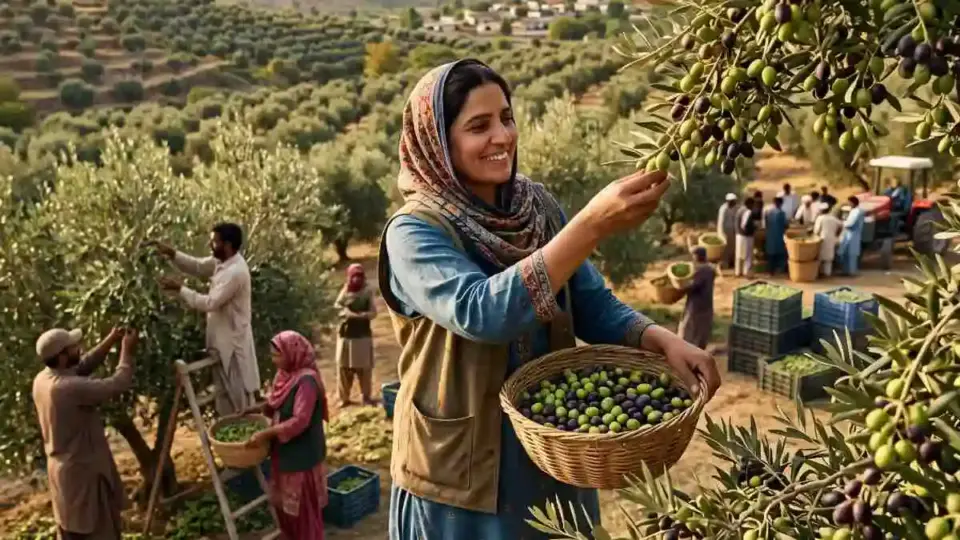
Pakistan has officially taken its seat as a permanent member of the International Olive Council, marking a major breakthrough for the country’s fast-growing olive sector.
The development took place during the IOC’s 123rd session in Lisbon, Portugal, where Pakistan joined 27 other olive-producing countries as a full member. Pakistan’s delegation was led by Federal Minister for National Food Security and Research Rana Tanveer Hussain, who briefed the council on the country’s expanding olive industry and its focus on sustainable production under climate change pressure.
Why This Is a Big Deal for Pakistan
For years, Pakistan has been trying to reduce its dependence on imported edible oil. Olive cultivation is now being treated as one of the country’s most promising alternatives because it can grow in dry, hilly and rain-fed areas where traditional crops often struggle.
Pakistan’s IOC membership gives the country access to international standards, technical cooperation, quality testing systems and global market credibility. The IOC is the only intergovernmental organization dedicated to olive oil and table olives, and it plays a central role in trade standards, quality assurance and technical cooperation among member countries.
This means Pakistani olive oil can now move closer to internationally recognized grading systems — a key requirement for entering high-value export markets.
Pakistan’s Olive Sector Is No Longer Just Experimental
Pakistan is no longer simply “testing” olive farming. The sector has already developed a national footprint.
According to official briefings shared at the IOC session, Pakistan has planted more than 7 million olive trees across the country. Olive cultivation is currently spread over around 55,669 acres, with clusters expanding in multiple regions. The country has also built a complete “farm-to-fork” value chain, including 51 olive oil extraction units, modern processing facilities, nurseries, weather stations and four quality laboratories aligned with IOC standards.
Pakistan has also achieved self-sufficiency in producing certified olive saplings domestically, which is important because local nurseries reduce dependence on imported planting material and allow faster expansion.
The Export Potential Could Be Huge
The most important number is not today’s production. It is Pakistan’s long-term potential.
Official data cited in recent reporting says Pakistan has around 10 million acres suitable for olive cultivation, but only about 55,000 acres have been developed so far. The same data suggests that, at full production potential, Pakistan’s olive sector could generate over Rs834 billion, or around $3 billion, annually through olive oil exports.
That number should be treated as a long-term potential, not an immediate forecast. But it shows why the government is pushing olive farming as a strategic crop.
Read more: CDA to launch Islamabad’s first organic market in sector F-7/3
A New Rs6.6 Billion Expansion Plan Is Coming
Pakistan is also preparing a major new olive development project.
The Ministry of National Food Security and Research has proposed a Rs6.598 billion project titled “Strengthening/Uplifting of Olive Value Chain in Pakistan – Phase III.” The project is planned from July 2026 to June 2029 and aims to establish commercial olive orchards on 40,000 acres across Pakistan.
The plan includes cluster-based orchards, drip irrigation on 10,000 acres, rehabilitation of around 300,000 wild olive trees through grafting, better storage, pomace utilization and private-sector participation.
This is exactly the type of investment Pakistan needs if it wants to move from scattered olive plantations to a serious commercial industry.
Pakistani Olive Oil Is Already Winning Recognition
Pakistan’s IOC membership also comes after an important quality milestone.
In 2025, Pakistani olive oil won a Silver Award at the New York International Olive Oil Competition, one of the world’s major premium olive oil competitions. Business Recorder reported that Loralai Olives was recognized for purity, sustainable production methods and packaging, marking a major step for Pakistan’s emerging olive oil industry.
This matters because olive oil exports depend heavily on branding, quality certification and trust. Countries like Spain, Italy, Greece, Türkiye and Tunisia dominate the market not only because they produce large volumes, but because their oils are associated with standards and origin credibility.
Pakistan now has to build that reputation from the ground up.
Why Farmers Should Pay Attention
For farmers, olive trees offer three key benefits.
First, olives can grow in marginal and rain-fed areas, especially in parts of Punjab, Khyber Pakhtunkhwa, Balochistan, tribal districts, Azad Kashmir and Gilgit-Baltistan. Second, olive trees are long-life crops, meaning one successful orchard can produce for decades. Third, olive farming can support local jobs in nurseries, harvesting, extraction, packaging, testing and marketing.
However, farmers should not treat olives as a quick-profit crop. Olive orchards require proper variety selection, spacing, pruning, irrigation planning, pest control and access to extraction facilities. Without technical support, many plantations may fail to produce export-grade oil.
That is why IOC membership is important. Pakistan can now access better technical guidance, training and international quality systems.
The Biggest Challenges Ahead
Pakistan’s olive future is promising, but not guaranteed.
The country still needs better farmer training, stronger private investment, branded packaging, cold storage, quality testing, traceability, export marketing and consistent government policy. Small farmers also need affordable drip irrigation, nursery support and buyback arrangements from processors.
The biggest challenge will be quality. International buyers will not pay premium prices for oil that lacks certification, proper storage or consistent taste. Pakistan must focus on extra virgin olive oil standards, lab testing and branding from day one.
Bottom Line
Pakistan becoming a permanent member of the International Olive Council is more than a diplomatic achievement. It is a chance to turn olive farming into a serious export industry.
The country already has millions of trees, thousands of acres under cultivation, dozens of extraction units and growing international recognition. Now, with IOC membership, Pakistan has a stronger platform to improve standards, attract investment and enter premium olive oil markets.
If Pakistan executes properly, olive oil could become one of the country’s next major climate-smart agricultural exports.
FAQs
What is the International Olive Council?
The International Olive Council is an intergovernmental organization focused on olive oil and table olives. It sets trade standards, supports quality improvement and promotes technical cooperation among member countries.
When did Pakistan become a permanent IOC member?
Pakistan took its seat as a permanent member during the IOC’s 123rd session in Lisbon, Portugal, on June 30, 2026.
How many olive trees has Pakistan planted?
Pakistan has planted more than 7 million olive trees across around 55,669 acres.
Can Pakistan export olive oil?
Yes. IOC membership can help Pakistani olive oil meet international grading and quality standards, making exports to premium markets more realistic.
Which areas of Pakistan are suitable for olive farming?
Rain-fed and hilly regions of Punjab, KP, Balochistan, Azad Kashmir and Gilgit-Baltistan have strong potential for olive cultivation.
What is Pakistan’s long-term olive oil potential?
Official estimates suggest Pakistan has around 10 million acres suitable for olive cultivation and could eventually generate billions of dollars in olive oil exports if the sector is developed properly.



Join the Conversation
Share your thoughts, questions, or feedback below.