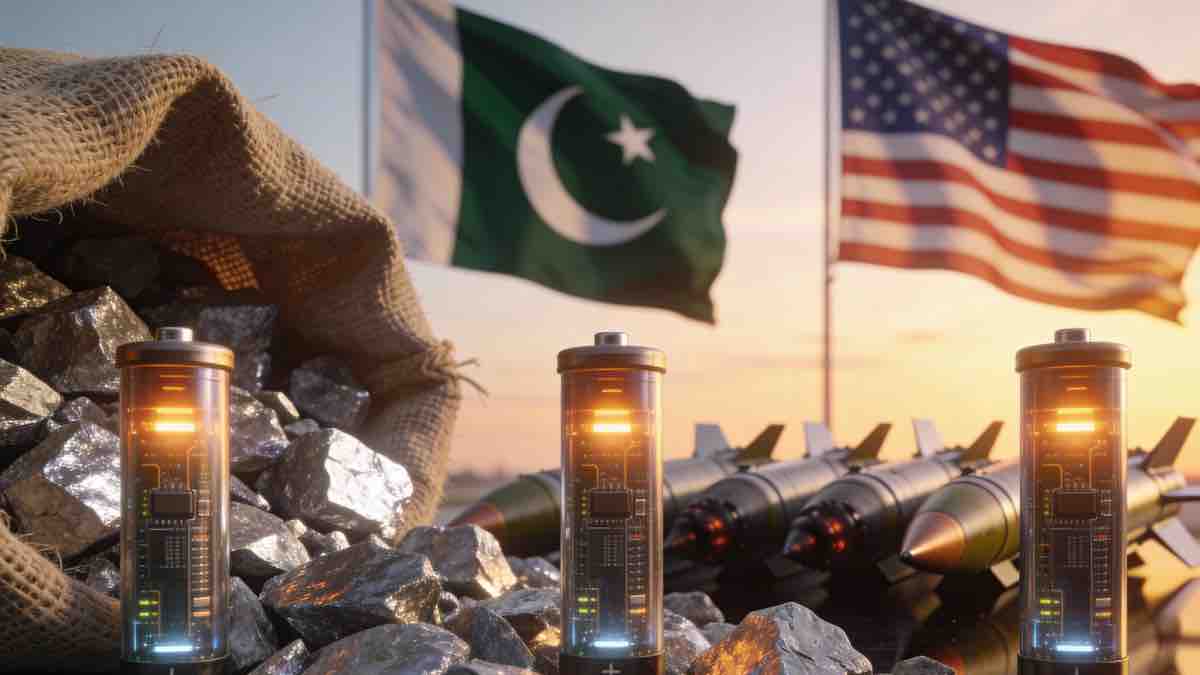
Pakistan’s antimony discovery in Balochistan has placed it on the US radar as a potential supplier of a critical mineral used in missiles, batteries, and flame retardants.
Pakistan has unexpectedly come into focus for the United States as Washington looks to reduce its heavy dependence on China for critical minerals, particularly antimony, a key material used in missiles, batteries, and flame retardants. According to a report by the Financial Times, growing supply chain concerns and rising prices have pushed US buyers to explore new sourcing options—and Pakistan is now on that list.
Antimony has become increasingly valuable in recent months. Prices for antimony trioxide have jumped to nearly $40,000 per ton, up sharply from around $26,000 in September 2024. This surge has alarmed Western governments and defence-linked companies, many of which rely on China-dominated supply chains. As a result, securing alternative and reliable sources has become a strategic priority.
Although Pakistan currently produces only a small share of global antimony, holding about one percent of the world’s reserves according to the US Geological Survey, interest from American buyers is growing. Pakistan-based Himalayan Earth Exploration has reportedly received increased inquiries from US firms seeking antimony sourced directly from Pakistan.
Dedicated export terminal is proposed to be built
The opportunity has reached high-level discussions. Industry intermediaries have even proposed building a dedicated export terminal to ship antimony directly from Pakistan to the United States, bypassing traditional routes and reducing reliance on Chinese-controlled processing channels.
In addition, a US company, Strategic Metals, has agreed to collaborate with Pakistan in developing critical mineral supplies for
- Defence
- Aerospace
- Advanced technology industries
The partnership is manifesting Washington’s broader effort to diversify mineral sourcing amid rising geopolitical tensions.
Read more: Pakistan sends first-ever rare earth shipment to United States under $500 million deal
Various challenges still exist
However, significant challenges remain. Pakistan is still positioned at the lowest end of the value chain. Most antimony is extracted via small-scale mining, with limited refining or processing facilities inside the country. As a result, raw material is often exported at prices far below international market rates, limiting economic gains.
Globally, China continues to dominate antimony processing, with only a handful of large-scale smelters operating outside its borders. There are also concerns around traceability, as some antimony sold as Pakistani is reportedly mined in Afghanistan and moved across the border through informal channels.
While antimony prices have eased slightly as new supplies enter the market from Southeast Asia and buyers explore substitutes, US interest in Pakistan is still strong. If Pakistan is strongly making investments in
- Refining capacity
- Transparency
- Regulatory oversight
This growing attention could evolve into a strategic opportunity—both economically and geopolitically.