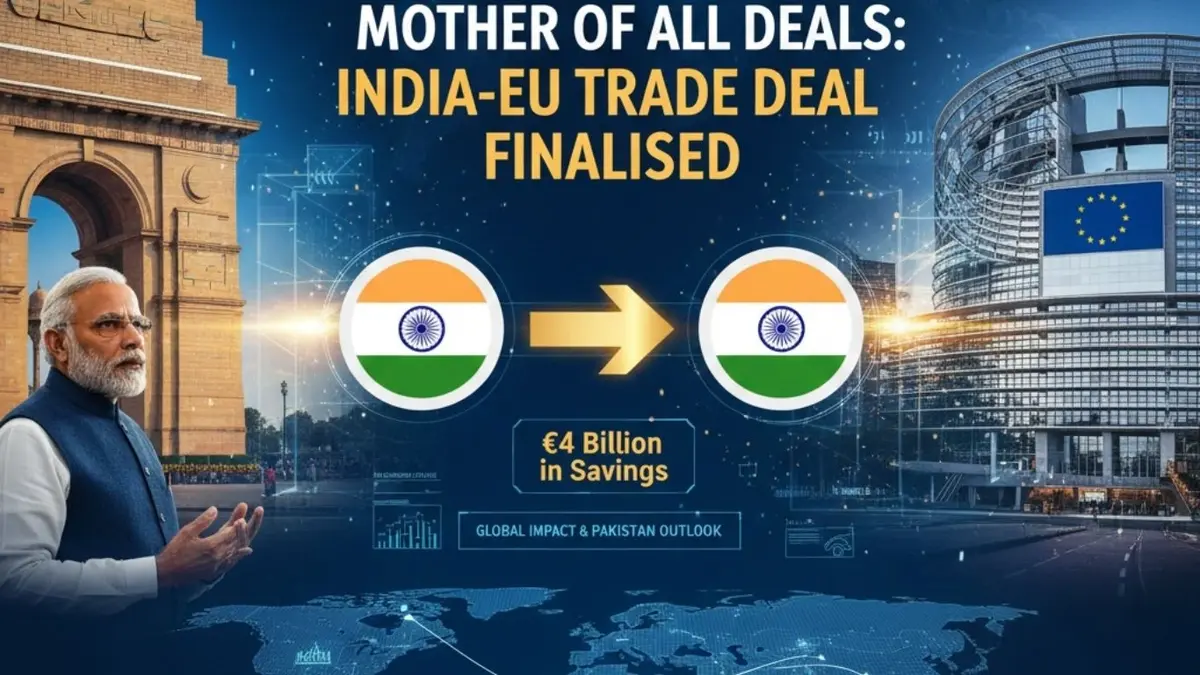
Pakistan is closely reviewing the implications of a new free trade agreement between India and the European Union, amid growing concern from industry experts and exporters.
Analysts warn that the deal, granting India tariff-free access to European markets, could seriously undermine Pakistan’s $9 billion textile exports and put the livelihoods of over 10 million workers at risk.
With Pakistan’s position in Europe potentially weakened, the country faces a critical test in maintaining competitiveness and safeguarding its key export sector, making the fallout of this deal a pressing national concern.
The agreement marks a major shift in global trade dynamics.
Key Features of the India-EU Trade Deal
India and the European Union have finalized a long-pending landmark trade deal. Prime Minister Narendra Modi described it as the “mother of all deals.” Both sides aim to protect their economies as global trade tensions rise, especially with the United States.
First, the deal will sharply cut tariffs. The EU will reduce or remove duties on 99.5% of goods traded with India over seven years. At the same time, India will lower tariffs on 96.6% of EU imports by value.
As a result, European companies will save nearly €4 billion in duties.
Next, India will open its tightly controlled market. It will slash car tariffs to 10% from as high as 110% within five years. This move will benefit companies like Volkswagen, BMW, and Mercedes-Benz.
Moreover, India will cut tariffs on wines and spirits. Wine duties will fall to 75% immediately and later drop to 20%. Tariffs on spirits will decline to 40%.
In return, the EU will offer duty-free access to Indian exports such as
- Marine products
- Textiles
- Leather goods
- Chemicals
- Gems
- Jewellery
Why the India-EU Trade Deal Matters Globally
This deal strengthens economic ties between the two major markets. It also signals a global push to diversify trade partners.
Meanwhile, rising US tariffs and political uncertainty have pushed countries to seek safer alternatives. Therefore, the India-EU trade deal is acting as a hedge against unstable US trade policies.
Read more: Everything you need to know about US-Pakistan and US-India trade deals
Impact of the India-EU Trade Deal on Pakistan
For Pakistan, this deal is bringing both challenges and opportunities.
On the downside, Indian exports may gain a price advantage in the EU market. This could increase competition for Pakistani textiles, leather goods, and seafood exports.
However, Pakistan can also benefit. The deal may push Islamabad to revive trade talks with the EU and strengthen its GSP Plus strategy. In addition, European investors might have the chance to explore South Asia more broadly, which could attract investment into Pakistan.
Furthermore, Pakistan can study India’s tariff reforms and adopt export-oriented policies to stay competitive.
Final Thoughts
The India-EU trade deal truly earns its “mother of all deals” label. It will
- Reshape trade flows
- Boost exports
- Signals a new global economic alignment
For Pakistan, the message is clear: adapt fast, diversify exports, and engage deeper with global markets.