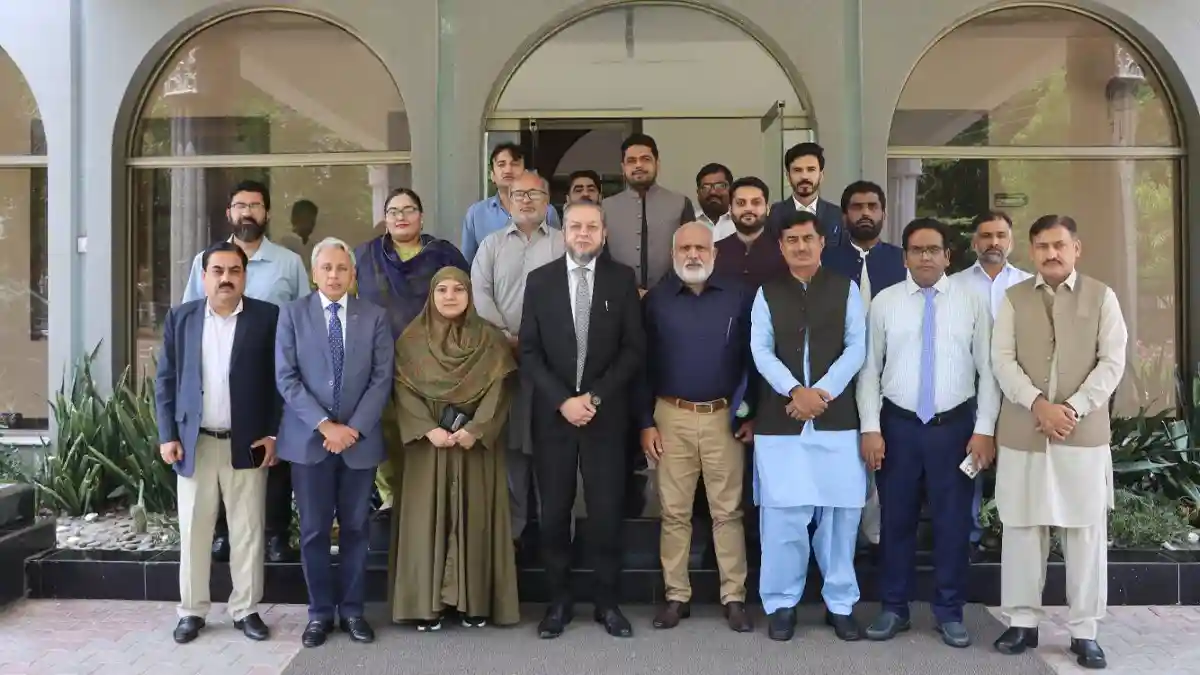
The Islamia University of Bahawalpur (IUB) has partnered with China’s Gansu Academy of Agricultural Sciences (GAAS) to establish a Joint Laboratory for Modern Agricultural Science and Technology.
This collaborative effort is set to revolutionize the way farming is done in the country—by combining state of the art Chinese agricultural methods with Pakistan’s local farming needs.
The partnership was formally signed and declared recently, marking a major milestone in scientific cooperation between Pakistan and China. The new lab is intended to address Pakistan’s long-standing agricultural challenges, including
- Water scarcity
- Low crop yields
- Outdated farming tools
Innovation and technology solutions to various agricultural issues
GAAS President Chang Hong has focused the similarities between Pakistan’s current agricultural issues and those that Gansu province in China encountered not too long ago. “Gansu overcame those obstacles through innovation and technology,” he noted. “Now, we desire to share our solutions—such as land farming technique, modern crop cultivation strategies and smart mechanization—with our friends in Pakistan.”
Research hubs to be set up in both Bahawalpur and Gansu
As part of the plan, research hubs will be set up in both Bahawalpur and Gansu, enabling cross-border knowledge exchange and locally adapted research.
Read more: Pakistan to deploy AI, global experts in push to modernize agriculture
The core focus will be on developing high-yield, climate-resilient crop varieties and improving soil and water conservation, and promoting sustainable farming systems that are meant to protect the environment.
Some of the major goals of the joint lab include:
• Introducing grain-legume intercropping systems and dryland water-saving technologies to enhance productivity specifically in those areas where drought issues mostly occur.
• Combining Gansu’s advanced crop breeding methods with local Pakistani germplasm is meant for producing new, and better-performing crop varieties.
• Providing technical training for Pakistani researchers, students, and farmers to ensure widespread understanding and adoption of the new techniques.
Modernization of agriculture will bring various impacts
IUB Vice Chancellor Prof. Muhammad Kamran has displayed great optimism. “This collaboration comes at a time when Pakistan desperately in need to modernize its agriculture,” he said. “With around forty percent of our workforce tied to this sector, the potential impact will be on food security, climate resilience, and rural livelihoods is enormous.”
He further added that the lab is not just a research project—it’s a true reflection of friendship and scientific solidarity. “By working side by side, our scientists and students can be capable of developing homegrown solutions backed by global experience.”
As climate change and population growth place greater pressure on food systems, this Pakistan-China initiative could become a beacon of hope—and a model for future international cooperation in agricultural innovation.