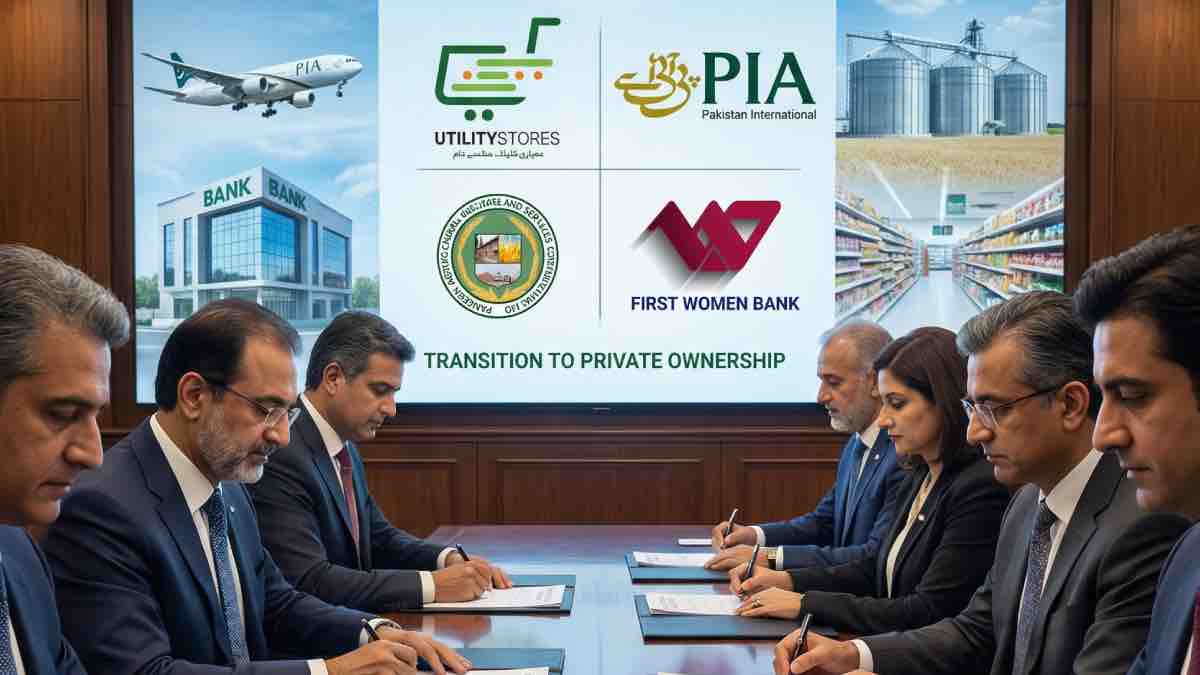
Several major state-owned institutions have been privatized over the past six months. These include Utility Stores Corporation, Pakistan International Airlines (PIA), PASSCO, and First Women Bank.
Pakistan’s government has taken a major step forward in reforming its state-owned enterprises (SOEs), completing the winding-up or privatization of several long-troubled entities over the past six months. The move is being seen as a decisive effort to reduce financial pressure on the national budget and put the economy on a more sustainable footing.
According to official updates, Utility Stores Corporation, Pakistan Agricultural Storage and Services Corporation (PASSCO), PIA, and First Women Bank have now been marked as “completed” under the government’s reform agenda. These entities were among the largest SOEs and had long been associated with heavy losses, inefficiencies, and recurring demands on public funds.
The progress was highlighted in a post shared by Khurram Schehzad on social media platform X, where he described the development as a major milestone in Pakistan’s ongoing structural reforms. In particular, Utility Stores, PASSCO, and PIA had built up significant fiscal burdens over the years, making their restructuring or privatization a long-standing demand of economic managers and international lenders.
Reducing the Burden on Public Finances
State-owned enterprises have historically been a drain on Pakistan’s exchequer, requiring frequent government bailouts to cover operational losses. Officials say completing the winding-up or privatization of these major entities will assist in freeing up public resources, reducing government borrowing, and improving overall fiscal discipline.
The reforms are also closely aligned with Pakistan’s broader structural adjustment and economic stabilization efforts, which aim to control deficits, restore investor confidence, and improve the efficiency of public-sector institutions.
Read more: ADB approves $130 million for Pakistan’s energy sector as Govt pushes DISCO privatization
A Shift Toward Market Efficiency
Economic analysts view the move as a signal that the government is serious about changing how public-sector businesses are managed. By reducing direct state involvement in commercial activities, policymakers hope to encourage greater efficiency, transparency, and private-sector participation in the economy.
The privatization of PIA, in particular, has drawn attention as one of the most high-profile reforms, given the airline’s symbolic importance and long history of financial losses. Similarly, the closure or restructuring of Utility Stores and PASSCO marks a shift away from subsidy-heavy models that were increasingly difficult to sustain.
More Reforms Ahead
The government has clearly indicated that the reform drive is not going to end here. Several other SOEs are currently in the pipeline for
- Restructuring
- Privatization
- Winding up in the coming months
Officials keep on saying that momentum will be maintained to make certain that reforms are not reversed or delayed.
While challenges remain — including workforce adjustments and political resistance — the completion of these major cases suggests that Pakistan’s SOE reform agenda has moved from planning to execution. For policymakers, the hope is that leaner public finances and a stronger private sector will assist in supporting long-term economic stability and growth.