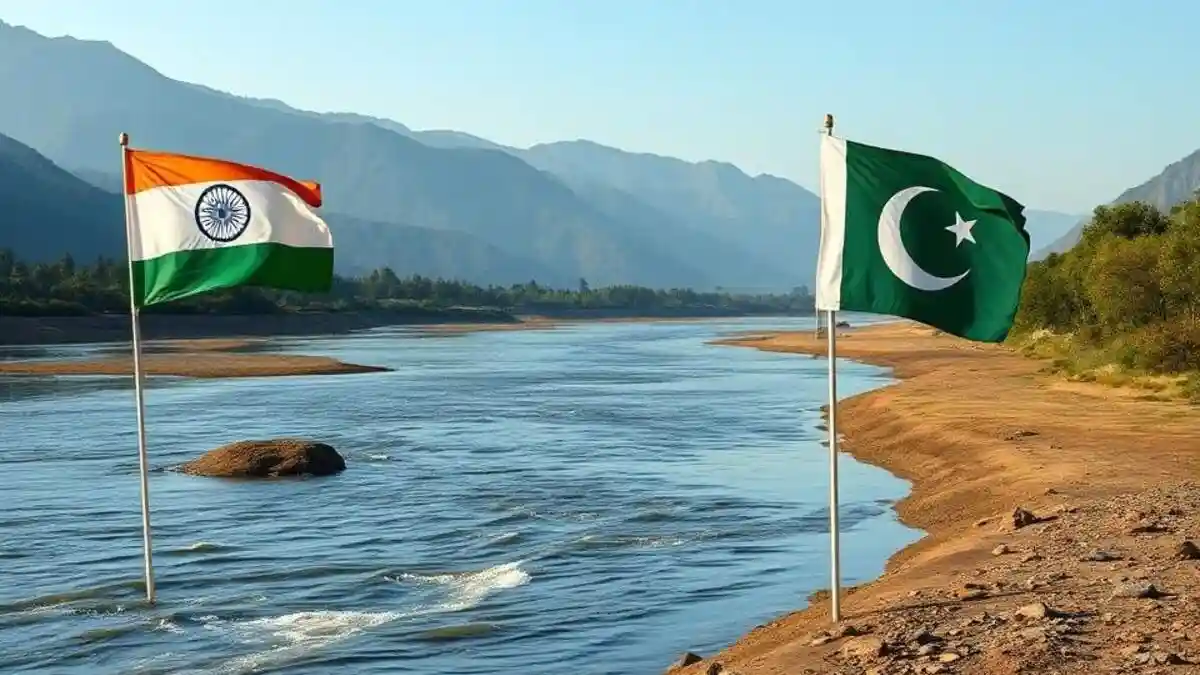
Prime Minister Shehbaz Sharif declared that Pakistan will significantly enhance its water storage capacity, responding firmly to what he called India’s “designs to weaponise water” against Pakistan.
Speaking at the National Emergencies Operations Centre in Islamabad, the prime minister has discussed regarding India’s move in April to hold the Indus Waters Treaty (IWT) in abeyance following a deadly attack in Pahalgam, occupied Kashmir—an incident New Delhi blamed on Islamabad without providing evidence.
The Indus Waters Treaty which was signed in 1960 and brokered by the World Bank, divides the six rivers of the Indus Basin between the two countries. India gets the eastern rivers, such as
- Ravi
- Beas
- Sutlej
While Pakistan depends on nearly 80% of its water from the western rivers such as
- Indus
- Jhelum
- Chenab
Calling India’s threat to suspend Pakistan’s share an “act of war,” Islamabad warned it violated international law. Pakistan has already signaled potential legal action, citing the 1969 Vienna Convention on the Law of Treaties. The Permanent Court of Arbitration (PCA) in The Hague also ruled that India cannot unilaterally suspend the treaty.
Read more: India’s suspension of the Indus Waters Treaty: What it means for Pakistan
“We Must Build Our Own Capacity”
During his speech, PM Shehbaz Sharif stressed: “The enemy has certain evil designs against Pakistan and wants to take steps against the water treaty. For that, the government has decided that we will build our water storage.”
He said the government would prioritize “non-controversial water storage projects” such as the Diamer Bhasha Dam, using Pakistan’s own resources. Shehbaz also said that the 1991 Water Accord between provinces already has a clear clause supporting expansion of water storage capacity.
The prime minister underlined the critical role of the National Disaster Management Authority (NDMA) in managing this effort.
Natural Disaster Preparedness
PM Shehbaz also issued instructions to the NDMA and the Pakistan Telecommunication Authority to collaborate on sending regular weather warnings and calamity alerts via mobile phone messages.
He recounted the devastating floods of 2022, which he said were among the worst in the world that year, killing over 1,700 people and causing over Rs30 billion in damages.
“Pakistan is on the world map of disaster-prone countries despite contributing little to climate change,” he said.
He also mentioned the tragedy in Swat, where flooding claimed lives, and called for an honest review of that disaster. He directed authorities to develop a comprehensive mechanism in collaboration with the provinces to avoid such incidents in the future.
Strengthening the NDMA
PM Shehbaz received all the details from NDMA Chairman Lieutenant General Inam Haider Malik regarding the current monsoon season, flood risks, and preparedness plans.
Shehbaz has shown appreciation to the National Emergencies Operations Centre, admired them, and guaranteed full government support to support the agency.
He is hopeful that the centre would soon be linked with provincial authorities to allow real-time data sharing and early warning systems.
Impacts of the Plan (Brief and Clear)
• Improved Water Security: New storage projects are going to minimize overdependence on upstream releases.
• Disaster Resilience: Improved flood control infrastructure can assist in safeguarding the region from any destruction.
• Economic Stability: Safeguarding water supplies is extremely important for agriculture and energy.
• Cooperation among provinces: Strengthened NDMA systems will support cooperation and quicker responses.
• Climate Adaptation: The Initiative is meant to prepare our country for glacial melt and erratic rainfall patterns.
This initiative is strongly intended to secure Pakistan’s
- Long-term water
- Food
- Energy security for generations