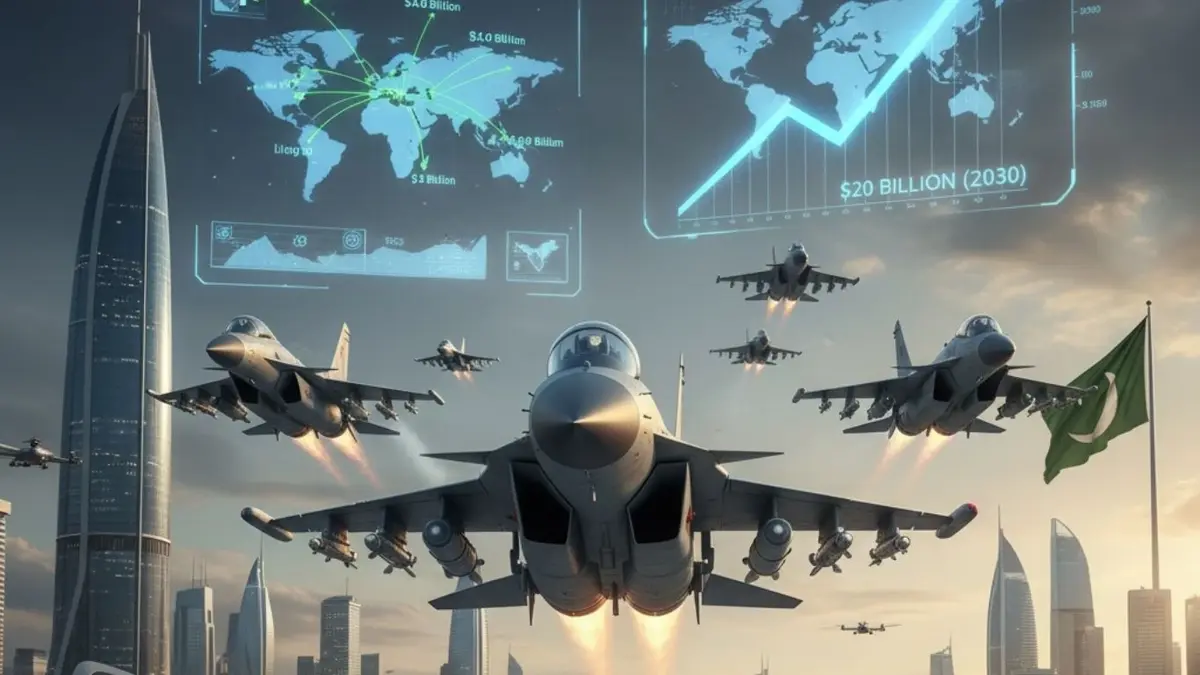
In a global defense market dominated by expensive Western aircraft, the JF-17 Thunder has rewritten the rules. What began as a necessity for Pakistan’s own air force has now become the country’s most successful defense export, driving billions of dollars in arms sales and reshaping Pakistan’s position in the global weapons market.
Unlike many fighters designed purely for prestige, the JF-17 Thunder focused on practical warfare needs, affordability, and export flexibility—a strategy that paid off.
The Strategic Beginning: Why the JF-17 Was Different
Pakistan launched the JF-17 project in the early 2000s to substitute outdated aircraft while avoiding political restrictions from Western suppliers. Partnering with China allowed Pakistan to retain control over
- Production
- Upgrades
- Exports—a critical advantage.
From the start, planners designed the JF-17 Thunder not just for domestic use but for international buyers with limited budgets and real security threats.
This export-focused mindset actually played a role in building the foundation for long-term success.
Why JF-17 Thunder Became Pakistan’s Best Defense Export
Several key factors explain why the JF-17 Thunder outperformed other Pakistani defense products in global markets:
1. Affordable Without Compromising Combat Power
At $25–30 million per jet, the JF-17 costs less than half of many Western fighters. Yet, it still offers modern radar, BVR missiles, and digital avionics. For developing countries, this balance proved irresistible.
2. Freedom from Political Pressure
Many nations are preferring to avoid Western jets due to
- Sanctions
- Usage restrictions
- Spare-parts dependency.
Pakistan offers the JF-17 with fewer political conditions, making it attractive to Africa, the Middle East, and Central Asia.
3. Continuous Upgrades (Block I to Block III)
Instead of freezing the design, Pakistan kept upgrading the aircraft. The JF-17 Block III, with AESA radar and advanced electronic warfare systems, directly competed with far more expensive platforms.
4. Combat-Proven Credibility (May 2025)
The turning point came during the May 2025 aerial engagements with India. JF-17 Block III jets demonstrated effective BVR capability, sensor fusion, and real-world reliability. This combat validation instantly boosted buyer confidence.
Defense markets trust performance more than brochures—and the JF-17 delivered.
Export Boom: JF-17 Driving Multi-Billion Dollar Deals
After 2025, exports accelerated rapidly. Pakistan crossed $10 billion in arms sales contracts in 2024–25, with the JF-17 as the flagship product.
1)Azerbaijan: Expanded its fleet to 40 JF-17 Block III jets in a $4.6 billion deal
2) Libya: Signed a multi-billion-dollar defense agreement, including JF-17 aircraft
3) Saudi Arabia: Ongoing talks for a $2–4 billion strategic purchase
4) Africa & Asia: Multiple states evaluating the platform for cost-effective air power
These deals transformed the JF-17 into Pakistan’s top defense export earner.
Strategic Impact: Beyond Revenue
The success of the JF-17 Thunder goes beyond money. As it played a role in strengthening Pakistan’s defense diplomacy, supported local industry at PAC Kamra, and positioned the country as a reliable global arms supplier.
Most importantly, it proved that smart design, affordability, and combat credibility can beat prestige and price.
Conclusion: A Blueprint for Pakistan’s Defense Future
The JF-17 Thunder did not succeed by accident. It became Pakistan’s best defense export because it solved real problems—for Pakistan and for the world.
As Pakistan targets $20 billion per year in defense exports by 2030, the JF-17 is now standing as the blueprint for what works.