The landscape of Pakistan’s public education has undergone a seismic shift over the last two years. What began as a strategic proposal in early 2024 has evolved into a robust technological ecosystem. Driven by a partnership between the Ministry of Federal Education and Professional Training (MOFEPT), Google for Education, and local partner Tech Valley, Pakistan is no longer just a consumer of educational technology—it is now a producer.
With the launch of the first local Chromebook assembly line in late 2025 and the operational success of 50 smart schools in the federal capital, the country is tackling its “education emergency” through unprecedented digital scale. These initiatives aim to bridge the gap for the 26,000,000 out-of-school children while modernizing the learning experience for those currently enrolled.
The Islamabad Milestone: 50 Smart Schools and 30,000 IDs
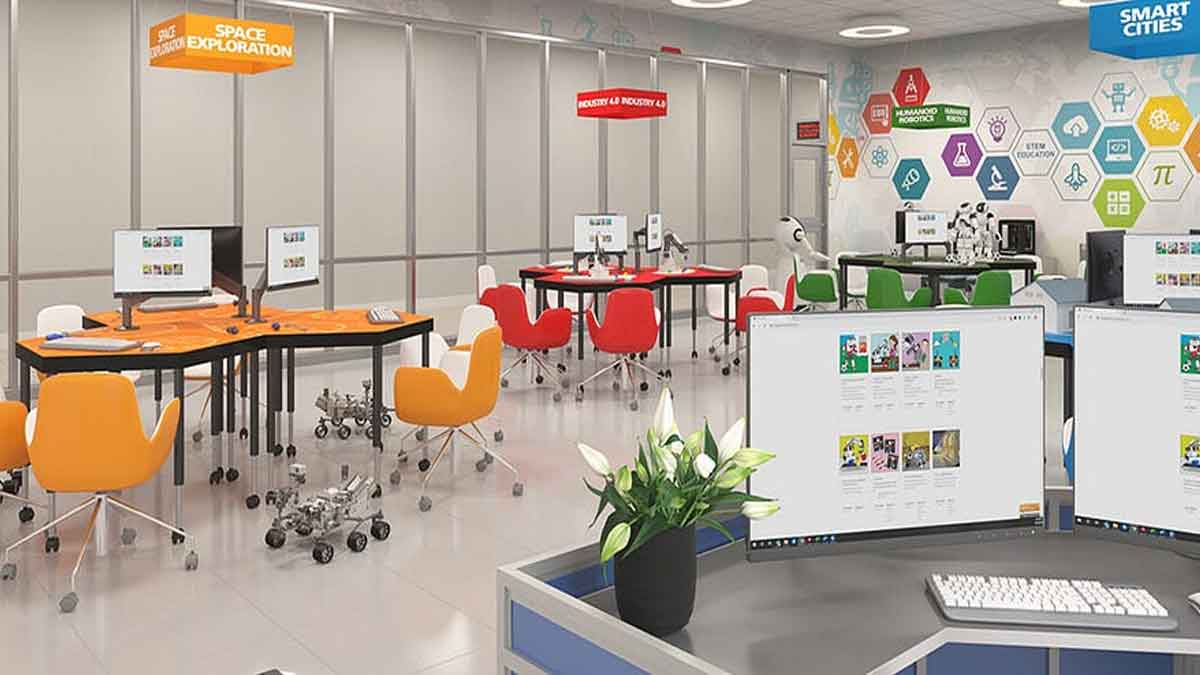
The flagship “Smart Schools” project in Islamabad has transitioned from a pilot phase to a full-scale operational model. As of early 2026, the Ministry has successfully provisioned 30,000 Google for Education IDs across these institutions. These digital identities serve as the gateway to a personalized learning environment, allowing students to move beyond traditional rote memorization.
These schools are equipped with advanced digital tools that facilitate a level of collaboration previously unseen in the public sector. By centralizing the curriculum through Google Classroom, the ministry has standardized the quality of instruction, ensuring that a student in a model college receives the same caliber of resources as those in private elite institutions.
Integration of AI-Powered Learning Tools
Central to the smart school experience is the deployment of AI-powered practice sets. These tools use machine learning to provide students with real-time feedback, identifying specific areas where a learner might be struggling. For teachers, this means a reduction in administrative burdens, as the system automates grading and provides data-driven insights into classroom performance. This shift allows educators to focus on high-value interactions and individualized support for students.
The Haripur Industrial Shift: Local Chromebook Assembly
Perhaps the most significant development in Pakistan’s tech sector is the inauguration of the country’s first Google Chromebook assembly line. Launched on November 4, 2025, at the National Radio & Telecommunications Corporation (NRTC) premises in Haripur, the facility represents a landmark public-private partnership.
The collaboration between Google, Tech Valley, and the Australian manufacturer Allied Corporation has moved Pakistan into the global hardware value chain. By producing devices locally, the government has significantly lowered the per-unit cost of technology, making it feasible to scale digital access to the farthest reaches of the country.
Impact of the NRTC and Allied Corporation Partnership
The Haripur facility is not merely an assembly plant; it is a center for technical skill transfer. By bringing international manufacturing standards from Allied Corporation to the NRTC, Pakistan has established a blueprint for future high-tech industrial projects. The facility is currently on track to produce 500,000 Chromebooks by the end of 2026. These devices are specifically optimized for the educational environment, featuring rugged designs and long battery lives suited for the local infrastructure.
Job Creation and Economic Goals for 2026
The economic second-order effects of this project are already evident. The assembly line has directly created 600 high-skilled jobs in the Khyber Pakhtunkhwa region. Beyond domestic use, the government and its partners are eyeing the export market, intending to position Pakistan as a regional hub for affordable educational hardware. This transition from technology importer to potential exporter is a cornerstone of the country’s updated digital economy framework for 2026.
Scaling the Ecosystem: Punjab and Sindh Expansions
While the smart school initiative began in Islamabad, the “Google effect” has rapidly expanded to other provinces. In Punjab, a massive agreement signed in January 2025 is currently providing 200,000 digital IDs to students. This rollout is complemented by the integration of Gemini AI, Google’s most advanced large language model, which helps students with complex problem-solving and creative writing tasks.
Lahore Center of Excellence and Gemini AI
In September 2025, the Google for Education Center of Excellence was inaugurated in Lahore. This facility serves as a “lighthouse” school, a reference model where educators from across the country can observe the impact of Chromebook Plus devices and AI-powered English learning tools like “Read Along.” The Center of Excellence is instrumental in training the next generation of “Google Certified Educators,” ensuring that the hardware is matched by pedagogical expertise.
Addressing the Education Emergency
The scale of the digital rollout is a direct response to the national education emergency. With millions of children remaining outside the formal schooling system, the government is utilizing these digital tools to power “microschools” and mobile learning centers. By utilizing locally assembled Chromebooks and low-bandwidth cloud IDs, the state can deliver high-quality educational content to remote areas where traditional school buildings may not yet exist.
Technical Impact: How Chromebooks Change the Classroom
The choice of Chromebooks over traditional PCs was a strategic decision based on total cost of ownership and security. Unlike traditional operating systems, ChromeOS is designed to be lightweight and virtually immune to the malware that often plagues public computer labs.
The impact on the classroom is multifaceted:
- Instant Boot Times: Students can begin learning within seconds of opening the lid, maximizing instructional time.
- Cloud-Based Continuity: Since all work is saved to the cloud ID, a student can start a project on a school Chromebook and finish it on a mobile device at home without losing progress.
- Offline Capabilities: Recognizing the internet connectivity challenges in certain parts of Pakistan, these devices are configured with offline modes for Google Docs and Drive, syncing only when a connection becomes available.
As we progress through 2026, the synergy between local manufacturing and digital classroom integration has set a new standard for South Asia. The target of 500,000 devices is not just a numerical goal; it represents 500,000 individual opportunities for Pakistani youth to compete in the global digital economy. The partnership between the Ministry of Education and Google has successfully moved the needle from “potential” to “proven impact.”