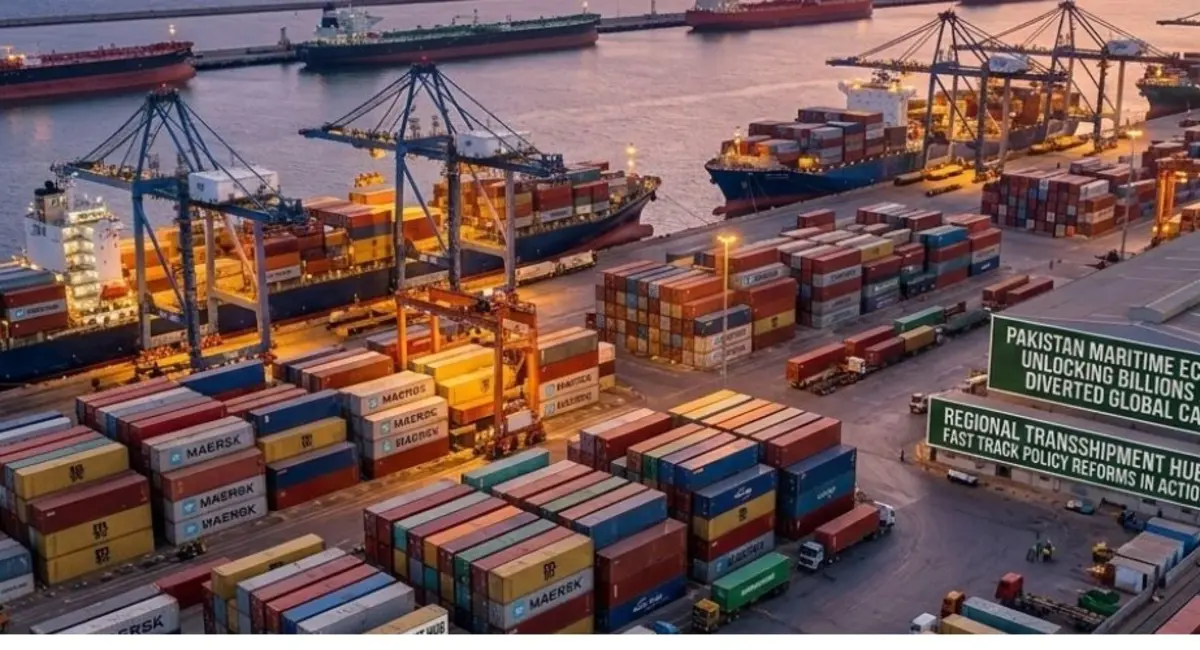
Pakistan is capable of attracting diverted global cargo during the Middle East conflict and earning billions in foreign exchange.
The ongoing conflict in the Middle East has created serious disruptions in global shipping routes. As security risks increase across important maritime corridors, shipping companies are actively searching for safer and more reliable routes to move their cargo.
This situation has opened a major economic opportunity for Pakistan.
Industry experts are of the view that Pakistan could earn billions of dollars in foreign exchange if it quickly adjusts its shipping and customs policies. The idea is simple: when cargo ships avoid dangerous areas, they must reroute through other ports. If Pakistan prepares its ports and regulations in time, it can attract this diverted global cargo.
Stakeholders from Pakistan’s maritime industry have therefore urged the government to introduce urgent regulatory reforms to capture this opportunity before competing ports take the lead.
Maritime Industry Calls for Immediate Policy Changes
The Pakistan Ship Agents Association has formally approached the Federal Board of Revenue (FBR) with an important proposal. The association sent a letter to FBR Chairman Rashid Mahmood Langrial, explaining that Pakistan must act quickly to benefit from the current global shipping disruption.
As per the association, tensions in major sea routes have already forced many cargo operators to reroute shipments away from high-risk areas. This diversion is capable of creating a chance for Pakistan to become a regional transshipment hub.
However, current regulations can be the reason of creating a serious obstacle.
Pakistan’s customs rules do not allow transshipment containers to be stored at off-dock terminals. As a result, the available storage space inside port terminals becomes limited.
This restriction makes it highly arduous for Pakistani ports to handle a sudden increase in cargo volumes.
Maritime experts keep on arguing that if the government gives permission for off-dock storage through a Statutory Regulatory Order (SRO), Pakistan could significantly expand its cargo handling capacity.
Without this policy change, shipping companies may simply choose other ports in the region.
Read more: Trump declares peace in the Middle East, thanks Pakistan for Gaza peace efforts
Why Pakistan’s Geographic Location Is a Major Advantage
Pakistan enjoys a strategic location along key global shipping lanes connecting the Middle East, South Asia, Central Asia, and East Africa.
Major ports such as Karachi Port, Port Qasim, and Gwadar Port already serve as important gateways for regional trade.
Because of this geographic advantage, Pakistan can easily position itself as a transshipment hub where cargo containers arrive, get sorted, and then move onward to other destinations.
If the government improves regulations and logistics infrastructure, international shipping companies could begin using Pakistani ports as temporary cargo redistribution centers.
This development would generate multiple economic benefits for the country.
Billions in Foreign Exchange: How Pakistan Can Benefit From Diverted Global Cargo
If Pakistan successfully attracts diverted cargo, the economic impact could be substantial.
Every container that passes through a port has the guts to increase revenue via multiple channels.
These include:
- Port handling charges
- Storage fees
- Customs services
- Logistics operations
- Transportation services
Port authorities, shipping agents, trucking companies, and warehouse operators all benefit from the increase in cargo volume.
In addition, increased maritime activity actually helps in strengthening Pakistan’s foreign exchange reserves, which remain under constant pressure due to high import bills and external debt obligations.
Even a moderate increase in transshipment traffic could add hundreds of millions or even billions of dollars to Pakistan’s economy annually.
The Risk of Missing This Opportunity
Despite the clear potential, experts keep on giving warnings that Pakistan could easily miss this opportunity if policy reforms move too slowly.
Global shipping companies usually choose ports based on speed, efficiency, and regulatory flexibility.
If Pakistan maintains strict restrictions on container storage, shipping companies may prefer competing regional ports such as Dubai, Oman, or Sri Lanka, which already have strong transshipment facilities.
Once shipping lines establish new routes through other ports, it becomes difficult to attract them back.
For this reason, maritime stakeholders are urging the government to issue the required SRO immediately and allow off-dock container storage.
This step alone could dramatically increase the capacity of Pakistan’s port system.
Regional Conflict Is Already Reshaping Global Trade Routes
The war in the Middle East has triggered major changes in global trade patterns.
Security concerns in sensitive maritime corridors have increased insurance costs, shipping delays, and freight charges.
As a result, shipping companies have started adjusting their logistics networks to reduce risk.
These adjustments include:
- Changing sea routes
- Using alternative ports
- Increasing transshipment operations
- Diversifying cargo handling hubs
Pakistan can benefit from this shift if it moves quickly and creates a business-friendly maritime environment.
Strengthening Pakistan’s Logistics and Port Infrastructure
Policy reforms alone are not enough. Pakistan must also strengthen its logistics infrastructure to handle increased cargo flows.
Improving port efficiency requires several steps.
First, authorities must expand container storage facilities both inside and outside ports.
Second, the country needs faster customs clearance systems to reduce cargo delays.
Third, better road and rail connections between ports and industrial areas will help move containers quickly across the country.
Investments in digital port management systems can also improve efficiency and transparency.
If these improvements take place, Pakistan can become a competitive logistics hub in the region.
A Turning Point for Pakistan’s Maritime Economy
The current geopolitical crisis is the reason for rising uncertainty across global trade networks. However, it has also created some of the best opportunities for countries that are capable of adapting fastly.
For Pakistan, attracting diverted global cargo could become a major turning point for its maritime economy.
Higher cargo volumes would
- Boost port revenues
- Support related industries such as shipping services, warehousing, transportation, and logistics.
In addition, stronger maritime activity would enhance Pakistan’s position in regional trade.
Conclusion: Quick Action Can Unlock a Billion-Dollar Opportunity
Pakistan stands at an important crossroads.
The global shipping disruptions caused by the Middle East conflict have created a rare chance for the country to mesmerize diverted cargo flows and become a regional transshipment hub.
However, success is highly reliant on speedy policy reforms and smarter logistics planning.
If the government permits off-dock container storage, upgrades port infrastructure, and simplifies customs procedures, Pakistan could be capable of unlocking a multi-billion-dollar maritime opportunity.
But if reforms are delayed, competing port are likely to capture the cargo instead.
In global trade, timing is everything—and right now, Pakistan has a window of opportunity that it can never afford to miss.