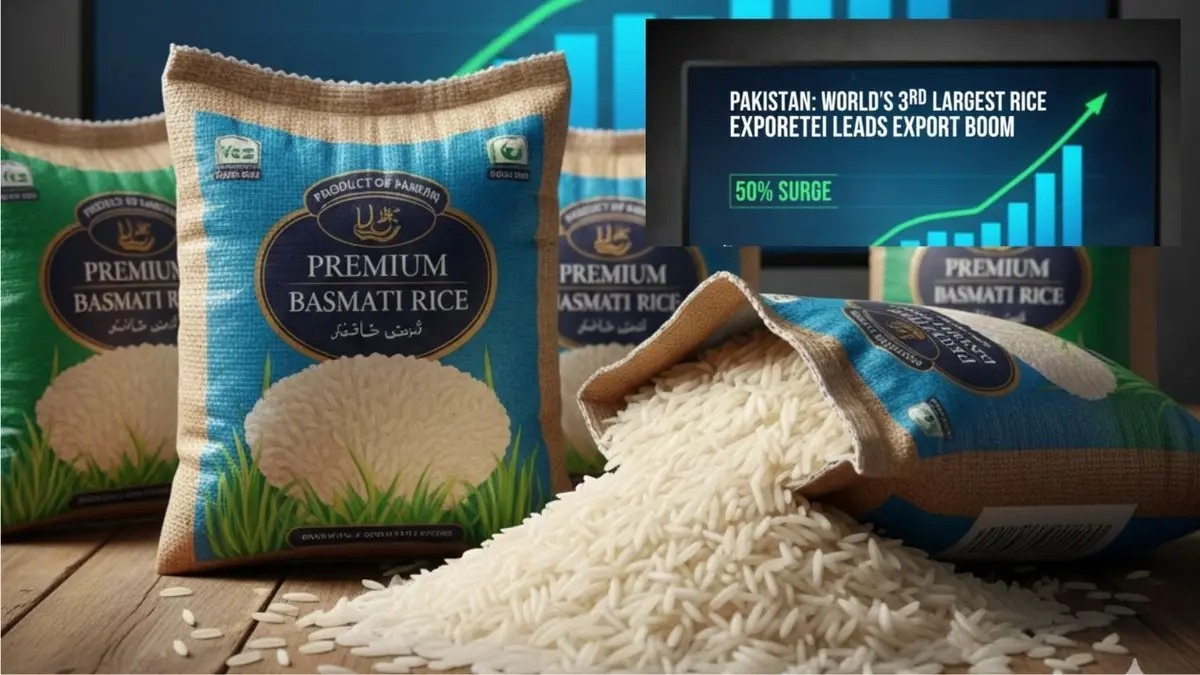
Pakistan becomes the world’s third-largest rice exporter in December 2025, marking a major comeback for the country’s agriculture exports. Strong demand and a sharp rise in Basmati shipments pushed Pakistan ahead of Vietnam for the month to become the world’s third-largest rice exporter, behind India and Thailand.
Pakistan’s rice exports rose 14% in December compared to November. The main driver remained Basmati rice, with exports jumping more than 50% month-on-month.
As a result, Pakistan shipped 489,000 tonnes of rice in December, excluding Iran-bound cargo. Vietnam exported only 387,000 tonnes, allowing Pakistan to secure the third position globally. Only India and Thailand exported more rice during the month.
However, the overall picture for the first half of fiscal year 2025-26 remains weak, with total rice exports plunging 49.56 percent to just $405 million, down from $804.86 million in the same period last year. Basmati exports fell 52.68 percent to $170.25 million from $359.78 million, while exports of Irri-6 rice dropped 21.93 percent to $37.24 millionfrom $47.7 million.
Basmati Surge Powers Pakistan’s Rice Exports
The Basmati surge played a decisive role in helping Pakistan become the world’s third-largest rice exporter. Premium quality and competitive pricing supported higher demand across multiple regions.
The United Arab Emirates emerged as the largest buyer, importing 74,897 tonnes, including 16,850 tonnes of Basmati. Meanwhile, China followed closely with imports of 74,685 tonnes.
Pakistan also shipped rice to Oman, the United States and Canada, strengthening its presence in high-value markets.
Central Asia Emerges as a Key Growth Market
Another major highlight came from Central Asia. Pakistan expanded direct exports to the region instead of routing shipments through Afghanistan.
Exports to Kazakhstan crossed 17,000 tonnes, including 10,300 tonnes of Basmati. Shipments to Uzbekistan reached 10,382 tonnes, showing strong regional demand.
Experts say this shift is clearly reflecting a structural change in Pakistan’s rice trade routes, improving efficiency and margins.
Challenges are still there Despite Strong Performance of Basmati Rice
Despite the positive momentum, challenges continue. Exports to Iraq and Turkiye remain minimal, limiting access to important regional markets.
However, opportunities are also growing. Bangladesh demand stays strong, while a 50% US tariff on Indian rice has improved Pakistan’s competitiveness in the American market.
In Iran, foreign exchange shortages have shifted imports to private buyers, which is highly favorable for Pakistan due to geographic proximity.
With the right policies and stable support, Pakistan’s rise as the world’s third-largest rice exporter could become a long-term trend, not just a monthly milestone.