Pakistan is considering a major change to its federal system through the 28th Constitutional Amendment. The proposal aims to redraw provincial boundaries and create smaller provinces to improve governance and service delivery.
Supporters say many provinces are now too large to manage effectively. This has led to slow decision-making, unequal development, and weak local representation. Smaller provinces, they argue, can bring government closer to the people.
New Provinces in Punjab Under the 28th Amendment
First, Punjab will see the biggest change after the creation of the new provinces. The province will be split into four new provinces.
These include:
• West Punjab
• South Punjab
• Bahawalpur
• Potohar
Supporters keep on saying that Punjab has grown too large to manage well. Smaller provinces could mean faster decisions, better hospitals, and improved schools. In addition, people in neglected regions may finally get a stronger voice.
Read more: Is dividing Pakistan into 12 smaller provinces a cure or a complication?
Sindh’s New Structure
Next, Sindh will also split into three provinces under the 28th Amendment.
These are:
• Karachi / Lower Sindh
• Upper Sindh
• Mehran
Karachi will gain more control over its resources. Meanwhile, rural areas may receive focused development. As a result, regional gaps could shrink over time.
Changes in Balochistan
Balochistan will divide into:
• Balochistan
• Makran
This change aims to reduce long travel distances for services. It may also improve law enforcement and local administration. People in coastal areas like Makran could see faster growth.
Khyber Pakhtunkhwa to Get Four Provinces
Khyber Pakhtunkhwa will split into:
• Khyber
• South KPK
• Hazara
• Kohistan
Each region has unique needs. Smaller provinces may allow leaders to focus better on local issues such as jobs, roads, and education.
Federal Territories Remain the Same
Some regions will stay under federal control:
• Islamabad
• Gilgit-Baltistan
• Azad Kashmir
These areas will continue with their current status.
Read more: With 33 million population, Karachi will become world’s 5th largest city in 25 years
What is the reason behind making new provinces?
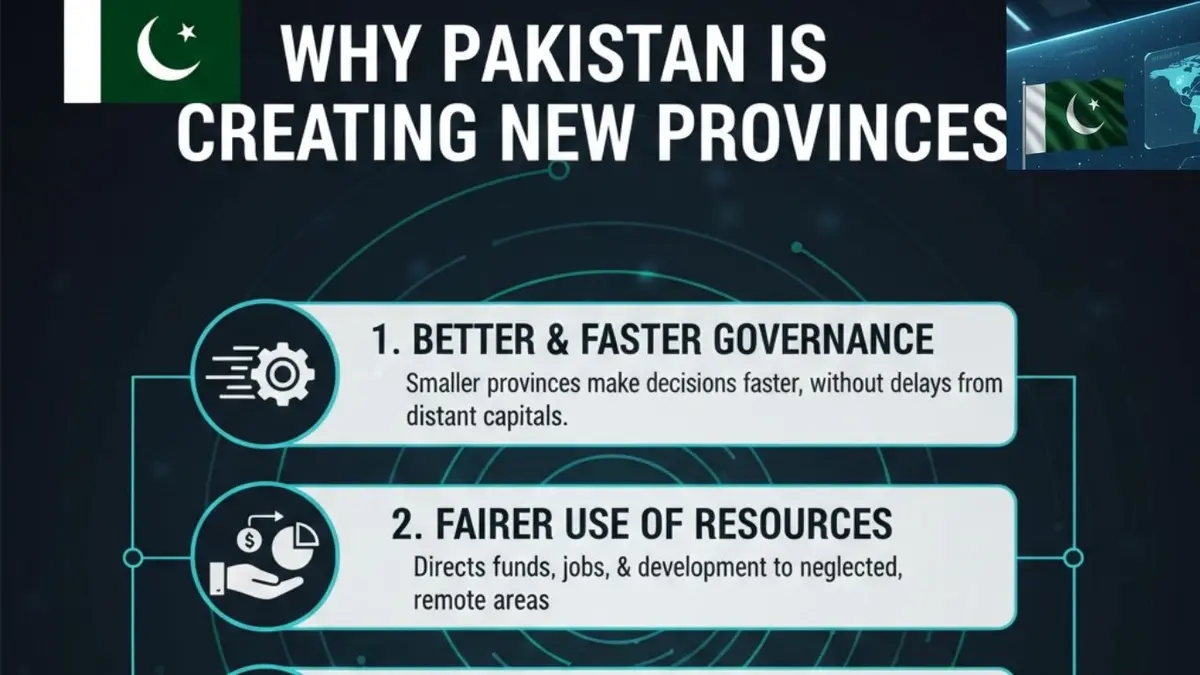
The plan to create new provinces follows three clear goals. Each goal focuses on making life easier for ordinary people by providing them with access of service.
1. Better and Faster Governance
Large provinces are hard to manage. Decisions often take too long. Smaller provinces make governance simpler. Local governments can act faster. They are capable of providing solutions for the problems without waiting for approval from distant capitals.
2. Fairer Use of Resources
Development often stays limited to major cities. Many remote regions remain ignored. New provinces aim to change this. They can help direct funds, jobs, and projects to areas that have stayed behind for decades.
3. Government Closer to the People
For many citizens, reaching courts, hospitals, or offices means long travel. This costs time and money. New provinces bring government offices closer. People can access healthcare, justice, and education without crossing hundreds of miles.
Positive Impact of New Provinces in Pakistan
This plan could bring government closer to the people. It may improve service delivery. It can reduce neglect. It may also strengthen local identity and political inclusion.
Negative Impact of the 28th Amendment
However, challenges remain. New provinces will be in severe need of more funding. There are chances for the rise of Political disagreements. Ethnic tensions could also increase. Moreover, implementation will take time and a strong consensus.
Conclusion
The 28th Amendment is going to bring major shifts or transformation in Pakistan’s future. It offers hope but also risk. Success will depend on unity, planning, and fair execution.