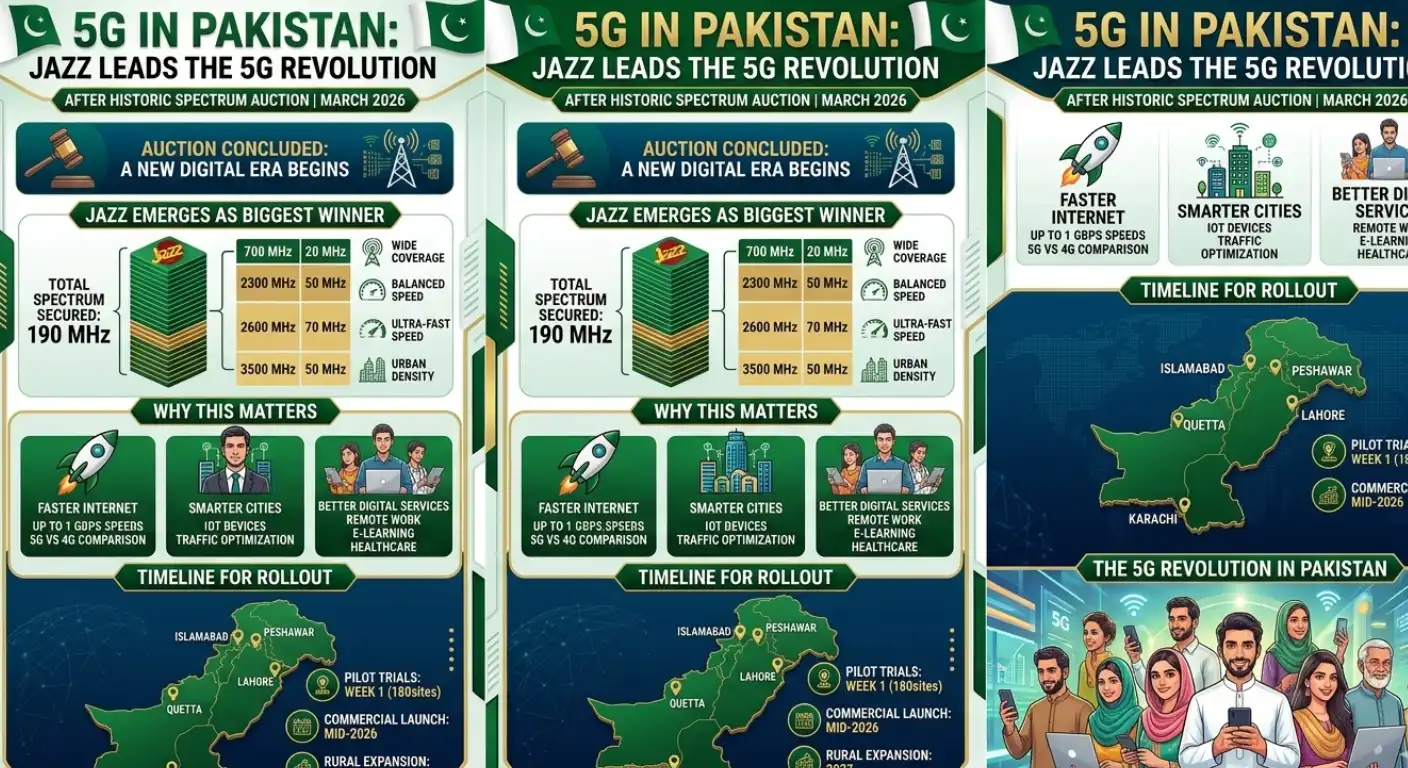
Pakistan has officially stepped into the 5G era, marking a major milestone in the country’s digital transformation. After years of planning, delays, and preparation, the long-awaited 5G spectrum auction concluded in March 2026, opening the door to faster internet, smarter cities, enhanced digital services, and next-generation mobile experiences.
Among all telecom companies, Jazz emerged as the biggest winner, securing the largest portion of the auctioned spectrum and positioning itself as the leader in the upcoming 5G revolution in Pakistan. This is more than a numeric victory—it’s a roadmap for how 5G will roll out and where it will reach first.
The 5G Spectrum Auction
Pakistan’s telecom regulator, the Pakistan Telecommunication Authority (PTA), conducted the 5G spectrum auction in March 2026. Telecom operators participated in a competitive online auction that spanned three rounds to allocate radio spectrum for next-generation mobile services.
The country offered around 597 MHz of spectrum, with 480 MHz sold in the auction. The process generated approximately $507 million in revenue, a significant step for Pakistan’s digital economy and the foundation of 5G networks.
Spectrum Distribution Among Operators
- Jazz: 190 MHz
- Ufone: 180 MHz
- Zong: 110 MHz
The auction covered four frequency bands: 700 MHz, 2300 MHz, 2600 MHz, and 3500 MHz. Jazz strategically acquired blocks in every band, giving it unmatched versatility and competitive advantage.
Understanding Spectrum
To understand Jazz’s strategy, spectrum can be thought of as roads for your data:
Long Highways — Low-Band Spectrum
Low-band frequencies like 700 MHz function as long highways. They cover wide areas, penetrate buildings, and reach rural or remote regions. These bands prioritize coverage over speed, ensuring reliable connectivity even in challenging locations.
Busy City Routes — Mid-Band Spectrum
Mid-band frequencies (2300 MHz and 2600 MHz) are like major intercity roads. They balance speed and coverage, handling high data traffic across towns and urban areas. These bands ensure smooth performance during peak usage.
Super-Speed Expressways — High-Band Spectrum
High-band spectrum like 3500 MHz resembles multi-lane expressways in cities. They carry enormous amounts of traffic at high speeds over shorter distances, ideal for ultra-fast downloads, low-latency gaming, and streaming in dense urban centers.
Jazz’s Spectrum Strategy
Jazz acquired spectrum across all critical layers of 5G, creating a strong network foundation.
700 MHz — Long-Distance Coverage
Jazz secured 20 MHz in the 700 MHz band, the only operator to buy new low-band coverage. This spectrum travels far and penetrates buildings, providing:
- Stronger signal at home and in offices
- Better coverage in rural areas
- Fewer dropped calls
2300 MHz and 2600 MHz — Mid-Band Urban Coverage
Jazz purchased 50 MHz in 2300 MHz and 70 MHz in 2600 MHz. These bands provide:
- High-capacity data handling in cities and towns
- Smooth performance even during high usage
- Reliable 4G and 5G experience across populated areas
3500 MHz — High-Speed Urban Network
Jazz acquired 50 MHz in 3500 MHz, delivering ultra-fast 5G speeds in cities. This spectrum enables:
- Fast downloads and uploads
- Low-latency applications like gaming and video calls
- High-speed performance in dense urban centers
Benefits for Jazz Customers
Jazz’s spectrum acquisition provides multiple benefits:
Better Coverage
5G reaches more homes, offices, and rural areas due to low-band spectrum.
Stronger Indoor Signals
Low-band coverage ensures better indoor connectivity, reducing dropped calls and buffering.
Blazing City Speeds
High-band spectrum enables ultra-fast data performance in urban centers.
Future-Ready Network
Jazz’s network is designed to handle emerging digital services, such as smart cities, IoT, and telemedicine.
Timeline for 5G Services
- Operators are conducting 5G pilot tests in major cities.
- Commercial service is expected within the next few months as infrastructure ramps up.
- 5G services could go live in primary cities within six months of auction completion.
Conclusion
The 5G spectrum auction lays the foundation for Pakistan’s digital future. Jazz’s strategic spectrum acquisitions ensure:
- Extensive and stronger coverage
- Reliable indoor performance
- Ultra-fast city speeds
- A scalable, future-ready network
Jazz didn’t just buy spectrum; it built the roads for your data, from long-distance highways to high-speed expressways, ensuring faster, farther, and more reliable 5G internet for its customers.