
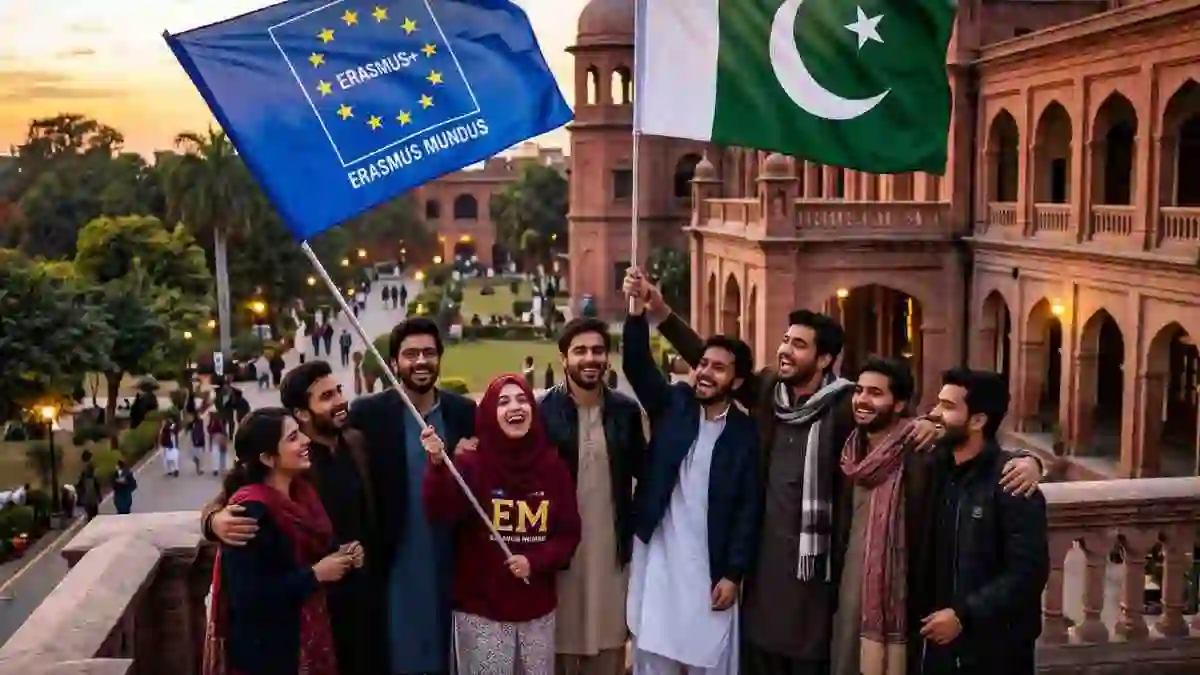
The European Union announced its 2026 Erasmus Mundus scholarship results. Out of 135 countries competing for 1,872 fully funded places, one country came first.
Again.
Pakistani students secured 98 fully funded scholarships in the 2026 cycle, placing the country ahead of all other participating nations for the fifth consecutive year. Bangladesh ranked second with 80 recipients, India third with 75, the United States fourth with 68, and Italy fifth with 67.
The European Union congratulated 98 Pakistani students selected for the prestigious Erasmus Mundus Joint Masters scholarships for the 2026 cycle, describing the achievement as another major milestone in Pakistan’s growing academic engagement with Europe.
Let that sink in. Pakistan — ranked 97th on the global passport index, navigating a difficult economy, with universities still rebuilding research capacity — just outperformed the United States, Germany, France, and China in Europe’s most competitive fully funded scholarship programme. For the fifth year in a row.
This guide explains what Erasmus Mundus is, exactly what money is on the table, who can apply, and how to build an application that actually wins.
The Five-Year Dominance: How Pakistan Got Here
Pakistan’s participation in Erasmus Mundus has grown significantly over the years. To date, more than 2,500 Pakistani students have benefited from Erasmus scholarships, with over 200 students selected annually in recent years.
The year-by-year record is striking:
In 2024, Pakistani students achieved 189 awards among 2,603 selected students worldwide — a record at that time. In 2025, Pakistani students secured 114 scholarships out of 2,176 global selections. In 2026, 98 Pakistani students were selected from 1,872 global awards.
The slight decline in absolute numbers from 2024 to 2026 reflects a reduction in total scholarships awarded globally — Pakistan’s share of the total has remained consistently dominant. In 2024, Pakistan won 7.3 percent of all Erasmus Mundus scholarships globally. In 2026, with a smaller total pool, Pakistan still captured 5.2 percent — more than any other nation on earth.
HEC has played a vital role in facilitating the Erasmus programme in Pakistan since it began operations in 2014, with HEC’s formal support starting in 2016. HEC promotes Erasmus actions by organising information sessions for Pakistani universities — faculty, deans, heads of departments, international offices, registrar offices, students, and related organisations.
Education experts advise that the latest rankings signal intensifying competition for future intakes, with prospective applicants advised to begin preparations months in advance, tailor their statements of purpose carefully, build strong recommendation profiles, and demonstrate research or social impact potential.
The competitive bar is rising. This is the moment to understand exactly how the programme works and what winning applications look like.
What Is Erasmus Mundus? The Programme Explained
Erasmus Mundus Joint Masters is a high-level programme offered by a consortium of international universities. It brings students to at least two European countries, as opposed to a regular degree in one city over two years. At graduation, recipients receive a joint degree from several universities or a certificate from each.
This is not a study-abroad exchange. It is a complete, structured master’s degree programme designed and jointly delivered by two to four European universities — typically one in France and one in Germany, or one in Spain and one in the Netherlands, or three universities across three countries. You do not choose where to go based on preference. The programme has a fixed mobility structure — you spend Semester 1 at University A, Semester 2 at University B, and Semester 3 or 4 at a third institution or on research placement.
The programme awards a joint degree, double degree, or multiple degree. Each cohort includes at least 20 scholarship holders selected from a global applicant pool.
The result is a qualification that carries the academic stamps of multiple European institutions — one of the most internationally recognised and differentiated degree credentials a student can hold.
The Financial Package: Every Euro Explained
This is the section that stops people in their tracks when they read it carefully.
The Erasmus Mundus Joint Masters scholarship is a fully funded award that allows international students to study in at least two to three European countries and earn joint or multiple degrees. The EU scholarship covers tuition fees, travel, insurance, and provides a monthly stipend to cover living expenses.
Here is every component broken down:
Monthly Living Allowance
Each grantee will receive €1,000 each month for living costs during the 24-month duration of the programme. The scholarship also includes a contribution to travel and installation costs paid in two instalments, as well as health insurance coverage for 24 months.
Some programmes pay higher. The total stipend over the two-year programme amounts to €33,600, distributed as a monthly allowance. The exact monthly amount may vary depending on the payment option selected, but all students receive the same total amount over the two years. Some programmes structure this as €1,275 per month with three separate €1,000 travel advance payments, while others pay €1,400 per month with no separate travel payment.
In practical terms: €1,000 to €1,400 per month depending on the programme’s payment structure. Over 24 months, the total living allowance ranges from €24,000 to €33,600.
Tuition Fees
Tuition fees are fully waived for all scholarship recipients. No tuition, library or lab fees are charged.
European master’s tuition fees typically run €4,500 to €9,000 per year per institution. A two-year Erasmus Mundus programme involving three universities could cost a self-funded student €20,000 to €30,000 in tuition alone. For scholarship holders: zero.
Travel and Installation Allowance
The scholarship includes a travel allowance between €2,000 and €3,000, paid in instalments, covering flights, visa costs, and installation costs at each new location.
Some programmes structure this as three advance payments of €1,000 each — one before arrival at the first university, one at the end of Year 1, and one at the start of Year 2. These payments are specifically designed to cover the costs of relocating between European countries during the programme.
Health Insurance
Full health insurance coverage for the entire 24-month duration of the programme is included. This covers medical treatment, hospitalisation and emergency care across all European countries where you study.
The Total Package in Numbers
| Component | Amount |
|---|---|
| Monthly living allowance | €1,000–€1,400/month |
| Total living allowance (24 months) | €24,000–€33,600 |
| Tuition fees | 100% waived |
| Travel and installation | €2,000–€3,000 |
| Health insurance | Full coverage, 24 months |
| Estimated total value | €50,000–€70,000 |
No other scholarship programme accessible to Pakistani students offers a comparable total financial package. Chevening covers one year in the UK. DAAD offers stipends but may not cover full tuition. Fulbright is primarily US-focused. Erasmus Mundus is the most financially comprehensive EU scholarship that Pakistan has direct, structured access to.
Read more: Fully funded internships in Europe for Pakistani students
Who Can Apply: Eligibility Explained
Basic Academic Requirement
Scholarship students must have already obtained a first higher education degree or demonstrate a recognised equivalent level of learning according to national rules and legislation in place by the application deadline.
A bachelor’s degree in a relevant field is required, or final-year undergraduate status — though you must have graduated before the master’s programme starts. Work experience is not required.
Any Pakistani student who holds a completed bachelor’s degree — from any recognised Pakistani university — meets the basic academic eligibility requirement. There is no minimum CGPA specified at the programme level, though individual programme consortia set their own academic benchmarks. Most competitive programmes expect a strong academic record — realistically 3.0 GPA equivalent or above for serious consideration.
Language Requirement
Proof of English language proficiency through IELTS, TOEFL, or equivalent tests is required. Most Erasmus Mundus programmes are taught entirely in English.
Some programmes — particularly those based primarily in France, Germany, Spain or Italy — may require or prefer French, German, Spanish or Italian language skills alongside English. Always check the specific programme requirements in the Erasmus Mundus Catalogue. For most programmes, IELTS 6.5 or TOEFL 90 is a minimum, with competitive applicants typically holding IELTS 7.0+ or TOEFL 100+.
The 12-Month Residency Rule
The Erasmus Mundus 12-month rule means that applicants from Partner Countries — including Pakistan — are only eligible for a Partner Country scholarship if they have NOT resided or carried out their main activity (work, training, or study) in a Programme Country for more than 12 months within the last five years.
This is the most commonly misunderstood eligibility rule. If you have lived in Germany, France, the UK (pre-Brexit), or any other EU/Erasmus Programme Country for more than 12 months in the past five years, you do not qualify for the Partner Country scholarship — the scholarship tier available to Pakistanis. You may still apply and study on a self-funded basis, but you would not be eligible for the scholarship.
Dual Nationality
Students with two nationalities can choose the nationality under which they want to apply. However, the 12-month residence rule applies — always check whether residence in a Programme Country disqualifies you under the chosen nationality.
Is There a Field of Study Restriction?
No. Erasmus Mundus covers virtually every academic discipline — engineering, data science, environmental studies, public policy, literature, food science, health, architecture, law, economics, social sciences, and more. Whether your passion is engineering, social sciences, environmental studies, or another field, the scholarship covers all eligible programmes.
There are over 100 active Erasmus Mundus Joint Masters programmes in the current catalogue. Every applicant needs to find the programmes that match their academic background and career goals — not apply to a generic “Erasmus Mundus” programme, because no such generic option exists. You apply to specific named programmes run by specific university consortia.
How to Apply: Step by Step
Step 1 — Find Your Programmes on the Catalogue
The Erasmus Mundus Catalogue is the official database of all active programmes. It is updated every October for the following year’s intake.
A list is shared for the courses that will start in the next year, and the Erasmus Mundus Catalogue is updated every October.
Go to erasmus-plus.ec.europa.eu, find the Erasmus Mundus section, and open the Catalogue. Filter by your field of study, preferred language of instruction, and programme countries. Make a shortlist of five to ten programmes. Read each programme’s specific eligibility requirements carefully — they vary significantly between consortia.
Step 2 — Check Individual Programme Deadlines
Erasmus Mundus deadlines vary across programmes. Most scholarship deadlines fall between November and January for September entry. Some close as early as November 30. A few run until February. Missing a programme deadline by one day means waiting another full year.
Applications for Erasmus Mundus programmes typically open in October, with scholarship deadlines in December and January. Mark every programme deadline in your calendar immediately after building your shortlist.
Step 3 — Gather Your Documents
The three application steps are document submission, online form completion, and interview if the consortium requires it.
Standard documents required across virtually all Erasmus Mundus programmes:
Academic transcripts — Official transcripts from all previous universities, certified and translated into English if in another language. NADRA-attested and HEC-verified transcripts carry more weight.
Bachelor’s degree certificate — If you are in your final year, a provisional certificate or letter from your registrar confirming expected graduation date.
Statement of Purpose / Motivation Letter — Typically 500 to 1,000 words explaining your academic background, why you chose this specific programme, your career goals, and what you will contribute to the cohort.
Two letters of recommendation — From academic supervisors or professors who can speak specifically to your research capacity, intellectual curiosity, and academic performance. Avoid generic praise. The best recommendation letters cite specific projects, papers, or contributions.
Curriculum Vitae — A clean, concise academic CV covering education, publications if any, research experience, relevant work experience, and academic achievements.
English language certificate — IELTS, TOEFL, or equivalent. Some programmes accept Cambridge C1 Advanced or C2 Proficiency.
Copy of passport — Valid passport required.
Research proposal — Some programmes, particularly those with a strong research component, require a short 300–500 word research interest statement.
Step 4 — Apply to the Programme Portal
Students upload documents through the programme’s official application portal, complete the online form for their selected programme track, and attend an interview if the consortium requires it. Academic performance signals readiness for advanced study. Motivation clarity explains goals, skills, and alignment with the programme. Reference quality shows external validation of the applicant’s strengths.
Each programme has its own application portal — not a single centralised Erasmus Mundus application system. You apply to each programme separately. This is why applying to multiple programmes simultaneously is both permitted and strongly recommended.
Step 5 — Indicate Scholarship Preference
Within each programme application, there is a specific section to indicate that you are applying for the Erasmus Mundus scholarship. This is a checkbox or a form field — not a separate scholarship application. To be considered for the scholarship, you must submit a complete application with all supporting documents before the scholarship deadline, which is typically earlier than the general admissions deadline.
The Application Timeline for 2027 Entry
For students who want to apply for the 2027 intake — the next full cycle — here is the complete preparation timeline:
June–August 2026: Research programmes in the Erasmus Mundus Catalogue. Build your initial shortlist of ten programmes. Identify which require GRE scores, research proposals, or language tests beyond IELTS.
July–September 2026: Take or retake IELTS if needed. Target 7.0 band overall minimum, 7.5 for programmes at top institutions. Contact potential recommenders and brief them on the programme and what to emphasise.
October 2026: Catalogue is updated for 2027 entry. Confirm which programmes on your shortlist are accepting applications. Note exact scholarship deadlines.
October–November 2026: Begin drafting your Statement of Purpose for each shortlisted programme. Each SOP must be tailored to that specific programme’s research focus and partner universities — generic statements are rejected at the screening stage.
November–December 2026: Submit applications to programmes with early scholarship deadlines. First applications typically due by November 30 or December 15.
January 2027: Final scholarship deadlines for most programmes — typically January 15 to January 31.
February–April 2027: Shortlisting and interview phase for programmes that conduct interviews.
May–June 2027: Results announced. EU Delegation in Pakistan and HEC informed of Pakistani awardees.
August–September 2027: Departure. HEC and EU Delegation typically hold a pre-departure ceremony for Pakistani scholarship holders.
What Makes a Winning Application
Aspiring students should begin preparing their applications well in advance. Students with lower GPAs can strengthen their applications by focusing on a compelling motivation letter, a solid statement of purpose, and a good IELTS score.
The three evaluation factors that determine selection are academic performance, motivation clarity, and reference quality. Here is how to maximise each:
Academic Performance: Your CGPA matters, but it is not the only signal. Pakistani universities with lower average grades are understood by evaluation panels. What distinguishes successful applicants is evidence of intellectual engagement beyond coursework — research projects, publications, conference presentations, theses with a clear research question, or significant academic achievements. If your GPA is 3.0, your statement of purpose and references must work harder. If your GPA is 3.8, they still must work hard.
Motivation Clarity: The most common rejection reason for Pakistani applicants is a generic statement of purpose. Phrases like “I have always been passionate about this field” and “I want to contribute to Pakistan’s development” appear in thousands of applications. What evaluators want to see is: Why this specific programme? Why these specific partner universities? What research question or professional challenge drives you to this exact combination of disciplines and locations? Name specific faculty members whose work aligns with yours. Reference specific modules in the curriculum. Show that you read the programme guide, not just the scholarship headline.
Reference Quality: Ask your recommenders to write about you specifically — your thesis methodology, a seminar argument you made, a research approach you took. The best letters include a specific anecdote or project that illustrates the claim being made. A letter that says “this student is hardworking and intelligent” is not a reference — it is a template. Letters that cite a specific paper you wrote, a problem you solved, or a moment of intellectual leadership carry exponentially more weight.
Why Pakistan Keeps Winning
Officials and education experts say Pakistan’s consistent success reflects improved academic standards, better preparation, and increased awareness among students about international opportunities.
The structural reasons go deeper than individual effort. Pakistan has a young, English-medium university population that is increasingly digitally connected to global scholarship communities. HEC’s active promotion of Erasmus Mundus through university information sessions creates a pipeline of informed applicants that most countries lack. A growing alumni network of Pakistani Erasmus Mundus scholars now mentors current applicants — sharing successful SOPs, interview tips, and programme-specific insights that improve the quality of the next cohort’s applications.
What makes the 2026 data especially fascinating is not just Pakistan remaining at number one — it is the broader shift in scholarship geography. For decades, Western and larger economies traditionally dominated international scholarship ecosystems. The newest Erasmus Mundus figures show South Asian countries aggressively outperforming many developed nations in Europe, North America, and East Asia.
The competition is also intensifying. Bangladesh climbing to second place, India consolidating third, and even the United States appearing in the top five — countries that previously did not compete seriously for Erasmus Mundus — signals that Pakistan’s first-place position will require increasingly sophisticated applications to hold.
Frequently Asked Questions (FAQs)
Q: What is Erasmus Mundus and how is it different from a regular European university application?
Erasmus Mundus Joint Masters is a structured two-year master’s programme jointly delivered by two to four European universities under a European Union-funded consortium. Unlike a regular application to a single university, Erasmus Mundus takes you to at least two countries during the programme, delivering a joint or multiple degree from all partner institutions. The scholarship covers all tuition, a monthly living allowance of €1,000 to €1,400, travel costs, and health insurance — making it fully funded with no contribution required from the student.
Q: How many programmes can a Pakistani student apply to?
There is no official limit. Students are encouraged to apply to multiple programmes simultaneously, as each has its own application portal, deadlines, and selection process. Most experienced applicants apply to five to ten programmes to increase their odds. The acceptance rate across top programmes is typically 3 to 10 percent — applying to only one or two programmes significantly reduces your chances of winning any scholarship in a given cycle.
Q: Is a high CGPA required? What if my grades are not excellent?
No minimum CGPA is set at the Erasmus Mundus programme level. Individual consortium programmes set their own academic standards, but many look holistically at the complete application. Students with lower GPAs have been selected by focusing on outstanding statements of purpose, strong recommendation letters, relevant research or professional experience, and high IELTS scores. A 2.8 GPA with a compelling research narrative and excellent references will outperform a 3.8 GPA with a generic application.
Q: Does Erasmus Mundus require work experience?
No. Work experience is not required for the Erasmus Mundus scholarship. Programmes welcome applications directly from fresh graduates. However, relevant professional experience in your field can significantly strengthen your motivation letter by demonstrating real-world understanding of the problems your master’s degree will help you address.
Q: What is the 12-month rule and does it affect Pakistani students in the UK or UAE?
The 12-month rule states that applicants from Partner Countries like Pakistan must not have resided, worked, or studied in a Programme Country for more than 12 months in the last five years to be eligible for the Partner Country scholarship. The UK counts as a Programme Country under current arrangements. The UAE does not — it is not an EU Programme Country. Pakistani students living and working in the UAE, Saudi Arabia, Qatar, or other Gulf states are not affected by the 12-month rule and remain fully eligible for the scholarship.
Q: When do applications open for the 2027 Erasmus Mundus cycle?
The Erasmus Mundus Catalogue for 2027 entry is updated every October — meaning October 2026 for 2027 intake. Most scholarship application deadlines fall between November 2026 and January 2027. HEC Pakistan typically hosts information sessions in September and October to brief students on the application process. The earliest scholarship deadlines — November 30 for some programmes — require students to begin their SOP drafting and document collection no later than August or September.


Join the Conversation
Share your thoughts, questions, or feedback below.